Friday, November 30, 2012

Glengoyne 17 Year vs. 21 Year


stats:
Glengoyne 17yr, single malt scotch, Highlands, 43%, $58
Glengoyne 21yr, single malt scotch, Highlands, 43%, $125


In my Springbank 10yr vs. 15yr and my Bunnahabhain 12yr vs. 18yr posts I focused on examining the efforts that distillers make to create more difference in flavor between whiskies in their core ranges with different age statements. As I mentioned previously, I’ve experienced scotches which taste very similar even when one has been aged 50% (or more) longer than its sibling.

In the example of the two Springbanks, as well as that of the two Bunnahabhains, I’d say the difference was moderate. While being enough to set the two expressions apart in each case, it wasn’t so much that they seemed like entirely different whiskies.

Glengoyne is a good example of a single malt where this differentiation between the various ages is taken quite a bit further. I had tasted the 17 year for the first time a few months before going to Scotland, and I liked it enough that I was pretty excited to visit this distillery that I actually knew very little about. The distillery tour started with a short video and a healthy dose of the 10 year. Much to my surprise it was significantly different than the 17 – a lot lighter in color and considerably more fruit forward, especially bright tree fruits like apple and pear.

I think (I was pretty sleep deprived at the time) the tour guide said that all of the Glengoynes had “some” sherry cask whisky in them. I asked what the percentage of sherry cask whisky in the 10 year was, but couldn’t get a straight answer. I suspect that it has very little, if any content that has seen time in sherried oak. It’s obvious from the taste and color that the 17 year that there’s a much higher proportion of sherry aged malt in it. If I had to make an educated guess, I’d say 60%.

Thankfully, the distillery shop at Glengoyne had a good selection of miniatures, so I was able to bring back a 17yr and a 21yr in addition to the 700 ml Teapot Dram bottling I came away with.

I noticed that the label on the 21 year has “sherry matured” printed on it, which is absent from the labels of the younger bottlings. I’m taking that to mean it is 100% sherry matured. Just looking at the color difference between the two, I’m expecting a big difference in flavor as well.


17yr
color - medium golden (between dark chardonnay and light amber)
nose – gentle fruit with subtle floral notes
palate – the signature apple and pear notes are still obvious, but instead of being dominant like in the 10yr, they mingle with more dry oak notes and mild dark fruit
finish – dry spice notes are joined by floral / grassy flavors
It’s been a while since I tasted the 10yr, but I think it may have had some of the same floral qualities. The 17yr really brings this whisky a long way from the 10yr. There is a substantial difference between the two, and the 17yr is much more to my liking.

21yr
color - medium amber brown
nose – fruit with dry oak notes
palate – spice box up front, then a wave of bright tree fruit that quickly gives way to darker baked fruits, there’s still a hint of the floral aspect, but it becomes a quiet background note in this expression.
finish – dry oak spice finish which turns slightly nutty at the very end
nicely balanced, great complexity (cedar, cinnamon and unsweetened cocoa all pop up along the way) right through the long finish.

The 17yr is very nice, but the 21yr has been refined into something quite special. The difference between the 21yr and the 17yr is not quite as dramatic as the difference between the 17yr and the 10yr, but their dissimilarity is still very significant, especially when you consider that the time spent in cask has increased by less than 25%.

Of course the jump from the 10yr to the 21yr is striking enough that in a blind tasting many people might not even recognize them as being from the same distillery. I appreciate the variety, and find it interesting to see what sort of magic can happen in the warehouse. But there is the downside that someone could try the younger expression, not like it, and pass up its elders which they could potentially have really liked.

Wednesday, November 21, 2012

The Nostradamus effect


When I was a much younger man, I was in awe of the apparent clairvoyant abilities of Nostradamus. As I grew older and wiser (and significantly more cynical), I came to realize that he was likely nothing more than a charlatan. As far as I know, none of his prophetic writings have ever predicted anything correctly in advance. They are merely retroactive prognostications – cryptic writings which have been interpreted to have predicted events only after said events have transpired.


You may be wondering why I’m blathering about a 16th century figure whose story is better left to the History Channel – well, I’m about to go out on a limb and make a bold prediction. Of course my forecast is related to whisky, a subject of which I have some knowledge. And I’m only going to prophesize a year into the future at most – I have no intentions of telling you what people will be drinking in the 25th century.

A little less than a year ago I wrote a blog post comparing Johnnie Walker Black to the new Double Black. A quick look at the stats reveals that this is far and away the most viewed post on the blog - obviously the subject is of great interest. In recent months my father has been lamenting about his inability to locate the Double Black in the greater Boston area. My arrogance got the best of me as I proclaimed that I’d have some for him in no time. A little online research showed not a single bottle in New Hampshire and a stock status of “Unavail (Do not order)” in Vermont.

I think it’s safe to say that Johnnie Walker is having supply issues with their new Double Black. You may remember my post about Bulleit Bourbon from early October, where I analyzed how the brand dealt with a shortage of product around 2008. Since both brands are owned by Diageo, I think we may see some similar actions in response to the current issues.

The Double Black carries no age statement, so it would be easy for them to reformulate the blend with some younger whiskies. I think this is likely to happen, but only to a minimal extent. Considering the great reviews it has received along with the marketing being heavily focused on its flavor profile, they would be playing with fire if they were to alter the way it tastes too drastically.

As for simply adding water to dilute the whisky and stretch existing stocks (like Bulleit did in select markets), the Double Black was already at 40% abv. Since that is the minimum legal strength for Scotch whisky, lowering it further is not an option.

Limiting availability (at least on a continual basis) doesn’t seem to be the way of the scotch industry in general or Diageo in particular, so I don’t think that will be a part of any long term strategy once we get past the current shortage.

That leaves just one last option – a price increase, and I fear it will be a fairly drastic one. Also, when you consider my original opinion of the price versus quality of Double Black and regular Black label, I think the new whisky had the potential to really decimate sales of Walker Black. The easiest way to keep that from happening and not have one expression steal sales from another expression is to vastly widen the price gap between them. Last year you would pay a 10% - 20% premium for Double Black over Black. Whisky prices have been rising rapidly lately, so I’m probably not making too bold of a prediction here, but I really think that by the end of 2013 it will be impossible to find Double Black for less than 50% more than the price of Walker Black.

Interestingly, I wrote most of this post last night and went on a little whisky hunting mission south of Boston before proof-reading and posting – and sure enough, at the third store I stopped by there was the elusive Double Black, at $60 a bottle! I suppose this store could have stumbled across some forgotten inventory and engaged in a bit of price gouging, knowing that no one else in the area has what they have. But I really think that this price is the new normal and will become widespread over the next 6 to 12 months. Time will tell.

Monday, November 12, 2012

Bunnahabhain 12 Year vs. 18 Year


stats:
Bunnahabhain 12yr, single malt scotch, Islay, 46.3%, $40
Bunnahabhain 18yr, single malt scotch, Islay, 46.3%, $80

When I went on the tasting tour of the Bunnahabhain (pronounced boona-ha-ven) distillery back in April I sampled both the 12 year and the 18 year. They seemed quite similar but I had them one after the other rather than side by side, which makes it harder to compare. At the time, I also tasted a new-oak aged Bunnahabhain and a heavily peated expression. Each of those was different enough to make the 12 and the 18 seem identical by comparison.

In light of the Springbank 10yr / 15yr comparison I did last week, it makes sense to revisit the Bunnahabhain 12yr and 18yr and see how they measure up to each other. On a side note, I was perusing the Springbank website a few days ago, and noticed that they actually give some composition information for the various expressions. The 10yr is 60% bourbon / 40% sherry matured and the 15yr is aged 100% in sherry casks (they are a little vague with the 18yr listing it simply as bourbon/sherry, and strangely more specific with the 12yr cask strength’s description of 60% fresh sherry hogsheads / 40% refill sherry butts).


Before the tasting, a little Bunnahabhain history is in order. The distillery was established in 1881, and in 1887 a merger led to Bunnahabhain being owned by the newly formed Highland Distilleries Company Limited. In 1999, the Edrington group took over Highland Distillers and Bunnahabhain entered a period of relative neglect, with the company paying much more attention to the higher profile distilleries in its portfolio. In 2003, Edrington sold the distillery to Burn Stewart, owners of Tobermory and Deanston, and a much needed revival began.

For much of its history, the only regularly available official distillery bottling was the 12 year old, and occasional special releases would be put out on a limited edition basis. In 2005 the standard line was extended to include the 18 year and a 25 year. In 2010, all three expressions were raised from 43% abv to 46.3% and all chill filtration was eliminated.

12yr
a dark brownish red in color
malt and baked goods on the nose
a little dark fruit on the palate (dried fig, baked apple pie) adds depth to the core of sweet malt, butterscotch and ginger snap cookies
finishes long, with warming dry spice notes (cinnamon) balanced by some lingering malty sweetness

18yr
very close in color to the 12yr, maybe just a hint darker.
similar nose, but much less malty richness
on the palate, the malty sweetness is quite toned down, with the butterscotch edged out by toasty oak notes
the finish is equally long, but noticeably drier, with gentle spice notes lingering on for some time

The 12yr possesses a beguiling juxtaposition of flavors, while the 18yr comes across as being more subtle and refined. The difference between these two is more significant than I had originally thought, probably close to the degree of difference I saw between the 10yr and 15yr Springbank last week. I’m actually quite enchanted by each of them, but for an everyday drinker, the 12 year is much more attractively priced. Looks like I may have to hunt down a sample of the 25yr Bunnahabhain after all.

It’s interesting to note that I did taste the 12 year Bunnahabhain that was at 43% abv several years ago, and it was much lighter (body and flavor), and less malty but more floral on the palate, if I recall correctly. I was a little suspect of that bottle as I knew it had been opened and partially consumed for several years, but I now have a feeling that chill filtering had stripped out much of its character. 

The 8yr Bunnahabhain from Gordon & Macphail that I wrote about back in March is much more dramatically different compared to the current 12 year than the 12 and 18 are compared to each other. None of the three is chill filtered, so I guess the dissimilarity comes down to age, proof and cask selection.

Thursday, November 1, 2012

Springbank, 10 Year vs. 15 Year


stats:
Springbank 10yr, single malt scotch, Campbeltown, 46%, $69
Springbank 15yr, single malt scotch, Campbeltown, 46%, $104

I think I expounded on the inner workings of the Springbank distillery during my time there (starting here) to the point of leaving nothing to discuss for this post. But fear not, another burning topic will lend itself to this tasting quite well.

Over the years of comparing various whiskies, I’ve noticed that many times different age variants of the same whisky can have very little difference in their flavor profiles. I think this first came to my attention five years ago, with 12yr Chivas Regal and their 18yr old. Slightly less smoke and slightly more oak was all that really stood out to me. All of that for a fairly significant jump in price (not to mention that I kind of preferred the 12yr). Around the same time I compared 10yr and 18yr Glenmorangie, and found them very similar.

But I’ve recently seen this trend reversing, and current releases of 18yr Glenmorangie taste quite distinctive compared to the 10yr. I suspect that many consumers grew wise to the fact that a considerable increase in age, along with a much bigger price tag, often didn’t correspond to very much of a difference on the palate. And I’m guessing that many distillers, eager to drive sales of their more expensive offerings, realized that they had to take extra steps to make their older bottlings taste more unique.

Bottling the different ages at different proofs is one quick and easy way to achieve this. Chill filtering the entry level offering and going unfiltered on the older examples would also do the trick. For distillers that use a combination of bourbon and sherry casks, varying the percentages in the mix seems like it is becoming more common, usually with the amount of sherry cask whisky in the vatting increasing as you progress through the age range. Some prime examples of the last technique would be Tobermory 10yr and 15yr, Glengoyne 10yr and 17yr, and An Cnoc 12yr and 16yr (in this case the younger of the two sees more sherry wood). Another method is to simply utilize cask management / selection. The distillery manager will pick casks with a certain flavor profile for the flagship age, and hold back casks that taste different / better for further maturation.

So, how do the two Springbanks compare?

10yr
light golden amber in color.
fruit and mild peat on the nose.
amazingly full flavored, with plenty of fruit (apple and orange), followed by a hint of vanilla and brine. as the fruit fades, dry oak spice and gentle, but firm peat smoke take up the slack. wonderful complexity and a long, enduring finish. a true classic.

15yr
very close to the 10yr in color, just a touch darker.
the nose is more restrained, with dry oak spice notes leading the way.
there’s plenty of flavor here as well, but the fruit is less bright, more along the lines of dark and baked fruits (apple pie, etc). the oak spice is drier and warmer (cinnamon spice). the brine and peat smoke are still present, but toned town quite a bit. the finish is also lengthy, but much drier.


I think the folks at Springbank have done a nice job of making some differentiation between these two expressions without taking it too far. They aren’t radically different from each other, but still distinctive enough so that consumers wouldn’t feel like they wasted their money on the 15 year. I have to admit that, even though I’d be happy to drink either one, I do like the 10 year a little more. I would put that down to personal preference though.

 I’m guessing that there is slightly more sherry aged whisky in the 15, and possibly some cask selection leaning toward a drier profile. Unfortunately, one thing I missed at whisky school was the process for selecting the group of casks that would be vatted together before bottling. Given the opportunity, I’d be sure to explore this topic further.

Monday, October 22, 2012

Yamazaki 18yr


stats: Japanese single malt whisky, 43%, $135

I find it surprising that I’ve been writing this blog for a year and a half and haven’t yet broached the subject of Japanese whisky – it’s something I’ve had a mild fascination with for several years.

Of the five major whisk(e)y producing nations, Japan’s whisky industry is the youngest and the only one whose history can be traced back to just a few men. One of those men, Masataka Taketsuru, is generally regarded as the father of Japanese whisky.

Born in 1894 to a family which had owned a sake brewery for many generations, Masataka went to work for the spirits producing company Settsu Shuzo, after graduating from the Osaka Technical High School. Just three years into his career there, he was chosen to go to Scotland and learn the secrets of that country’s whisky industry, toward the end of 1918.

He enrolled in chemistry classes at Glasgow University, and by April of 1919 had landed a brief internship at the Longmorn distillery. After marrying a Scottish native in January of 1920, Masataka and his new wife moved to Campbeltown, where he began working at the Hazelburn distillery. By November of 1920, the couple had made their way to Japan.

Whisk(e)y from the Europe and North America made its way to Japan after the 1850’s, when the country started to engage in trade with the West. In the early 1900’s many firms in Japan were trying to emulate these whiskies by producing spirits flavored with herbs, spices and perfumes. Unfortunately, the post World War I economic depression caused Masataka’s employers to continue on that path, and give up their plans to use his newly acquired knowledge to produce proper whisky. He left the company out of frustration in 1922.

But not all was lost. In 1899 Kotobukiya, a wine and liquor importing business was started by Shinjiro Torii. He was fascinated by whisky and aspired to start a whisky distillery in Japan. In 1923, Shinjiro hired Masataka Taketsuru to oversee the building and operation of his Yamazaki distillery, near Osaka.

Authentic whisky was finally being made in Japan in 1924, but Torii and Taketsuru could never agree on a house style. Masasaka remained true to the Scotch Whisky flavor profile he knew from his formative years abroad, which was powerful, robust and smoky. Shinjiro favored a much lighter style of whisky that would have mass appeal to the Japanese consumer. The two men parted ways in 1929.

Masasaka’s wife, Rita, had been teaching English for many years and it was through her connections that he was able to secure investors in his new firm, Nikka, and build his Yoichi distillery in 1934 on the island of Hokkaido. Nikka added a second distillery, Miyagikyo, in 1969.

Shinjiro Torii’s firm, Kotobukiya, became Suntory in the 1960’s. In addition to the Yamazaki distillery, they opened the Hakushu distillery in 1973.

These are the four major whisky distilleries in Japan today, although several smaller, less significant outfits also make Japanese whisky. For many years Yamazaki 12yr and 18yr were the only Japanese whiskies exported to the U.S., but that has started to change in recent years.

Enough of the history lesson, let’s get on to the tasting.

The color is a dark, rich amber, almost mahogany.
The full, complex nose has nutty, floral and malty sweet aromas.
It is full bodied, complex and evolving on the palate. It starts of nutty and slightly floral (just enough to add depth) with a malty richness, before giving way to the dark, cooked fruit flavors typical of sherry cask maturation.
Then it moves into the warming, slightly spicy, long finish with some of the earlier flavors lingering gently.


I really like this whisky, it’s well made and nicely balanced, but it has a sense of intrigue about it. Even though it could pass as Single Malt Scotch in a blind tasting, there’s still a certain uniqueness to it.

Sunday, October 14, 2012

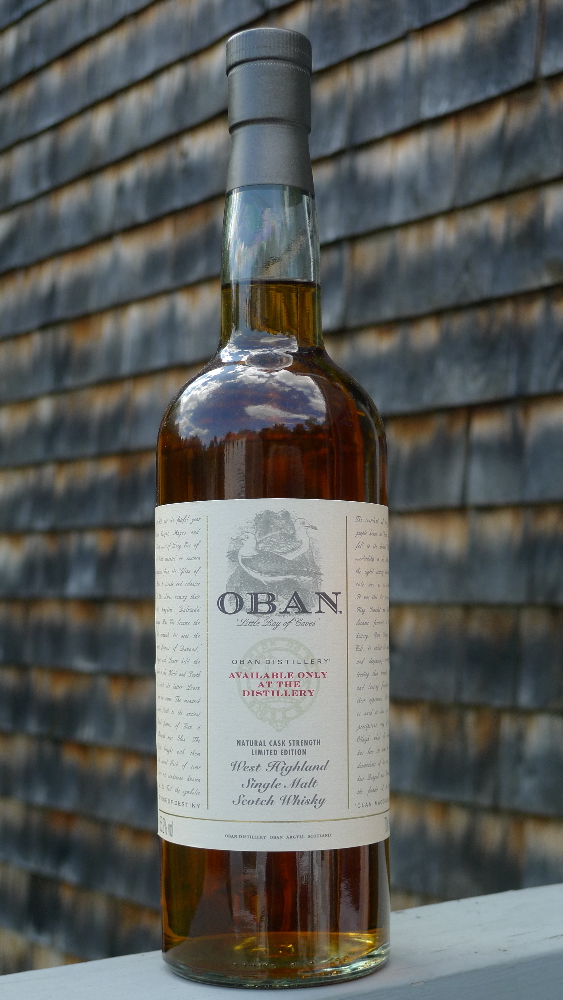
Oban, 14 Year vs. Cask Strength


stats:
Oban 14yr, single malt scotch, West Highlands, 43%, $71
Oban cask strength limited edition, single malt scotch, West Highlands, 55.2%, $100

I’ve made an effort to correctly pronounce the names of single malts from early on, and with the likes of Bruichladdich and Bunnahabhain it’s safe to assume one’s got it wrong without some research and practice. But with a name as seemingly simple as Oban, I never even gave so much as a second thought as to what to proper pronunciation might be. Yet it turns out that this is probably one of the most commonly mispronounced single malt names, at least here in the U.S. Fortunately, I was politely informed of my phonetic error by a kindly Glaswegian six weeks before I left for Scotland, saving me the embarrassment of saying it incorrectly while I was staying in the town of the name. So, for the record, it is not oh-bahn, but owe-bin, coming across almost as one syllable.

14 yr Oban is the almost singularly ubiquitous distillery bottling. But there are other expressions out there. As with many other Diageo owned single malts, there is also a Distiller’s Edition. 300 casks are set aside each year for this bottling, which is finished in Montilla Fino sherry casks. A special release of 18 yr Oban proved popular recently, and now 300 casks are being set aside annually for that expression as well. Back in 2002 there was a very limited release of 32 yr Oban, and over the years several different releases have also been put out under the Manager’s Dram title.

While visiting Oban, my father picked up a bottle of a distillery exclusive, cask strength edition. At the time, we were told that although it has no age statement, it was primarily 14 yr with some older whisky in the mix, and possibly some variety of cask types. I decided to compare this to the standard 14 yr, which is aged exclusively in 2nd fill bourbon barrels. There were two or three months between the tastings, so it’s not exactly a direct comparison, but close enough.

Oban 14yr 43.0%
Fruit aromas dominate the nose, primarily orange, but supported by a malty backbone.
It almost seems too mild up front, but the flavors build up quickly. Medium to heavy body. Nice depth, with fruit (primarily orange, maybe some apple and pear too), a little oak, a little spice, just a whiff a peat smoke, and a pinch of sea salt all playing nicely together. After peaking, the flavors fade slowly through the long finish. Well balanced throughout.


Oban Cask Strength Limited Edition (bottled in 2010)
The nose is intense but smooth, with creamy fruit aromas. Fiery up front on the palate, but the heat gives way to intense flavors (maybe “is joined by” is a more appropriate term than “gives way to”). Lots of body, quite viscous on the tongue. It’s kind of hot, but it’s entertaining to experience the burning heat and the intense, evolving flavors battle for dominance on the palate, pretty much from start to finish. Classic Oban balance of fruit and oak with just a hint of peat, and some very mild floral notes. Like the 14yr on steroids.

Friday, October 5, 2012

Bulleit Bourbon


stats: Kentucky Straight Bourbon, 90 proof, no age statement, $25


I was given a bottle of Bulleit bourbon a few years ago. I’ve lost track of how long it’s been, but my best guess is that it came my way some time in 2008. I had a fairly low opinion of it, even after sampling on several occasions, and it’s been sitting on the whiskey shelf partially consumed ever since.

A couple of weeks ago I was working behind the bar on a particularly slow day and decided to taste a few things, strictly for educational purposes, of course. For some reason I nipped into the open bottle of Bulleit, and much to my surprise it seemed significantly better than I had remembered. I was going to have to smuggle my bottle from home into work one night for a proper head-to-head comparison.

Before I get to that comparison, I need to cover a topic that has been on the back burner for quite a while. That topic is an examination of how whiskey can change over time in the bottle. This is a subject that I may revisit in future posts as well, as the opportunities arise.

Distilled spirits are quite shelf stable, and if changes do occur in an unopened bottle, it would be over a time period on the order of at least a decade, if not several. For practical purposes, I think it is safe to assume that a full bottle of whiskey will not see a change of flavor over many years, as long as it is not exposed to direct sunlight for prolonged periods and/or subjected to unusually high temperatures.

But once the bottle is opened changes do happen, albeit still at a relatively slow rate. This is something that I have had first hand experience with, having a collection of bottles that grows far faster than I drink. The rate of change definitely depends on the amount of headspace (the volume of air in the bottle relative to the volume of liquid) – a bottle minus one drink will change more slowly than a bottle with one drink left in it. Either way, I wouldn’t expect a significant change if the bottle has been open for less than a year.

I believe evaporation (especially different components of the whiskey evaporating at different rates) and oxidation are the main culprits, but I wouldn’t be surprised if other processes played a roll. On rare occasion, I do spray a mix of inert gases (primarily nitrogen and argon) into my open whiskey bottles to prolong their shelf lives.

I have actually noticed that some whiskeys get worse while others get better as this process occurs. I’m generalizing a bit, but I have seen delicate whiskeys lose aroma and flavor, falling flat eventually, while at the same time I have observed some whiskeys, having started off too hot, that have toned down and come into balance after being given some time to breath.

My point here is that this comparison needs to be taken with a grain of salt, as I’m tasting a bottle that was only opened a few months ago against on that has been opened and half consumed for at least four years. That being said, the tasting notes for the older bottle do generally match my recollection of how that bottle tasted when I first opened it.

And here is how they stack up:

Old Bottling
Reddish-amber in color.
Nose of grain and spice, but with a slight chemical-like undertone.
A little hot up front, followed by some promising grain and spice flavors, but it quickly turns astringent, then pretty much falls flat on the finish, ending hot, which might be okay if there was more flavor for balance.

New Bottling
Basically the same color, but noticeably darker.
The nose is also similar, but much fuller and lacking the off notes of the older version.
Smoother up front, with a little more body. Warming cinnamon spice is the main flavor component, but mild oak and floral notes come in to assist. It’s well balanced and finishes nicely, but could improve further with more complexity.


Seeing this contrast led me to research online discussions about Bulleit to see if others had made similar observations, or if any major changes in the production or specifications of the whiskey had occurred during this time period. I didn’t find much, short of a post on a bourbon forum from 2008, where someone remarked that current (at the time) samples of Bulleit paled in comparison to earlier bottlings.

The color difference that I saw between the two bottles I compared suggests that the newer one has a good bit more age on it. In 2008, Bulleit bourbon that was made for export to Australia and the UK was dropped from 90 proof to 80 proof. Add more water before bottling and you instantly have more whiskey.

This all adds up to pretty solid evidence that demand for Bulleit exceeded supply in 2008, and I’m sure they must have lowered the age of the whiskey (or more likely vatted some very young whiskey into the existing stocks) for a period of time while increasing production levels. Reports of some sharp price increases for Bulleit in 2008 were also uncovered. This would have tempered demand a bit while the increased supplies had some time to age properly.

When faced with a similar situation, other brands have taken different approaches to dealing with the problem. Knob Creek was unavailable for a few months earlier this year, the Van Winkle whiskeys are only available during limited annual releases, some brands are restricted to selling only in key markets, and the majority of the Scotch whisky industry has followed a model of dramatic price increases. I would think that compromising quality, even if only for a short time period, to ensure availability would be a risky strategy. Bulleit seems to have gotten away with it, their reputation and popularity coming through unscathed.

Friday, September 28, 2012

Isle of Arran 10yr

stats: single malt scotch, Islands, 92 proof, $48

The end of my last post made me realize that it was high time to pull that dusty bottle of 10 year Arran off my shelf for a thorough tasting. It can be hard for me to find the motivation to write about a whisky that I’m indifferent to – it’s much easier to get the ball rolling with a whisky that is spectacular, or even one that is awful. But tasting a much more impressive bottling from the same distiller was just the kick in the pants that I needed.

Before I get into the whisky (literally and literarily) I’d like to take a look at the background of the distillery. I’ve talked before about the massive downturn that the Scotch whisky industry went through in the 1980’s, but the reality of that time period truly comes to light when one looks at the pattern of distillery openings and closings in Scotland over that last five decades.

Information about distillery closings from the 1960’s is hard to come by, but I’m relatively sure there were very few, if any, and during that decade at least 13 new distilleries came on-line. The 1970’s saw the trend begin to reverse, with just five new facilities being almost balanced out by the three that were lost. Then things really went south in the 1980’s with no less than 18 distilleries shutting their doors, and not a single new one opening. Keep in mind that I’m only counting closures that were essentially permanent – I’m not even considering the outfits that were mothballed for anywhere from a few years to a decade before eventually coming back into operation. The after effects of the 1980’s saw four more distilleries go under in the 1990’s, but there was some hope as consumer demand surged and three new distilleries came to be. In the first decade of the new millennium, six more new facilities commenced production. In the same period roughly half a dozen have closed or been mothballed. It remains to be seen if those mothballed distilleries will return to production, or become permanent closures.

The point that I’m trying to get at here is that it would take a lot of moxie to open a new distillery in Scotland in the early 90’s; but that is just what Harold Currie, a former director of Chivas, did. He founded the Isle of Arran distillery in 1993, construction began late in 1994 and the stills were running by mid 1995.

The island is located in the Firth of Clyde, a body of water that separates the Kintyre peninsula from the southwest coast of the Scottish mainland. Arran has a rich distilling history, although most of the 50+ distilleries that operated on the island in the early 1800’s were not licensed, and the last legal distillery closed in 1837. The location of the new distillery, on the far north of the island, was chosen partly for its exceptionally pure water source – Loch na Davie.

In the early years of operation, several very young expressions were released, but now that they have enough stock aging, the lineup is led by the 10 yr, as well as a 14 yr and a few “no age statement” cask finished bottlings. Several limited releases seem to be available, as well as a moderately peated version (most of the malt used here is unpeated). No chill filtering is employed, and no caramel coloring used. As for the 10 year:

Pale golden in color.
Aromatic nose, mix of clay and floral notes.
Light to medium bodied.
Slightly sweet up front. Fairly floral through the mid palate, and those flavors carry on through the respectably long finish, where they are joined by warm spice notes of moderate intensity. The spice fades off late in the finish, leaving the floral notes as the whisky’s final voice while they turn slightly perfumed. It progresses through with no rough edges and decent balance, but I’d like to see more complexity.


My feelings of mediocrity towards this whisky may be partly down to personal preference. As I’ve put some time in with this bottle over the last week, it seems to have grown on me a bit, and I think it’s really just the tail end of the finish that I don’t care for.

Looking at the CalMac ferry map, I see that a short drive from Glasgow followed by less than an hour on the ferry will get you to Arran. From the other side of the island, a 30 minute ferry ride would put you on the Kintyre peninsula, where one could head south to Campbeltown, north to Oban, or west to catch the ferry to Islay. Every picture I see of Arran looks stunning, and I think this could be a great way to start a coastal / island distillery adventure.

Thursday, September 20, 2012

Whiskey bars of Washington DC, part 3


I had been at Bourbon longer than intended and sampled more whiskeys than I had planned to; there’s a distinct possibility that I hay have been moderately intoxicated by the time I arrived at the Jack Rose Dining Saloon, around 1:00 in the morning. I feel fortunate to have the ability to maintain my composure under such circumstances. But I do have to apologize for the quality of the pictures in this post; my photography went from being creative earlier in the night to sloppy by the end.

My springtime visits to Duffie’s Bar on Islay with 300 bottles and the bar in the Ardshiel Hotel in Campbeltown with 450 bottles had both been real eye openers for me. But the 1400 bottle collection at Jack Rose was truly a sight to behold. The space is roughly 25’ by 50’ and features high ceilings. Whisky bottles adorn 2/3 of the interior wall space, and reaching as many as six bottles vertically, several library ladders are needed to access the higher shelves.


I would have loved to have checked out their whisky list in advance of my visit, but at the time they didn’t have it on their website. They have since posted a partial list online, showing about 350 selections, I think it covers maybe half of their single malts.


Upon my arrival I asked to see the list, and was handed a hefty book that, while well organized, could easily overwhelm with volume alone. I was kind of surprised by some of the omissions; I thought surely a list of this size would feature 40yr Glenfarclas or 21yr Springbank. Of course there were plenty of offerings far more rare than the above mentioned, and many of whose existence I wasn’t even aware. Official distillery bottlings ranged from run-of-the-mill flagship expressions to rarities and limited releases. All of this was backed up by a healthy selection of independent bottlings, giving astounding depth to most categories.

After much perusing, I finally settled on a 19yr Bunnahabhain at 54.3%, part of the Raw Cask series from independent bottler Blackadder. This is a cask strength, non-chill filtered, single cask bottle, I believe from a sherry butt. Pretty much hit a home run right off the bat:

Crazy intensity, fire, burning nasal cavity. Black hole of Bunnahabhain flavor.

And yes, I meant that in a good way. I tasted several Bunnahabhans when I was on Islay, but none at such high proof. It was truly stunning to see where this whisky could go.


It was getting pretty late at this point, and I still had to navigate my way back to the hotel before the trains stopped running at 3:00 – I had time for one more glass of whisky. The bartender seemed quite competent, so I threw caution to the wind and put the fate of my last drink of the night in his hands.

I was a little apprehensive when he pulled a bottle from the Isle of Arran distillery off the shelf. I have a bottle of their 10yr 46% at home, and I’m kind of indifferent to it. But this was a Port Cask Finish version, with no age statement at 50% abv. It’s amazing what a little Port wood and a slight increase in strength can do - one taste put this distillery in a whole new light for me.


For some unknown reason, I took a small pad of paper out of my pocket at this point and wrote down my tasting notes instead of typing them into my phone. Unfortunately, my normally meticulous handwriting had devolved into something that only a doctor could be proud of, and now I’m having a hard time deciphering my scribblings. Here’s my best attempt:

Depth, earth, fruit (quince), intensity, honey, dry port, raisins, smooth, balance.

Earth, quince and honey were the really tough ones; those may have been entirely different words. But the bottom line was that I really liked it. Now I’m excited to try out other Arran expressions and maybe I’ll even pay a visit to the distillery some day.

For the whisky obsessed, this place is a must see. As impressed as I was, the realist in me has a hard time believing that such a business model would be viable outside of the land of lobbyists, political schmoozing and international deal making.

I somehow got slightly disoriented trying to retrace my steps in reverse, so the 15 minute walk back to the train station took 30 minutes, but I got there by 2:45 and managed to catch the last train out to Bethesda.

Apparently, in my pre-trip whisky hunting euphoria, I grabbed the wrong suit; one that I’ve owned for far longer than I care to admit. So, yes, I had to suffer through the wedding moderately hung-over, wearing a horribly ill-fitting suit. But it couldn’t have been too bad; I did manage to throw back a glass of 12yr Chivas before the sun set.

Sunday, September 16, 2012

Whiskey bars of Washington DC, part 2


A short ride on the DC Metro from Union Station to Dupont Circle brought me within walking distance of the Adams Morgan neighborhood, home to the Jack Rose Dining Saloon and Bourbon. The two bars share a common ownership, and are on the same street, just about a block apart.

Jack Rose was just a fifteen minute walk from the closest Metro station. I arrived around 11:00, and looking in from the outside it seemed very crowded and very loud. The noise levels seemed to echo a common complaint of many online reviews. With a large, rectangular open floor plan, I think that problem is just the nature of the space. I decided to save the best for last, and hoofed it a little further up the street to Bourbon.

With a long, narrow layout, Bourbon has a more intimate feel than Jack Rose. It too was pretty packed with people when I got there, and I’m guessing this is typical of most bars in the area at 11:00 on a Friday night. I had checked out their website in advance, which shows a whiskey list 200 bottles deep, primarily American offerings as one would expect. The standard pour is 2 oz here, and ½ oz pours are available for most of the selections.

The list featured some limited releases, such as Van Winkle Family Reserve Rye 13yr, which I’ve been curious to try for many years, as well as Pappy Van Winkle Family Reserve 23yr Bourbon (at a very reasonable $8 for the ½ oz pour, considering the bottle’s $230 retail price tag). I was going in with a game plan.

Of course no seats were to be had at the bar, or near it for that matter. The bartenders were super busy, and it seemed that far more people were drinking cocktails than whiskey. I jockeyed my way forward and waited patiently for the attention of one of the two bartenders. It took a while, but when it was finally my turn, I went straight for the 23yr Pappy – only to be informed that they ran out of it a few weeks before. A short pause from me, and she was on to the next thirsty soul. I really can’t be too critical of this, I’ve spent plenty of time on the other side of the bar and when that many people want drinks at once, a good bartender will move on to someone who knows what they want after about 10 seconds of indecision.


Okay, on to plan b – pick something off the shelf. Fortunately, I’ve been at this long enough that I can figure out what many of the whiskey bottles behind a bar are, even if I’m not close enough to read the labels. My eyes honed in on a pair of matching ½ size bottles that could only be this year’s release of the Woodford Reserve Master’s Collection – a pair of 100% rye whiskeys, one aged in new oak casks, the other in used oak casks. It wasn’t too long before I was able to order a ½ oz of each, and a bar stool had actually become available in the mean time. I had narrowly passed up the opportunity to buy these bottles (at $100 for a pair of 375ml’s) three or four months prior, so I was really excited to have a chance to try them. Again, that tasting notes typed into my phone are essentially unedited.

Big color difference, medium amber vs. medium to pale straw. Light spice nose on aged cask version, fuller nose on new cask version, rounder too. New cask is a solid spice wave American rye, classic. Aged cask is nice, decent spice, but lacks the depth of the new cask version. Can almost liken them to a single malt vs. a blend.


Over the next hour the crowd thinned out a bit and the bartenders, who were both quite helpful, were able to spend some time guiding me through my selections. I later learned that the Van Winkle Rye had sold out too, but that was okay, there were plenty of interesting choices here.

While visually scanning through the bottles, I noticed one with a peculiar shape, short and squat with an extremely long slender neck. I thought it might be something I had hunted for in the past, so I asked one of the bartenders what it was. She brought the bottle over and it turned out to be the Willett Pot Still Reserve Bourbon (something totally new to me), a moderately priced 6yr old at 94 proof. The next thing I knew, she had poured me a (presumably) complimentary splash. The bottle was more impressive than its contents.

Deep Caramel and Vanilla nose. Fair to midland overall.

The next thing to catch my attention was a collection of bottlings from High West, another producer who had been on my radar for a bit, but remained untried. A micro-distiller based in Utah, they actually bottle a variety of whiskeys, younger ones that they have distilled themselves, and older ones that they have acquired from other sources. I decided to put my faith in the bartender, and asked him to pour me a glass of his favorite High West offering. I ended up sipping on the Double Rye, a marriage of 2 yr old (95% rye and 5% malted barley), and 16 yr old (53% rye, 37% corn and 10% malted barley).

Very mild nose. Palate is familiar, but can’t put my finger on it. Some sort of floral spice? Smooth finish. B+.


Next I noticed most of the Hudson Whiskey line from Tuthilltown Spirits. This is a fairly new distiller in upstate New York, known for aging their whiskey in small casks and using other techniques to increase the surface area of wood that the spirit is in contact with in order to mature their whiskeys more quickly. The lineup is well marketed, being presented in distinctive 375 ml bottles with eye catching labels, but they don’t come cheap, retailing around $50.

Once again, I decided to go with the bartender’s choice from the lineup. When I told him what I was after, he bluntly informed me that he didn’t really have a high opinion of any of them. I was then presented with another (presumably) complimentary splash. This time it was the Hudson Manhattan Rye Whiskey, I assumed it was the Hudson offering that the bartender found least offensive. My unbiased opinion definitely fell in line with his.

Hot, spice, lack of balance. Doesn’t suck, but meh.


The bar staff had steered me well thus far, and I felt safe putting the choice of my last drink here in their hands. I soon found myself sipping on a glass of Old Pogue Master’s Select Bourbon and it did not disappoint.

Subtle, smooth, sublime. It doesn’t do anything exceptionally, but it does everything extraordinarily well. A good, solid bourbon.

I like this bar, it has a comfortable feel, a helpful staff (who aren’t afraid to share their honest opinions), and a well rounded list of American whiskeys with plenty of obscurities and limited releases. For the true whiskey fanatics, I would suggest going at off-peak times to avoid the crowds.


I hate to stretch this out over 3 posts, but I’m going to for the sake of avoiding going far too long between posts.