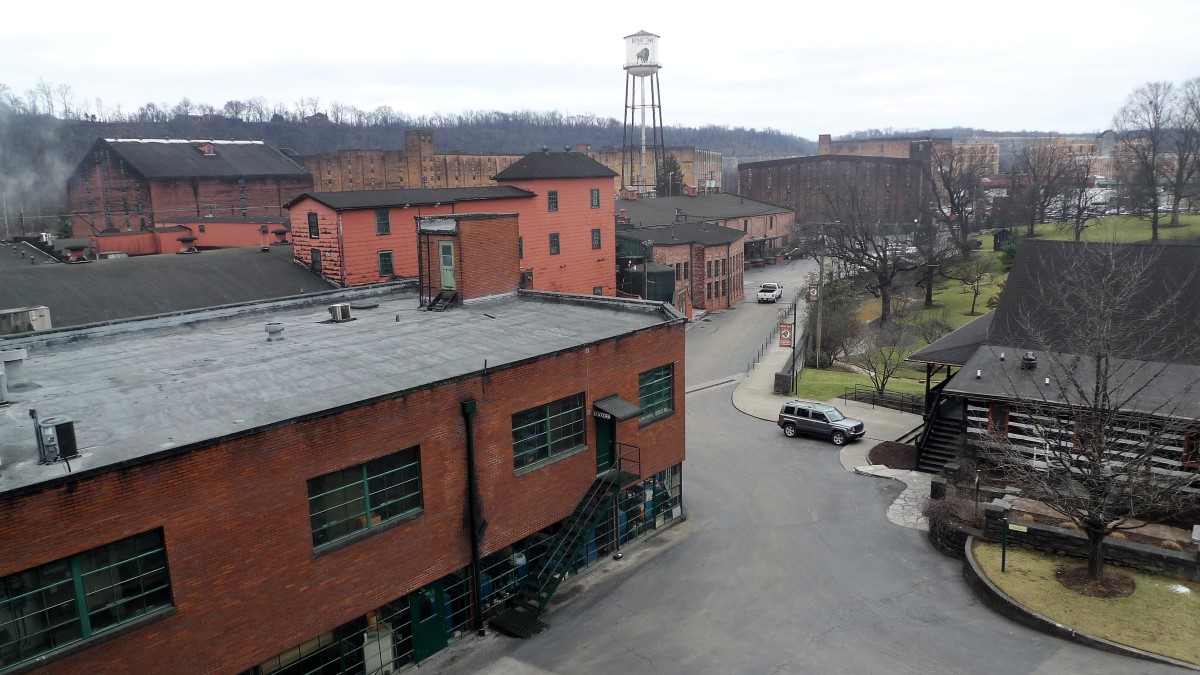
The history of the Buffalo Trace Distillery is quite fascinating, but the modern history of the place (post-WWII) is often glossed over and the story of the distillery’s ownership in the 1980’s and early 1990’s is usually overlooked completely. Most people also have no idea that a few of the most sought after bourbon brands made at Buffalo Trace are not even owned by the distillery (or its parent company, Sazerac, by extension). How did this come to be? Let’s take a fuller look at the history of this American whiskey producing icon.

The distillery campus is in Kentucky’s capital, Frankfort, and stretches out from the east bank of the Kentucky River, which bisects the city. The area where the distillery lies was originally surveyed in 1773 and settled as Leestown in 1775 (Kentucky was actually part of Virginia until it attained statehood in 1792, becoming the 15th state). While records indicate that distilling occurred in the immediate area in those earliest days and the oldest building currently standing on the distillery grounds dates to 1790, the first true commercial distillery on the site was constructed in 1812 by Harrison Blanton.
There was at least one change of ownership in the mid-1800’s, and distilling had expanded to what could be considered an industrial scale by 1858. Then the distillery was purchased by Colonel E. H. Taylor, Jr. in 1870. He christened the distillery with its first name that we know of; O.F.C. (Old Fire Copper or possibly Old Fashion Copper). Although it was a relatively modern distillery, Taylor invested heavily and rebuilt it into the “best of the best”. Taylor oversaw the introduction of copper fermentation tanks, column stills and a steam heating system for the warehouses, among other whiskey making innovations.
But Taylor had overextended himself and declared bankruptcy in 1877. He was rescued financially by George T. Stagg, whose company had taken much of O.F.C.’s whiskey on consignment. Stagg became the owner of the distillery in 1878, but Taylor remained involved as a partner in the business and continued to manage and develop the operation. In 1879-1880 a second distillery was built on the site. The Carlisle Distillery was also located on the Kentucky River, just north of O.F.C. Distillery.
Eventually the relationship between the two men soured and they parted ways in 1886, with Taylor keeping the J. Swigert Taylor Distillery in Woodford County, which the company had purchased in 1882. By the early 1890’s, Stagg had sold a controlling interest in the company to Walter B. Duffy, a business tycoon from Rochester, NY. Stagg retired from the company shortly after that.
In 1898 the Carlisle Distillery was renamed as the Kentucky River Distillery and remodeled so it could turn out high volumes of cheap whiskey. The O.F.C. Distillery continued to produce premium “hand-made” whiskey for the company’s more respected brands. In 1904 the O.F.C. Distillery was renamed as the George T. Stagg Distillery, in honor of its previous owner.
One of the most important men in the history of the distillery was actually hired on as an office boy at the age of 16, in 1897. Albert B. Blanton was raised on a farm adjacent to the distillery and was a descendent of Harrison Blanton. He worked his way through every job possible in the company before becoming the plant manager in 1912. Blanton led the distillery through the uncertain years leading up to Prohibition, guided it through Prohibition, and oversaw operations for another 20 years after Repeal.
With Prohibition looming (both on the state level and nationally), the distillery shut down at the end of 1917 and was sold at auction in 1918. Blanton, having the vision to see beyond Prohibition, bought the distillery himself to ensure its future. He sold it a year later to Henry Naylon, a business associate of the previous owner, Walter Duffy. Blanton then become the president of the company that ran the distillery.
Blanton was able to obtain one of very few permits available for the George T. Stagg Distillery to operate as a concentration warehouse. This allowed the company to store whiskey that had been held in less secure, rural warehouses and it gave them the authority to bottle and sell whiskey for medicinal use. The still house of the Carlisle / Kentucky River Distillery was partially demolished during Prohibition, but beyond that the site remained largely intact during those dark years.
In 1929 the government announced that they would issue a small number of permits for distilleries to operate once again so they could replenish the supplies of medicinal whiskey. Naylon was unwilling to invest in the repairs necessary to get the distillery running again, so Blanton orchestrated a deal for the sale of the company and facility to the Schenley Products Co., which went on to become one of the four big players in the American whisky industry after Prohibition (along with Seagram’s, National Distillers and Hiram Walker and Sons).
Blanton was able to obtain one of those permits and the distillery went back into production in April of 1930. In addition to distilling their own small allotments, the George T. Stagg Distillery was able to produce whiskey for other concentration warehouses that had permits but no operational production facilities. This kept the distillery running until Prohibition finally ended on December 5, 1933.
By 1935 Schenley had initiated a major rebuilding of the distillery which was overseen by Blanton. It was his vision which made the distillery into what we have today. His first big decision was to rebuild the old still house into the new power plant. Now with tremendous boiler capacity, the distillery was properly positioned for rapid growth. Next to come were the new buildings for mashing, fermenting and distilling. Blanton also deeded a right-of-way to the Frankfort and Cincinnati Railroad, allowing a branch line leading to the distillery site to be built.
With production capacity way up, new warehouses were needed. Warehouse H, the only metal clad warehouse on the site, was built first, with a capacity of 15,000 barrels. Today, Warehouse H is the aging location of Blanton’s Single Barrel Bourbon. Warehouses I and K were also added in 1935. Warehouses L and M followed in 1936, and Warehouses N and O in 1937. Each of those six buildings has a capacity of 50,000 barrels.
Blanton oversaw further expansions of the distillery in the years following World War II before he finally retired in 1952. In June of 1953, the George T. Stagg Distillery became the first in Kentucky to produce its 2 millionth barrel after Repeal.
Not much changed at the distillery after the early 1950’s, but production continued at a steady pace into the 1970’s, even as demand for whiskey declined. By the early 1980’s there was a massive oversupply of aging whiskey at Stagg, and across the industry. In 1983 The George T. Stagg Distillery was sold to a newly formed company called Age International. It was started by Ferdie Falk and Bob Baranaskas, who had been the CEO and President, respectively, of Fleischmann’s Distilling.
Nabisco was preparing to sell off its subsidiary which owned Fleischmann’s Distilling and the prospective buyer already had an established liquor division. Falk and Baranaskas assumed that they would lose their jobs, so they decided to start their own liquor business. With a small group of investors, they approached Schenley with the hope of buying the Old Charter bourbon brand. Old Charter wasn’t for sale, but the family that owned Schenley offered to sell them the Ancient Age bourbon brand along with the George T. Stagg Distillery, where it was produced.
With a focus on the more promising Japanese market, Falk and Baranaskas asked their Master Distiller, Elmer T. Lee (who had worked at the distillery since 1949) to help them develop a new product. In 1984 he came up with Blanton’s, the first commercially produced single barrel bourbon. Barrels for Blanton’s were sourced from Warehouse H, said to have been the favorite aging location of Albert B. Blanton, the new bourbon’s namesake.

Blanton’s was a great success and in the years that followed, Age International introduced three other single barrel bourbons; Elmer T. Lee, Rock Hill Farms (named after Blanton’s former home) and Hancock’s Presidential Reserve. Along with Blanton’s, they were all produced from the same mash bill as Ancient Age bourbon.
In spite of these new brands, Age International wasn’t doing well financially, and by 1991 the distillery’s staff had dwindled down to 50 employees; a skeleton crew compared to the 1000 people that worked there during the peak years.
In the spring of 1991, in order to keep the distillery going, Falk and Baranaskas sold a 22.5% stake in Age International to a Japanese company named Takara Shuzo. That company, which was established in 1842, is a major producer of Sake and Shochu, and began importing whisk(e)y into Japan in the 1960’s. They had been the Japanese importer of Blanton’s since its inception, as well as importing the other Age International bourbon brands. As part of that deal, Takara Shuzo was given a 30-day right of refusal to purchase the remaining shares of the company, should they be put up for sale.
By mid-1992, Falk and Baranaskas had entered into an agreement to sell their majority interest in Age International to Heublein Inc. (a subsidiary of Grand Metropolitan, the multinational corporation which merged with Guinness to form Diageo in 1997). Takara gave notice of their intent to exercise their right of refusal and purchase the remaining shares of the company exactly 30 days after they were given written notice of the impending sale to Heublein. They cut it so close (a day before the deal was to have closed) that they actually had to go to court and have an injunction issued to stop the sale to Heublein.
Why did they wait until the last minute? Well, Takara Shuzo didn’t actually want the distillery, they just wanted to take control of the bourbon brands that were owned by Age International. So they took that 30 days to put together a deal to sell the distillery to the Sazerac Company, along with the exclusive rights for the sales and distribution of the Age International bourbons in the US. Of course there was also a long term contract for Sazerac to continue producing those bourbons at the George T. Stagg Distillery.
Takara Shuzo finalized the deal with Sazerac on the same day that they notified Age International of their intent to exercise the right of first refusal. Takara matched the offer made by Heublein, paying $20 million for the remaining shares of Age International, and the sale was complete less than 30 days after they had given written notice of their intent to buy the business. Falk and Baranaskas retired as very wealthy men. Sazerac bought the distillery and the US distribution rights for the Age brands for an undisclosed sum. And finally, Takara left the corporate structure of Age International intact while gaining control of the brands that they wanted.
And who were the new owners of the distillery? The history of the Sazerac Company dates back to the mid-19th century, with the start of three separate businesses. Sometime in the early 1800’s, Antoine Amedee Peychaud emigrated from Haiti to New Orleans. Here, he created an herbal bitters with a strong influence of gentian and aniseed, which he named for himself. In 1841, Peychaud set up an apothecary shop in New Orleans’ French Quarter where he sold his patented Peychaud’s Bitters.
In 1840, just down the road from where Peychaud would open his shop the next year, a man named Sewell Taylor opened the Merchant’s Exchange Coffee House. At the time, coffee houses served both coffee and alcohol (and often more of the latter), but unlike taverns they were also centers of commercial activity. Taylor was also a merchant, and was the sole importer of many of the products that he sold in his coffee house. Among those products was Sazerac-de-Forge et Fils, a French brandy. A popular libation around this time was a cocktail of brandy, sugar and bitters. At the Merchant’s Exchange Coffee House, this drink was made exclusively with Sazerac brandy and Peychaud’s bitters.
By 1850 Sewell Taylor’s importing business had grown to the point that he decided to sell his coffee house and open a liquor store across the street, where he could focus on selling his imported products. Shortly after opening his new store, Taylor hired a young man named Thomas H. Handy as a clerk.
In 1852, Aaron Bird, the new owner of the Merchant’s Exchange Coffee House, changed its name to the Sazerac Coffee House. In 1860, Bird sold the business to John B. Schiller, who ran it for nine years before selling it on to Thomas H. Handy 1869. The next year Antoine Peychaud closed his apothecary store and went into business with Handy. The newly formed Thomas Handy Company was the sole importer of Sazerac brandy and the manufacturer of Peychaud’s Bitters (I believe that Sewell Taylor had retired, and possibly passed away by this point).
Unfortunately, the 1870’s also marked the beginning of the Phylloxera epidemic taking hold of mainland Europe. The little aphid devastated vineyards across the continent, eventually wiping out at least 2/3 of the region’s production capacity. As French brandy supplies dwindled, barmen in the U.S. switched over to American whiskey. The Sazerac-de-Forge et Fils Company was sold at some point and while the brand continued on for nearly a century, its production ceased around 1970.
At the Sazerac Coffee House, rye whisky became the main component of their signature cocktail. When exactly this cocktail took on the Sazerac name, when it transitioned from brandy to rye, and when Absinthe was added to the recipe are all highly debatable points and not really relevant to the topic at hand.
After Handy passed away in 1893, the company was taken over by his former secretary, C. J. O’Reilly, who relaunched the business as the Sazerac Company. Shortly thereafter, the company introduced an American rye whisky under the Sazerac name. The company survived Prohibition by temporarily running as a delicatessen and grocery vendor during those years. The Sazerac Coffee House had closed permanently at the beginning of Prohibition and Sazerac Rye was not revived after Prohibition ended, but the company did return to the spirits importing and distribution business. The Sazerac Company also continues to produce Peychaud’s Bitters to this day.
In 1948 the company was purchased by the Goldring family of New Orleans. Under their ownership the Sazerac Company has grown tremendously, buying existing spirits brands and creating new ones. But that growth, which was modest at first, has snowballed over the last three decades. Herbsaint, which was one of Sazerac’s first acquisitions under the new owners was historically notable. After Absinthe was banned in the US in 1912, a number of substitutes for it were used in the Sazerac cocktail in the years leading up to Prohibition. In 1934, after Prohibition had ended, Herbsaint, a wormwood-free replica of Absinthe which was produced in New Orleans, was introduced. It quickly became the ingredient of choice for the Sazerac cocktail. The Herbsaint brand was purchased by the Sazerac Company in 1949.
While Sazerac had a long history of spirits importing, sales and marketing, both of brands that they owned and brands that were owned by others, the biggest growth for the company didn’t begin until the late 1980’s. As Seagram’s sought to diversify their holdings during this time, they sold off a group of spirits brands in 1989 which were split between Heaven Hill Distillers and the Sazerac Company. The American whiskey brands picked up by Sazerac in this purchase were Eagle Rare bourbon and Benchmark bourbon. Sazerac didn’t own a distillery at the time, so production for these two brands was contracted out to Heaven Hill.
Then, in 1992, Sazerac bought the George T. Stagg distillery and the US distribution rights for the Age International bourbon brands. At the time, Sazerac primarily viewed this deal as a brand acquisition that just happened to have a distillery attached to it. Ancient Age bourbon was selling half a million cases a year back then, and that was what Sazerac was most interested in.
The distillery continued to make the Age International bourbons under contract using its Mash Bill #2 (which is estimated to be 12% to 15% rye). With Mash Bill #1 (which is estimated to be 8% to 10% rye), they starting making whiskey for their Benchmark and Eagle Rare brands. Most of the other bourbon brands that they have since created or acquired are made with Mash Bill #1, but they also make whiskies from a wheated bourbon mash bill and a rye whiskey mash bill. Mash Bill #2 has remained exclusive to the Age International brands.
In 1997 the company brought in a new management team for the distillery and started a two year restoration project. This was when they really dug into the history of the place and when the leaders of the Sazerac Company finally realized the true value of the distillery they had purchased.
Once the restoration project was completed in 1999, they renamed the distillery as Buffalo Trace and introduced the newly created Buffalo Trace bourbon as their flagship brand. The new name was a reference to the paths followed by Buffalo in the late 1700’s to a crossing point on the Kentucky River near the location of the distillery.

In spite of many incorrect reports to the contrary, this was only the third name that the distillery ever went by. It was the OFC distillery from 1870 – 1904, the George T. Stagg distillery from 1904 – 1999 and the Buffalo Trace distillery from 1999 onward. There are many claims of the distillery going by various other names through the years, but the most common one is Ancient Age. During the years that the place was owned by Age International it was operated through a subsidiary named the Ancient Age Distilling Company and “Ancient Age” was painted on the distillery’s prominent water tower since that was their flagship brand. But they had never changed the actual name of the distillery.
Sazerac also acquired a few more important brands in 1999. Schenley had been bought by United Distillers in 1987. United Distillers was part of Guinness, which merged with Grand Metropolitan in 1997 to form Diageo. Two years later, Diageo decided to mostly get out of the American whiskey business. They only kept the George Dickel distillery in Tennessee and the Bulleit and I.W. Harper bourbon brands. When they sold everything else in 1999, Sazerac picked up the Old Charter and Old Weller brands.
In 2000, the company introduced the Buffalo Trace Antique Collection. One of its initial offerings was the new 18 year Sazerac Rye. This was a product which was created from older barrels of rye whiskey which were discovered during a full inventory of the warehouses in 1997. After that the company made rye whiskey production a regular annual occurrence. Then, in 2006 they added a non-age-stated (but generally accepted to be about 6 years old) Sazerac Rye to their regular offerings. Also in 2006, Thomas H. Handy, a 6 to 8 year old, barrel proof rye whiskey was added to the annually released Antique Collection.
2002 saw the Sazerac Company go into a partnership with the Old Rip Van Winkle Company. The first pick of the barrels of wheated whiskey made at Buffalo Trace would now be set aside for the Van Winkle family of bourbons.
There were further acquisitions in 2009 with the Old Taylor brand being bought from Beam and the Barton 1792 distillery and several Barton owned bourbon brands being bought from Constellation Brands.
So far I have covered the major whiskey related acquisitions of the Sazerac Company that have taken place over the last 30 years, but the company has built a much broader portfolio at the same time. Sazerac now owns six distilleries as well as countless brands (along with the distribution rights to others) covering nearly every spirits category imaginable.
Before I wrap things up, I think it’s important to take a look at the capacity of the Buffalo Trace Distillery and see how it has been growing to meet current and future demand.
The column still at Buffalo Trace, at 84 inches in diameter, is one of the biggest, if not the biggest, used to distill American whiskey. In the post-WWII years the distillery’s capacity was built up to 6 million cases, or about 12 million proof gallons per year. But even that was only a bit more than half of the maximum capacity that their massive still was capable of putting out. The limiting factors were actually the boilers, the mash cookers and the fermenters.
Production was kept up as demand fell in the early 1970’s, and peaked at 200,000 barrels in 1973. They started to cut back the amount of whisky they were making after that, but demand continued to decline into the 1980’s. Even in 1995, as demand was starting to return, they were only filling 12,000 barrels per year. In a 2007 interview with Mark Brown, the president of Sazerac, he stated that the distillery was still capable of its historical maximum production levels if the demand was there. It’s hard to know how much they were producing at that time, but clearly not as much as they could have been.
And then the financial crisis hit in 2008 and they cut production, as was evidenced by the product shortages that the company suffered through six years later when the whiskey came of age. They’ve been playing catch up ever since.
As production increased, warehouse capacity became an issue. Many of the warehouses had been converted to other uses during the 1970’s and 1980’s. The nine warehouses still in use had a combined capacity of just over 322,000 barrels. Over 2015 and 2016, seven former warehouses were converted back to their original purpose (three had been used for finished goods storage and four had been converted to offices). This brought back an additional 350,000 barrels of warehouse capacity.

But even more warehouse capacity was needed and the distillery purchased 200 acres of farmland adjacent to their existing property for that purpose. The new, insulated warehouses would each hold just over 58,000 barrels. The first one was completed at the end of 2017 and they are scheduled to build another one every four months for up to the next 10 years.
When I visited the distillery early in 2016, I was told that they were producing 800 barrels per day. I assumed that they were producing five days per week with an eight week summer break, which would yield 176,000 barrels (probably the equivalent of the 200,000 barrels filled in 1973, since they used to add more water to the raw spirit and fill barrels at a lower proof back then). By 2017 they were running seven days a week, and by mid-2018 they were on track to produce 200,000 barrels for the year.
The boiler, which dated to 1951, was just replaced. A new bottling hall should be completed any time now, and the old bottling hall building will be used to add more production equipment. Planned for the summer of 2019 is the addition of new mash cookers that will have twice the capacity of the existing ones and four new fermentation tanks. These will each hold 92,000 gallons, matching the size of the 12 existing fermenters that they will join.
The visitor center facilities will be expanded as well, in spite of the fact that they were just renovated in 2015. All of this is part of a $1.2 billion investment that the Sazerac Company will make in the distillery over a 10 year period.
While the Age International brands are not owned by Sazerac, Blanton’s, and to a lesser extent Elmer T. Lee and Rock Hill Farms, are of great importance to the company and an integral part of the distillery and its history. I suspect that Sazerac would love to buy those brands back if given the chance. But even if the brands can’t be bought and the production contracts were to expire I’m sure that the mutually beneficial relationship between the two companies would continue indefinitely.
A lot has happened on Islay since my visit to the epicenter of Hebridean distilling in the spring of 2012. With the rising popularity of whisky in general and Islay whisky in particular over the last two decades, the stage has been set for numerous expansions and several new distillery projects. Let’s have a look at the current state of development on the island.
When I arrived on Islay, the whisky industry there was in pretty good shape, especially considering how bad things had gotten in the 1980’s and 1990’s. Caol Ila had just re-opened after a six month closure for upgrades which included a larger mash tun and two additional washbacks. Kilchoman, having gone into production in December of 2005, was Islay’s newest distillery and the first one to be built on the island in 124 years. Bruichladdich was on the cusp of being sold to Remy Cointreau (which wasn’t public knowledge at the time) 11 years after having been rescued by a group of private investors in 2001, following an eight year shut down. Ardbeg was also flourishing after having been rescued; the distillery was silent from 1981 to 1989, then saw minimal production (operating just two months a year) from 1989 to 1996 before shutting down again. Salvation came to Ardbeg with their purchase by Glenmorangie in 1997. Bunnahabhain was also benefitting from new ownership. Previous owners, Highland Distillers and subsequently the Edrington Group, had focused their efforts on the high-profile distilleries in their portfolio, namely Macallan, Highland Park and Glenrothes, neglecting the lesser known ones before eventually selling them off. When Burn Stewart bought Bunnahabhain in 2003, production had been at a bare minimum for the previous four years. With improved quality, revitalized production and a new range of single malts, things were looking up at Bunnahabhain. Meanwhile, Islay’s other three distilleries, Bowmore, Lagavulin and Laphroaig, were firing on all cylinders.
Starting a new distillery is no easy feat, both in terms of financing and planning approval. While several new projects have been proposed on Islay in recent years, only one has come to fruition thus far. The story of that distillery is intertwined with the story of what once seemed to be the most likely candidate to become the ninth distillery on the island, so I’ll discuss them together.
News of the Gartbreck Distillery first broke in September of 2013 when journalists discovered that a company called Gartbreck Distillery Co Ltd had been registered in May of that year. Jean Donnay, the owner of a French malt whisky distillery in Brittany, is the principal behind this project. His proposed site is an old farm on the shores of Loch Indaal, south-west of Bowmore, which he acquired in May of 2012. Initial plans were for a relatively small distillery, at 120,000 LPA, with traditional floor maltings, direct fired stills, worm tubs and wooden washbacks. Planning permission was obtained early in 2014, but the project stalled, likely due to issues with financing. Then, early in 2015, Donnay entered into an agreement with Hunter Laing, the independent bottler, where they would buy Gartbreck and complete the project, while keeping Donnay on as a consultant.
An adjoining strip of land, which was necessary for warehouses and parking, had not yet been acquired by Jean Donnay. Hunter Laing went ahead and purchased that property, then demolished some of the old farm buildings and began other site work. But the final contracts had not been signed and it seems that Donnay was unhappy with Hunter Laing’s plans for the project, so he pulled out of the deal. Apparently, he was unaware of the fact Hunter Laing had purchased that strip of land which was necessary to the project.
That set the stage for a protracted dispute between the two parties. No doubt the owners of Hunter Laing wanted a price for that bit of real estate which made up for the wasted time and effort they had put into the project. And of course Mr. Donnay likely didn’t want to pay any more for the land than the Laings had.
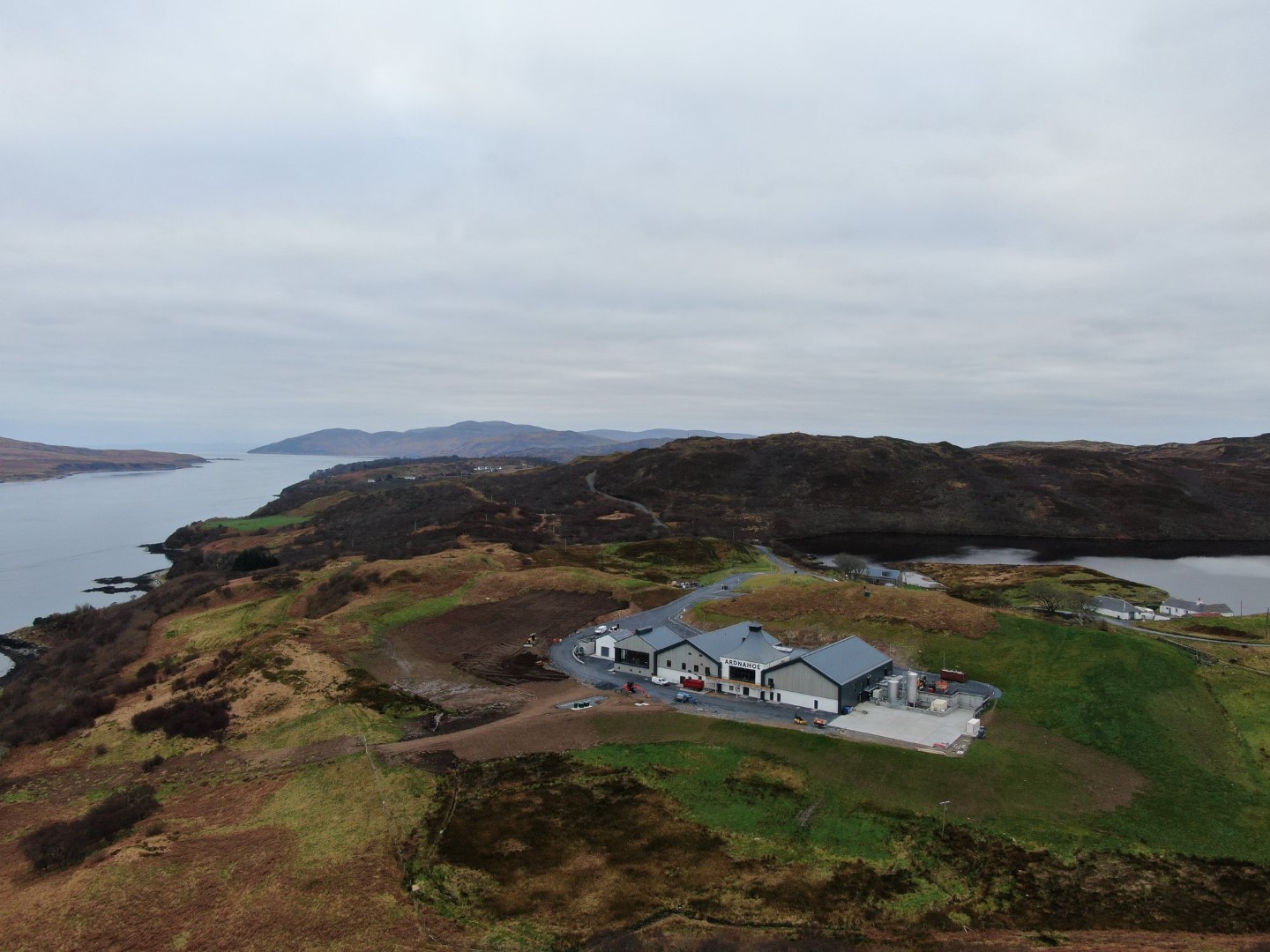
The owners of Hunter Laing moved on after the Gartbreck project fell through, announcing plans for a new distillery at another site in January of 2016. Planning permission for the Ardnahoe Distillery was granted in September of that year. Located on four acres of land on Islay’s north east coast, Ardnahoe is situated mid-way between Caol Ila and Bunnahabhain. Initial plans called for a manual distillery with worm tubs and a capacity of 500,000 LPA.
Work on the distillery started in November of 2016, but the big news came in January of 2017 when it was announced that Jim McEwan had been hired out of retirement as Ardnahoe’s Production Director. McEwan, having filled nearly every role at Bowmore during his 38 year carrer there, was poached by the new owners of Bruichladdich in 2000. He served as the distillery’s Production Director and Master Distiller through its resurrection and into the Remy Cointreau ownership phase. Retirement came after 15 years at Bruichladdich; a retirement which would last just a year and a half.
In spite of some overly optimistic estimates of the distillery opening in the spring of 2018, they do seem very close to starting production as of the start of 2019 (judging by the photos they’ve posted on social media).

Meanwhile, back at Gartbreck, Jean Donnay and the owners of Hunter Laing had finally settled on a price for the disputed land by November of 2017, potentially putting that project back on track. Of course, that was more than a year ago and there have been no updates of any progress since. I suspect that a lack of financing is holding the project back. We’ll just have to wait and see if construction ever starts.

2018 saw rumors of a possible distillery in or near Bridgend, the tiny village north of Bowmore and at the intersection of the road that circumnavigates Loch Indaal and the road that leads to Port Askaig. The rumors indicate that this could possibly be a gin distillery. Of course, these are just rumors and no one seems to be putting much weight behind them at this point.
Port Charlotte is another potential new distillery on Islay, but one that doesn’t look too likely at the moment. Port Charlotte was actually one of Islay’s lost distilleries, having been established in 1829 on the shore of Loch Indaal, just a few miles south of where Bruichladdich would later be built. The distillery was renamed as Lochindaal at some point, but after a 100 year run it closed for good in 1929. The plant’s equipment was removed, but the distillery buildings were repurposed and two of the stone warehouses survived as well.
In 2001 the new owners of Bruichladdich immediately began producing occasional runs of heavily peated single malt, which they have bottled under the Port Charlotte label since 2006. When the Inverleven Distillery in Dumbarton was set to be demolished in 2003, Bruichladdich went about acquiring all of its distilling equipment, transporting it to Islay and putting it in storage. Then, in 2007, they purchased former Port Charlotte distillery buildings and put out a press release announcing that they would bring the old distillery back to life using the equipment from Inverleven. Since 2007, those two surviving warehouses at the site have been used to mature the Port Charlotte whisky distilled at Bruichladdich.
Unfortunately, the financial crisis of 2008 put the Port Charlotte distillery plans on hold. Planning permission had been granted by 2012 and some assumed that the deep pockets of Bruichladdich’s new owners, Remy Cointreau, would help the project to move forward. And then nothing happened. Two years later, in 2014, Mark Reynier, who had been relieved of his duties at Bruichladdich after selling the distillery in 2012, announced a new distillery project in Ireland, at a former Guinness brewery. Shortly thereafter, Mr. Reynier acquired the two former Inverleven pot stills and took them to Ireland, pressing them back into service in his new distillery.
It is still possible that the powers that be at Remy Cointreau may someday decide that the time is right to re-start the Port Charlotte Distillery project. But no one seems to be holding their breath waiting for that to happen at the moment.
Rumors of a new distillery to be located just outside the village of Port Ellen, on the road that leads to Laphroaig, Lagavulin and Ardbeg began back in 2014. The man behind the Farkin Distillery project was said to be Sukhinder Singh, the owner of The Whisky Exchange (an online spirits retailer) and Elixer Distillers (an independent bottler which owns the Port Askaig and Elements of Islay brands).
The rumors went unconfirmed for several years, but finally, in April of 2018, Mr. Singh held a public consultation where he outlined plans for the project and took feedback from the area’s residents. Then, in December of 2018, his plans were submitted to the Argyll and Bute Council for approval. The distillery actually has no official name at this time, but Farkin is the name of its proposed location.
The site is in the rumored location, about half a mile from Port Ellen, on the road that leads out to Kildalton Cross. The plans are rather bold, calling for a 1.2 million LPA distillery with a modern / contemporary design. In addition to the four pot stills for malt whisky production, there will also be a pilot plant with a gin still and separate column and post still set up to produce other types of spirits. Additional points of interest include underground maturation vaults, a traditional floor malting and a separate tasting lodge closer to the shore for private events.
Pending planning approval, they would like to begin construction as soon as possible, with a goal of distillation starting in 2021.
The biggest surprise in Islay distilling news came in October of 2017, when Diageo announced that they would reopen the long closed Port Ellen Distillery. In spite of being a “closed” distillery, reopening Port Ellen will require that it be built anew from scratch. Let’s take a brief look at the history of this iconic distillery.
Established in 1825, the Port Ellen distillery was built on the site of a former malt mill, next to the village of Port Ellen. Alexander Kerr Mackay founded the distillery with the support of Walter Frederick Campbell, the Laird of Islay. Mackay ran into serious financial difficulties within months of the distillery starting up and production was taken over by three of his relatives; John Morrison, Patrick Thompson and George MacLennan. Then, in 1833, the distillery was taken over (and eventually bought) by John Ramsey, who was a cousin of John Morrison.
This was followed by a period of great success, with Ramsay pioneering direct exports to North America and expanding the distillery in the 1860’s. Ramsey owned and operated Port Ellen until his death in 1892. His widow, Lucy, then took over running the distillery and upon her death in 1906 it was passed on to her son, Captain Ian Ramsey.
After struggling through the World War 1 years (1914-1918), Ian Ramsey sold Port Ellen in 1920 to a company set up by John Dewar & Sons and W.P. Lowrie and Company. In 1925, that company merged with Distillers Company Limited. Suffering from the combined effects of an economic recession in the UK in the early 1920’s and Prohibition in the US from 1920, the Port Ellen distillery was mothballed in 1929. In spite of the closure, the maltings and warehouses at Port Ellen continued to be used in support of DCL’s other Islay distilleries.
37 years later, at the height of the post-World War II boom, it was time for Port Ellen to reopen. Extensive renovations and rebuilding of the distillery began in 1966 and were complete by the spring of 1967. Most historical descriptions note that the number of stills was increased from two to four at this time, implying that the two stills that were in place at the time of the 1929 closure were put back into service alongside two new ones. The wash stills were each 28,000 liters and the spirit stills were each 25,000 liters.
When Alfred Barnard visited Port Ellen around 1885, the two stills in use at that time were much smaller, with the wash still sized at 15,900 liters and the spirit still at 9500 liters. Of course it is certainly possible that the distillery upgraded to a bigger set of stills in the 15 years after Barnard’s visit, as this was a period of great growth in the industry.
When Port Ellen came back online in 1967 the floor maltings were put into use once again and the stills were direct fired by coal, using mechanical stokers. In 1970 the boiler was upgraded and the stills were converted to steam heating. Then, in 1973, large malting drums were installed alongside the distillery and the use of the floor maltings came to an end. This mechanized malting facility was capable of supplying malt to all three of DCL’s Islay distilleries; Port Ellen, Lagavulin and Caol Ila.
Port Ellen had a capacity of 1.7 million LPA, but actual output peaked at 800,000 LPA before the distillery was again mothballed in 1983, with DCL deeming it to be the least important of the company’s three Islay distilleries. The following timeline shows what has happened with Port Ellen (the distillery and the brand) since the 1983 closure.
In 1986 DCL was bought by Guinness.
In 1987 Port Ellen was officially closed (as opposed to merely being mothballed, a state from which it could easily be restarted).
Also in 1987, the Concordat of Islay Distillers was signed. This was a gentleman’s agreement between all of the distilleries on Islay and Jura, stating that they would purchase at least a portion of their malted barley from the Port Ellen maltings, allowing the facility to continue operating through the downturn of the 1980’s.
In 1990 the distillery was dismantled, with much of the equipment reportedly shipped off to India.
In 1992 Port Ellen’s distilling license was cancelled.
In 1997 Guinness merged with Grand Metropolitan, forming Diageo, which is the current owner of Port Ellen.
In 1998 a 21 year old bottling was released in honor of the 25th anniversary of the commercial maltings.
In 2001 a 22 year old Cask Strength Port Ellen bottling was the first of what would become an annual inclusion in Diageo’s Special Release series. While the whisky produced at Port Ellen was intended for blending and not much was thought of it at the time it was produced, the quality of its extra aged special releases and many independent bottlings has catapulted it to being one of the most sought after of whiskies from Scotland’s lost distilleries.
In 2003 the still house and a few other buildings were demolished so the maltings could be expanded. Two former kilns with pagoda roofs still exist on the site as well as a dozen warehouses. The two that most people see are the rack style warehouses that run along the shore and are emblazoned with the iconic black lettering. Just behind those, running in a long row, are another 10 connected dunnage style warehouses.

And of course, in October of 2017, came the announcement from Diageo that Port Ellen would be brought back to life yet again. The plan is to put up a new building somewhere between the maltings and the warehouses. Two new stills will be commissioned, recreating the old ones as closely as possible. They will also attempt to replicate the previous distilling processes where possible. The whisky will be moderately peated at 20 ppm (I believe Bowmore is at 25 ppm) and annual output should be around 800,000 LPA. The original press release called for distilling to commence in 2020, but we are more than a year out from that announcement and there has been no word of planning permission being granted so far. The goal may still be possible, but if they don’t start construction by the spring, a start date in 2021 will be more likely.
What of the existing Islay distilleries? There’s plenty of news on that front as well.
In November of 2017 Kilchoman announced plans to double capacity. They had already constructed a new kiln and malting floor, which can produce twice as much malt as the originals (which are still in use). The construction, which is well underway, includes a new still house, mash house and tun room. They will add a second set of stills, a second mash tun and six new washbacks, all the same size as the original units. The plans also call for five new warehouses to be built over the next five years. This will bring production to 460,000 LPA.
In February of 2018, Ardbeg announced that the distillery was planning to add a second set of stills, doubling capacity. Plans include a new still house for all four stills which be located on an area of the distillery grounds where warehouses once stood. The current still house will then be repurposed to contain new washbacks. This expansion would give Ardbeg a capacity of 2.4 million LPA

The folks at Laphroaig have been openly talking about their plans to expand since at least February of 2018. Though no official plans have been submitted for approval as of yet, Laphroaig’s distillery manager has stated that they would like to increase production capacity by up to 100%. Current capacity at Laphroaig is 3.4 million LPA, so a doubling would take that to 6.8 million LPA.
Caol Ila was completely rebuilt as a substantially larger distillery in the early 1970’s. The infrastructure that was added in 2011 allowed the distillery to increase its capacity to 6.5 million LPA with its existing stills. While there are no plans to expand production at Caol Ila, in October of 2018 the distillery did announce their intention to build a new visitor center. This will be incorporated into the upper section of one of the warehouses, with a rooftop patio and a footbridge connecting the visitor center to a new parking area built into the hillside above the distillery.
Bruichladdich has steadily increased production since the new owners took over in 2012 and they reached 1 million LPA in 2017. The distillery has since been adding warehouses to keep up with the increased production levels. They have also talked in the past of their desire to add a traditional malting floor, at least for their Islay grown barley. And they could always revive the Port Charlotte distillery project rather than expanding Bruichladdich.
While production levels at Bunnahabhain have steadily increased over the last 10 years, I’m not sure if they have yet reached the capacity of their four stills, which is 2.74 million LPA. There are no plans to increase capacity, but in July of 2017 the distillery announced that there would be an £11 million investment over the course of three years to improve infrastructure, upgrade buildings and make cosmetic improvements. All of this is aimed at creating a more appealing experience for visitors to Bunnahabhain.
Neither Lagavulin, with a capacity of 2.4 million LPA, nor Bowmore, with a capacity of 2 million LPA, have announced or even hinted at plans for expansion. Of course, most companies stay pretty tight-lipped about such projects until they are ready to seek planning permission or they are looking for feedback from the public ahead of that move. So the latest news of a planned distillery expansion could come at any time.
Regular readers will recall that a friend and former colleague of mine is the Beverage Director at Frenchman’s Creek, a private residential golf community in south Florida. I’ve appeared there as a guest speaker, hosting whisky dinners for the members a number of times over the last six years. I’ve also served as somewhat of an unofficial consultant to them, occasionally providing opinions and advice for potential whisky purchases.
I recently received an email from my friend asking (on behalf of one of the members) for recommendations of high end Scotches to purchase, ranging from $100 to $500 per bottle. I was actually asked for a top five list, but I went a little beyond that. Since I put a bit of time into coming up with an answer, I thought it would be good to roll that over into a blog post.
Single Malts were not specified, but I usually view high-priced blends with a bit of suspicion, so I really didn’t even consider any. Of course, these are all whiskies that I like; I chose not to include any offerings that don’t suit my personal preferences, even though they might be quite good.
While I haven’t tasted every whisky on the list, I have at least tried examples that were close enough to give me confidence in my recommendations. Here’s what I came up with:
There are a lot of interesting single malts in that price range.
The first thing I would look for is something from the Glenfarclas Family Casks series. These are vintage dated, cask strength, single barrel releases that span from the early 1950's to the early 2000's. The price range is pretty big depending on the distillation vintage and when it was released. Newer releases are much more expensive than the ones that came out seven or eight years ago for any given vintage. Most of the 1970's vintages that come out now are in the $2000 to $3000 range, but I recently bought a 1973 Family Casks bottle that was bottled in 2011 for $700. I also bought a 1995 vintage at the distillery two years ago for a little over $300. I haven't opened those two, but I've tasted others from the 70's, 90's and 2000's and they've all been stunning. Basically anything you can find from the Family Casks series that is in your price range will be worthwhile.

If you can't get any Family Casks bottlings, Gelnfarclas 25 year is by far the most reasonably priced 25 year old single malt out there. It comes in a little over $160, which is 1/10 the cost of Macallan 25 year and likely on par in terms of quality.
The Springbank Local Barley bottlings have a good reputation. I haven't tasted any of them recently, but I do have a 16 year in the collection that I bought for $200 not too long ago.
I recall you asking me about Glendronach 18 year and 21 year. If they are still available I would definitely go after them.
I know you don't have a lot of peat fans down there, but if that is an option, Ardbeg 21 year and Laphroaig 25 year would be great heavily-peated choices around the $500 mark. Slightly down the peat scale, Highland Park 18 year and Bowmore 18 year are great options in the $150 neighborhood.
Old Pultney 21 year is a lovely whisky that was recently discontinued. If there's any still available to you, get it while you can. Should retail around $175
Bunnahabhain 18 year is an old favorite. It runs around $150 and I actually prefer it over the much more expensive 25 year.
On the more delicate side, Auchentoshan 21 year is a nice option that is often overlooked. Should be around $250.
Craigallechie is a more assertive Speysider that tends to be somewhat divisive. For those that appreciate a whisky that can be a little abrasive but has lots of character, their 17 year at $150 or their 23 year at $300 are good options.
I also just noticed that there was a 21 year Oban in the 2018 Diageo Special Release collection. While I feel that the differences between their 18 year and flagship 14 year are too subtle to justify the price jump, the 21 year is aged in European oak and bottled at cask strength, which should help to differentiate it. Initial reviews look very good. Definitely pricey at $550, but it's on my radar now.
The Whishk(e)y Room Blog is now on Instagram! While my blog writing has been pretty limited this year, I certainly haven’t stopped buying and drinking whisk(e)y. I did, however, start to chronicle my spirituous adventures on Instagram toward the end of last winter.
There’s a great, vibrant whisk(e)y community on Instagram. It’s nice to have more interaction with other enthusiasts, and the amazing images that I see there have inspired to up my photography game. I’m typically posting two to three times per week, with a mix of new photos and older ones (some that were originally taken for the blog, and others from the many distillery tours that I’ve taken over the years). The commentary is more along the lines of brief opinions, bits of insightful information and simple updates on what I’m currently drinking.
I do intend to continue writing more in-depth pieces here, and hopefully will get back on track with that sometime soon.
So, if you’re already on Instagram, search for thewhiskeyroomblog and follow me. Not on Instagram? Allow me to explain how it works. First, I should mention that Instagram is really designed to be used on mobile platforms (phones and tablets) as an app. While it is possible to use Instagram as a website, that does limit its functionality.
The easiest way to view things on the Instagram website is to simply go to the web page of a specific user; in my case, https://www.instagram.com/thewhiskeyroomblog/
If you haven’t signed up yourself, all you’ll be able to do is look at the pictures. You can view larger versions of the images and their captions by clicking on them, and there’s a search bar up top which will allow you to explore further.
If you want to interact at all, you’ll have to sign up for an account (it’s a pretty painless process). This will allow you to follow other users (showing their images in your feed when you sign in), “like” images and post comments.
For full functionality, including posting your own images, creating “stories”, using the direct messaging feature, etc., you’ll have to download the app. Again, this is primarily intended for mobile devices. That being said, there is a Windows 10 based Instagram app available, but I haven’t used it and can’t speak to its functionality.
So, what are you waiting for? Get on over to the Insta and follow me!


It looks like I’ve let a bit more time slip by than intended since I took a break from writing about my trip to Scotland last year. I’m going to try to get caught up with the topic at hand sooner than later.
Day 9 was the last day of travel before I settled in to the heart of Speyside for most of the remainder of the trip. After initially planning out a very rough itinerary, I had looked over a map of the distillery locations I was most likely to visit and chose Aberlour village as the location of my home base for the five nights I would spend the area.
I only had a drive of about an hour and a half from Inverness to Aberlour, and the Benromach distillery was roughly mid-way between the two, so that was an easy choice for the first tour of the day.
Closer to my destination was the relatively new Dalmunach distillery, opened by Pernod Ricard / Chivas Brothers in 2014. Dalmunach isn’t open to the public for tours, but I made contact with the proper Public Relations representatives and tried to make arrangements for a visit. Unfortunately they weren’t able to accommodate my request for any of the dates during which I would be in the area.
Another option that I considered was the nearby Ballindalloch, a small (100,000 lpa), single-estate distillery built in converted farm buildings, which began producing in September of 2014. When I looked into the details of a visit I learned that the tours were quite expensive, by appointment only, and 3 hours in duration. I decided to pass, but do feel a bit of regret about that decision now; it looks like a pretty cool little distillery and from all accounts offers an impressive tour.
Ultimately, I decided to stop by Glenfarclas in the afternoon. I had a tour scheduled there the next day, but this was the second of two “must visit” distilleries (along with Edradour) on this trip, so stopping by to spend a little time in the visitor center the day before seemed appropriate. I was also hoping to take home a special bottle from the Glenfarclas Family Casks series and I thought it would be good to have a preview of availability and pricing so I could sleep on the decision before making my big purchase.
I ended up booking a room in a B&B that was on a hillside overlooking Aberlour Village and about a 10 minute walk from the pub I was most likely to frequent. The owners of the Fairy Knowe House were a retired couple with two rooms for rent and while staying there I felt a bit more like a house guest than the patron of a business. The price was very reasonable, but they only took cash or checks for payment. I had made the reservation somewhat last minute and didn’t bring enough UK currency to cover my stay, so I knew I’d have to exchange cash in Scotland.
I remembered using a currency exchange in a Tesco grocery store in Oban when I visited Scotland in 2012. The Tesco website shows which stores have currency exchanges, and there were several to choose from in the Inverness area. After catching up on some much needed sleep, my first stop of the day was at the Tesco that was a few miles out of the city and just off of the main road that led to the Benromach distillery. It may sound like sort of an odd thing to enjoy as a tourist, but spending a little time wandering around a grocery store and getting a glimpse of everyday life in Scotland was a nice departure after spending most of my time in places that are heavily frequented by tourists.
About four months prior to leaving for Scotland, I had met Richard Urquhart, one of the owners of Gordon & MacPhail, at a tasting in Boston. I talked with him about my upcoming trip and he mentioned the possibility of getting me in for a tour of their warehouse in Elgin. I reached out to him a few weeks ahead of my arrival in Speyside to make arrangements for that visit, noting that I planned to visit Benromach (also owned by G & M) on my way from Inverness.
Richard asked for my planned arrival time at Benromach so he could arrange for my tour there as well. I wasn’t really sure what he had planned for me (if anything, I didn’t make any special requests). I arrived a little before 11:00 and there seemed to be a bit of confusion at the visitor center when I mentioned that Richard had booked me in for a tour. Apparently there had been some miscommunication and they had me in the calendar for the day before.

This really wasn’t an issue; I was still able to take the 11:00 tour. Unfortunately though, this was another tour where I was part of a large group where most of the people knew very little about whisky making and English wasn’t their primary language. This being an independently owned distillery, I had assumed that photography would be allowed on the tour. I was wrong. I guess it was my own fault for not figuring that out ahead of time and seeking permission to do so, but it was disappointing nonetheless.
On the positive side, the entry fee for my tour was waived and the visitor center staff members were very accommodating; they spent a great deal of time answering my litany of questions about Benromach after the tour and tasting had ended.
I’ve gone over the story of Benromach and Gordon & MacPhail in a few previous posts, so I’ll just start with a brief recap here.
Benromach is in Forres, which is a town in the northern portion of Speyside, near the coast, and about 2/3 of the way from Inverness to Elgin. The distillery was established in 1898 by Duncan McCallum and FW Burickman. The architecture was by the well-known Charles Doig and construction took place over the course of two years, with operations starting in 1900.
This was one of 18 malt distilleries established in Scotland during the three year period of 1897 through 1899; and that was the end of the whisky boom of the late 19th century. Only one malt distillery was constructed (Inverleven, 1938) between then and the post-WWII distilling expansion, which kicked off with establishment of Tullibardine in 1949.
The downturn that started just before the turn of the century impacted the industry quickly; Benromach closed almost immediately after production began. The distillery was often silent during the next 50+ years and had several changes of ownership through that period.
After the brief start in 1900, the distillery remained closed until 1907. It ran for three years, closing again in 1910. That closure lasted until after WWI (1919 or later). Another shutdown lasted from 1931 through 1936. Finally, like most distilleries in Scotland, it was shutdown at some point during WWII (early 1940’s). Then, in 1953, Benromach went back online after the distillery was purchased by Distillers Company Limited (an industry behemoth and the predecessor of today’s Diageo).
Under DCL’s ownership and with the success that the industry saw after WWII, Benromach had her longest uninterrupted run, 30 years straight. Then, in 1983 the distillery was shut down again, being deemed surplus by DCL as the industry slid into one of its more pronounced downturns. Over the next 10 years, much of the equipment in Benromach was sold off or put to use in her parent company’s other facilities. With not much left besides the buildings and some aging stock, it probably looked like Benromach was closed for good before it was purchased by Gordon & MacPhail in 1993.
Gordon & MacPhail is one of Scotland’s oldest and most well known independent bottlers of Scotch whisky. The company was established in Elgin in 1895 as a family grocers and tea, wine and spirits merchant. John Urquhart joined the company in its first year and became a Senior Partner by 1915. At some point the Urquhart family took full control of the business but kept the long established name. John developed the company’s whisky brokering business and made deals for them to bottle single malts under license for several distilleries; this eventually led to Gordon & MacPhail filling and bottling casks of their own.
Ambitions for a Gordon & MacPhail owned distillery go back quite far; John attempted to buy the Strathisla distillery in 1950 after its owner was jailed for tax evasion and his assets were auctioned off. Unfortunately he was just barely outbid by Chivas Brothers. The dream never died, but the conditions for a distillery purchase weren’t right again until the early 1990’s, when the industry began to rebound from the massive downturn of the 1980’s.
As I mentioned above, DCL had stripped the distillery of almost all of its equipment over the course of its 10 year closure. Gordon & MacPhail had purchased little more than the shell of a distillery and its aging stock when they bought Benromach in 1993. Restoring the buildings and essentially outfitting a new distillery within them took the better part of five years; Benromach officially reopened on August 3rd, 1998.
A few turns and a very short distance of driving off of the A96 brought me to the distillery. A group of adjoined buildings house the production areas. The front of this structure presents a straight façade with a variety of rooflines, but the ends and the center section extend further to the rear, forming two alcoves in the back. Directly across a paved driveway from the front of that building is a smaller building which houses the visitor center. Although obviously an older structure as viewed from the outside, the visitor center was quite modern and well-appointed inside, with the full Benromach product line on display. I later learned that this building was the former barley store and drier house. Once the tour group was assembled, we made our way across the street and into the distillery.
When the new owners started to rebuild the distillery in 1993, they decided to minimize the use of modern technology, keeping Benromach as a manually operated distillery. They also chose to change the style of the whisky a bit from what had been produced in the years leading up to its latest closing. It would now have a moderate level of peat, which was the classic pre-1960’s Speyside style.
The distillery did operate its own floor maltings until 1968 and, sadly, the pagoda roof over the former kiln was replaced with a simple pitched roof during a period of renovation and modernization in the mid-1970’s. The old malting floors are still intact and currently used as storage space for empty casks. Today, the barley, which is all grown in Scotland, comes from commercial maltings with a peat level of 10-12 ppm.
Each batch uses 1.5 tons of barley, which is run through a Boby Mill. This relatively small unit dates to 1913 and was restored in 1996. Its origins are unknown as it was already at Benromach when the distillery closed in 1983, but it likely came from one of the three distilleries that operated in the Inverness area until the 1980’s.
Once milled, the malted barley grist is combined with hot water in an auger tube that feeds the mixture into the copper-topped, modern style, semi-lauter tun. After mashing takes place in this vessel, the wort is cooled and pumped over to one of the washbacks for fermentation.
The four washbacks are somewhat unusually located in the still room, directly across from the two pot stills. The apparent age of the wood that they were made out of immediately caught my eye. I soon learned that original (pre-1983 at least) Scottish Larch washbacks had stayed in the distillery during its 10 year closure and all of the wood that could be salvaged from them was used to make the current washbacks. The former held 23,000 liters each, but the latter have been downsized to 11,000 liters each. A combination of brewers and distillers yeast is used and the fermentations last from three to five days, producing a wash of 7% to 8% abv.
The two stills, which were newly commissioned as the distillery was rebuilt, were inspired by the original stills, but not exact copies of them. Medium sized in the grand scheme of things, the wash still has a capacity of 10,000 liters and the spirit still 6000 liters. Both are heated by internal steam plates. The old stills were direct oil fired for some time, but I was unable to determine if they were converted to indirect steam heating before the 1983 closure.
The new stills are shaped a bit differently from each other; the wash still has tapered sides on the pot, where those on the spirit still are straight. The shoulder of the wash still is straight with a somewhat shallow angle, while the shoulder of the spirit still has a pronounced curve. The tapered neck of the wash still contrasts to the neck of the spirit still with its reflux ball and minimal taper above that. Both lyne arms go almost straight out, with only a slight downward angle. These extend through the back wall and feed into shell-and-tube condensers, which sit outside in one of the two alcoves, where the original worm tubs were once located. The new make comes off the spirit still at 70% abv and at a rate of 10 liters per minute.
I noticed that some sections of the stills were much darker than other sections and the copper at the base of the reflux ball appeared to be heavily worked. When I asked about this, I was told that the neck of the spirit still had recently been replaced and the neck of the wash still had been replaced a few years prior to that. It seemed odd to me that such repairs would be needed after less than 20 years in service, but a little research has shown that this is quite normal.
In one corner of the still room was the brass spirit safe. It was dated 1980, and said to have come from the Millburn distillery; one of the lost Inverness outfits, which closed in 1985 and was dismantled in 1988.
From the still house we continued outside and around to the back of the building. After a quick look into the closest alcove to see the shell and tube condensers, we entered the cask filling store. The spirit is diluted down to 63.5% abv in the wooden cask-filling vat (it looked like it had some age on it, but I neglected to ask if it was a pre-closure relic) which sits up on blocks, allowing the casks to be filled by gravity.
Benromach uses a mix of bourbon and sherry casks, all of which are first-fill. The flagship 10 year old is aged in those two cask types separately (20% sherry, 80% bourbon) for 9 years. Then, that whisky is married together and entered into Oloroso sherry casks for one further year of aging.
All of the whisky produced here is matured for a minimum of five years. Benromach Traditional, the first bottling from the reopened distillery, was always held to that standard even though it carried no age statement. In 2014 the Traditional bottling was re-launched as Benromach 5 year old.
We were told that casks are hand-filled on site two times per week, with a total of 50 hogsheads being filled per week. This led to a conversation about how production has increased at Benromach over that last two decades.
After re-opening, a minimal amount of whisky was made at Benromach in 1998 and 1999. By 2000 they were consistently processing five mashes per week. That resulted in a production level of roughly 130,000 liters per annum, which continued on through 2013. The first significant increase came in 2014, when a second daily shift was added. With nine mashed being processed each week, production rose to 240,000 liters per annum. Three years later it was time for another increase, but this time there was a bottleneck; the washbacks. Nine new European Larch washbacks were constructed and housed in the former kiln (our tour didn’t go through that part of the building). This allowed production to increase to three shifts per day and 14 mashes per week in January of 2017. Four months later, at the time of my visit, they were projecting a production level of 380,000 liters for the year.
From the cask filling store we went back outside and walked just a short distance to enter one of the warehouses. Aerial photos from the 1970’s show two traditional dunnage warehouses on the left side of the land behind the distillery buildings. The larger of the two had fallen into disrepair and was removed by the previous owner prior to the 1993 sale of the distillery. The smaller one was still there during my visit, but I was told it was crumbling and slated for demolition.
Four new warehouses are located behind and to the right of the distillery building. They are of the traditional dunnage style (low roof, earthen floor and casks stacked two to three high on wooden stows), but made with modern materials (steel frames and composite, insulated cladding). The first one was likely built during or shortly after the 1990’s restoration. The second was added in 2007 and the third and forth were added in 2014.
The first three of the new warehouses are each 1600 square meters and the forth is 900 square meters. This gives a total capacity of 15,000 casks and at the time of my visit there were 11,000 casks aging on-site.
We spent a little time chatting with the tour guide inside Warehouse #3 (the numbering system takes the two original warehouses into account, so this was actually the first of the new ones). One cask of note which we saw was Cask #1; the first to be filled after the distillery reopened in 1998. We were told that this could possibly be bottled the next year as a 20 year old, in honor of the 20th anniversary of the re-start of operations and the 200th anniversary of the establishment of the distillery.
In mid-May of this year Benromach released their 20th anniversary bottling; a cask strength 19 year old, of which 3000 bottles were produced. I doubt that Cask #1 went into that vatting, but it won’t be 20 years old until August, so it could still be used as a separate 200th anniversary bottling later in the year.
Back to the visitor center, we all sat at tables in the tasting room to enjoy our samples of the flagship 10 year old Benromach. I’ve already opined on this whisky in a previous post, so I didn’t bother with tasting notes at the time.
Once the bulk of the tour group had left I spent a good bit of time talking with the visitor center staff and filling in a lot of the details which I’ve written about above. I also garnered some interesting information regarding the Organic and the Peat Smoke expressions of Benromach.
Peat Smoke is quite heavily peated, but it’s made in a single batch each year and the exact peat level varies from year to year. The whisky is matured for roughly nine years in first fill bourbon barrels. These bottles are vintage dated and at 46% abv. The peat levels for the last five years have been:
2013 – 53ppm
2014 – 67ppm
2015 – 62ppm
2016 – 57ppm
2017 – 47ppm
In 2006 Benromach became the first producer to put out an organic single malt Scotch (Bruichladdich wasn’t far behind, introducing their organic bottling in 2009). Benromach Organic is bottled at 43%, vintage dated (with the distillation year and bottling year) and non-age-stated. It was originally in the 5 to 6 year range, but I’ve seen bottles distilled in 2010 that that were bottled in 2015, 2016 and 2017, so they appear to be letting the age creep up.
I’ve been pretty indifferent to the organic single malts I’ve tried in the past. I think they are often fairly young (and usually non-age-stated), but I learned that there may be some other factors that influence the flavor profiles of these whiskies. They are all unpeated, assumedly because there is no certified organic peat. I’m not sure if it’s a matter of no one having made the effort and expenditure to have a peat bed certified organic, or if it’s just not possible to do such a thing since the peat that is dug out of the ground today was the plant material on top so long ago.
The other issue is the casks. I suspect that the wood may have to be certified organic, but the bigger problem is the former contents of the used casks; if it wasn’t certified organic then the residual liquid is in the cask would preclude the organic certification of the next fill. As far as I know, there are no certified organic Bourbons or Sherries being made. For this reason, virgin oak casks are used for organic single malt Scotches.
After my question & answer session with the Benromach staff, it was time to head into the heart of Speyside. My next stop was the Glenfarclas distillery. Rather than sticking to the main roads and passing through Elgin and Craigellachie (I’d see both in the coming days), I chose to take the more direct but less traveled route. While it was nice to pass through some very rural areas, the scenery through this area wasn’t as spectacular as I had hoped.
Once I reached the long driveway to Glenfarclas that all changed. As I approached the distillery, I was treated to a wonderful view of its buildings with Ben Rinnes (the highest peak in Speyside) standing in the distance as a perfect backdrop.
I’d seen photos of the outside of the Glenfarclas visitor center before and it seemed a little odd to me, architecturally that is. But there’s a good explanation; Glenfarclas was one of the first distilleries in Scotland to open a visitor center, way back in 1973. The new construction utilized the architectural style that was in vogue at the time, hence the slightly unusual look. Thankfully they had the good sense to crown the entrance with the pagoda top from their former kiln, which had been decommissioned the year before, rather than sending it off as scrap.

I was warmly greeted and had a nice time chatting with the visitor center staff (I think they were impressed that I stopped by for a pre-tour visit). The bottle displays they had set up were quite impressive. The full standard lineup alone is a beautiful thing to see. A few of those bottlings were available in the midi size (375 ml) as well, and almost every bottling was there for sale in the miniature format. The only mini exception was the 30 year old, whish they told me was in short supply in general because it was now coming from the mid-1980’s when the last downturn peaked and production was at its lowest. Every available Family Casks bottling was displayed in a large glass case across the end wall of the room and there were separate cases showing off some rare historical bottles.
After talking for a bit with one of the staff members, he mentioned that I could wander into the tasting room to sample something if I wanted to (other than the 10 year and the 15 year which I would taste as part of the official tour the next day). I couldn’t pass up that offer! They had a bottle of 50% abv 15 year old (the standard 15 year is bottled at 46% abv, where the rest of the age-stated lineup is at 43%) which had been a special limited release that was only available in the Canadian market. I’m a big fan of the regular 15 year, especially since it isn’t generally available in the US, so it was a nice treat for me to be able to sample this 100 proof version.
I took a few photos inside the visitor center, including one of the price list for the Family Casks bottlings so I could consider the options for my big purchase the next day. I also spent a little more time wandering around the distillery grounds and taking pictures, getting some nice shots of the iconic red warehouse doors.


From Glenfarclas it was just a short drive of a little over 5 miles on the A95 to Aberlour village, and another mile off the main road to my destination. The yard of the house featured well tended gardens and beautiful views of Ben Rinnes (this view was from the north, while at Glenfarclas the mountain is seen from the west).
Once I had settled in and reorganized my belongings, it was time to head out for dinner and a drink. A ten minute walk brought me back to the heart of Aberlour village, and just a few hundred feet beyond Main Street was The Mash Tun. This iconic establishment is a Bed & Breakfast, restaurant and whisky bar.
As much as I enjoy traditional Scottish food, finding an exceptional meal in the UK can be a bit of a hit or miss affair. I was impressed enough with dinner at The Mash Tun that I dined there for four of the five nights spent in the area.
After sampling some of the local ales with dinner, it was time for a whisky. With the Benromach tour fresh in my mind, I decided to sample their 15 year old expression. While not a great departure from the flagship 10 year old, it was nice evolution of that whisky; a little more maturity, depth and complexity compared to what is already a solid performer.