Sunday, April 29, 2012

Scotland, Day 6


Even after yesterday’s mega-tasting, we still pushed on to visit three more distilleries today, all on the northern part of the island.

First off was Bunnahabhain, where we were scheduled for a 10:30 tasting tour. This is a quirky, out of the way distillery. For many years it was owned by a large conglomerate and kind of ignored, only able to put out a 12 year old single malt on a regular basis. In 2003 they were sold (along with the Black Bottle blend) to a much smaller company, which also owns Tobermory and Deanston. Production has gone up, the standard lineup has had an 18yr and a 25yr added to the 12yr, and many other limited edition releases have made their way to market. Two years ago they stopped chill filtering, and raised the proof of the 12yr, 18yr, and 25yr from 43% abv to 46.3% abv.

Most of what they make is minimally peated, around 2ppm, but they do make spirit from heavily peated (15 to 25 ppm) malt for a few weeks at the end of the year before all of the equipment gets an annual clean out.


The tour was fairly standard, photography was allowed, just no flashes. The biggest thing that stood out was the size of the mash tun, which was bigger than the new one at Caol Ila, where they have almost triple the capacity. The mash runs much longer at Bunnahabhain than most other distilleries, I think around 10 or 12 hours, where most of the rest seem to be about 4 to 6 hours. They also add water to the mash is 4 stages here, when everyone else does just 3. I’m guessing this is done do maximize efficiency and get every drop of starch and sugar out of the grain that they can.


For some reason the 4 stills at Bunnahabhain were quite tarnished, where all the others we have seen practically glowing for the most part. I didn’t want to ask there and offend, so I’m still trying to figure out the reason for that.


We eventually made our way back to the tasting room, for a run through two from the standard lineup (12 and 18), and two more rare bottlings: Darich Ùr, which is aged in new charred oak, and Toiteach, which is the heavily peated version.

Darich Ùr, no age statement, 46.3% abv. Warm, vanilla and other oak flavors, tastes like something that is half way between bourbon and scotch. It is missing the rich malty flavors that I love in the 12yr.

12yr, 46.3% abv. More sherry flavors, dark dry fruit, malt & biscuit.

18yr, 46.3% abv. Not a huge difference from the 12yr. Smoother and maybe a bit more oak spice

Toiteach, no age statement, 46% abv. Floral up front, then into peat smoke. Slow, mellow, long lasting peat.

I have a bottle of 12yr and a bottle of 18yr at home, and plan to do a more complete comparison of the two in the coming months

From here we journeyed down to Bruichladdich. It was bound to happen sooner or later – we had to visit a distillery but forgo the tour. No disrespect to the fine people here, we just got too tight on time and a tour didn’t fit in the schedule. But we did visit their impressive shop and taste a few samples before purchasing some miniatures and 200ml bottles. I’ll write up tasting notes when I try them again at home. The shop had an unbelievable number of bottlings for sale, and many of them were available to be sampled as well.


Much like Ardbeg, Bruichladdich was brought back from the brink after a long closure, and they have also had many changes in their product line due to age gaps in the stock. In contrast to Ardbeg, they are big proponents of cask finishing, or Additional Cask Enhancement as they prefer to call it. This is the practice of aging primarily in one type of cask, usually bourbon barrels, then transferring the whisky to another cask (port, sherry, various wines) for a short period of time before bottling. Ardbeg does the opposite, they age in different cask types, but the whisky stays in one cask from start to finish. Then whisky from various cask types is vatted together to get the desired flavor. I don’t think there is anything wrong with either of these methods; they are just going by different philosophies to produce great end products.


In spite of missing the tour, it was still fun to wonder around outside the distillery and take photos of the many different, very specific cask types they had out there.


Finally, we made our way down the road a few miles to Islay’s newest distillery, Kilchoman, which began distilling at the end of 2005. Lunch from their café was excellent.


This distillery was started with the purchase of land and a few old farm buildings. Barley was planted, roofs repaired, and new distilling equipment installed. The intention here is to be a small scale farm distillery and do everything in-house, including malting and bottling. But even with a maximum capacity of just over 100,000 liters of spirit per year, they can still only produce 30% of the malted barley they need (this is moderately peated). The rest comes from an outside source (and is heavily peated). But they do keep the liquid produced from the two different malted barley sources separate, so you can know which you are buying a bottle of.


This tour wasn’t too different from the others, but it was very interesting to see everything being done on such a small scale relative to the other distilleries.


They have been doing limited releases of quite young whisky for a few years now, managing to generate revenue and interest in the brand. Many of these have been surprisingly good for their young ages. Tastings included in the tour were Machir Bay and 100% Islay. I picked up several miniatures here and will put together full tasting notes at home eventually.


I made one last stop on the way back to home base – Duffie’s Bar in the Lochside Hotel in the town of Bowmore. I had heard they have 300 single malts, that is impressive anywhere. When I got there and looked at the list I realized they had 300 Islay single malts. That is Crazy. I was hoping that the 25yr Bunnahabhain would be part of the tasting tour I did in the morning, but no such luck. I thought I might try it at a bar, but at £25 for a drink, and considering the minimal difference between the 12yr and the 18yr, I decided my money would be better spent in other ways. So I dropped down the price scale to £10.50 (which seems cheap when you look at the rest of the list) and tried a Bunnahabhain 16yr Manzanilla Sherry Wood Finish. A lovely dram enjoyed in a spectacular location.


Saturday, April 28, 2012

Scotland, Day 5


Today was the big day, with extensive tasting tours at Lagavulin and Ardbeg. Fortunately they are both within 3 miles of where I am staying.

We started at Lagavulin with the standard distillery tour in the morning. Usually these tours are given by someone who is fairly young and has only worked as a tour guide / retail shop employee. The guides are generally well informed, but you just can’t get the insight and depth that comes from an old timer who has worked every job at the distillery through their life. Our tour guide this morning was Marjorie, and she was somewhere between those two extremes. Being a bit older and married to a former Lagavulin distillery engineer (as well as her father having been a malt-man at Ardbeg many years ago), made her a very competent tour guide.


As I explained yesterday, we were told that the size of the cut (of spirit coming off the still) is something that differentiates Caol Ila and Lagavulin. Today we were told that Lagavulin has a slower distillation, which helps it retain its full peat intensity. They likened it to slow cooking food at a low temperature to retain flavor, where Caol Ila has a hotter, faster distillation, sort of cooking off some of its smoky character. I assume they are both correct, and the combination of those two differences in process is what gives the two whiskies their individual styles.


As expected we were banned from photography during the tour, although I did manage to get a shot of the stills through an open door while wandering around outside later in the day.


But the real treat came after the standard tour, when we took the warehouse demo tour with Iain McArthur. This is the real deal, an employee here for 42 years who started off painting the ends of the casks at the age of 15, and he has done nearly every job at Lagavulin. He is a walking, talking history book. No question is too tough, and every answer is honest, not to mention his great sense of humor and wonderful character. Iain leads this tasting demonstration which starts with new make spirit, and goes through samples drawn directly from four casks, progressing in through a range of ages and barrel types.


New Make Spirit, 68-69% abv. Big, hot, interesting mix of floral and smoke. Tastes like Death’s Door with peat smoke added.


12yr, 55% abv, 2nd fill bourbon barrel. Mild up front, with sweet/fruit flavors, then building, evolving peat smoke flavors, burning embers and campfire.


15yr, 52.4% abv, 4th fill bourbon barrel. Mild nose, pale color, mild up front, bigger blast of peat, mixed with mild floral notes, flavor comes in waves.


19yr, 53% abv, ex-sherry butt. Smooth, complex, dark fruits, long finish, wonderful balance, sublime.


46yr, abv not specified but claimed to be over 40%, bourbon barrel, fill # unknown. Wonderful mild palate, smooth and easy to drink, very little smoke left at this age, turns too woody on the finish. According to Iain, if they were to bottle this whisky, it would retail between £2000 and £3000 per bottle!


From there, we made are way down the road to Ardbeg, where we had lunch at the Old Kiln Café, which is in their old malt building (outstanding food by the way). Next up was the Old Ardbeg / New Ardbeg Tour.

Ardbeg was shut down in 1981 for what they thought would just be a few weeks at the time. This turned into a long term closing, and the distillery was almost lost forever, but it did come back with limited production from 1989-1996. In 1997 Hiram Walker sold the distillery to Glenmorangie, who restarted production and went to full production a year later. With a long period of no distilling followed by years of minimal activity, they had some huge gaps in the age of their stocks. Because of this, they have had various bottlings run out, and new variations of Ardbeg have replaced them over the recent years. This tour provides a tasting that explores the new varieties versus the lost ones, a rare opportunity indeed.


The tour started off in a former malt building, with a taste of the 17 year, which was an Ardbeg icon before it vanished. The company had found a forgotten surplus of 17yr miniatures that they chose to use for this tour’s tastings.

Ardbeg 17yr, 40%. Bright fruit, light smoke nose. Wonderful back and forth from fruit to smoke through several cycles. Very long finish. Peat flavors are intense but soft.

From here we ran through the typical distillery tour, exploring the various parts of the operation. And finally, we were on a tour where photography was allowed. Distillery photos abound!


At the end we were taken to a tasting room where the rest of the sampling took place. We tried an interesting mix of cask samples, current bottlings, and two more “no longer available” bottlings, one from another stash of rediscovered minis.

10yr, cask sample, 54.7%, 2nd fill bourbon barrel. Campfire smoke, tar, coal, intense long fiery finish.

Kildalton (generally not available, from minis), made from very lightly peated malt, 24yr (distilled 1981, bottled 2005), 52.6%. Tropical fruit nose, fruit on palate, feels like peat coming on, but quickly gives way to nice mix of fruit (pineapple, mango, etc) and oak flavors which dance around with cask strength intensity.

14yr, cask sample, 53.9%, 2nd fill sherry cask. Big nose of dark fruit & smoke. Great intensity. Fruit up front followed by a blast of fiery smoke, long smooth finish.


Airigh Nam Beist (a limited edition bottling, almost impossible to find for the last two year, but the distillery still has a few bottles), distilled 1990, bottled 2006, 46%. Mild nose, soft burning peat builds slowly in intensity. Long, lovely finish.


Next we were given a choice of current bottlings – Corryvreckan (aged in new toasted French oak) or Alligator (aged in a mix of bourbon barrels and new American oak with a #4 char). I went with the latter, since I have a bottle of the former at home.


Alligator (no age statement, claimed to be a mix of 10yr to 12yr) 51.2%. Mild nose, sweet vanilla and caramel flavors followed by strong peat which builds in intensity through the long finish.

That was the end of the tasting, but a few guys that were lingering around at the end convinced the guide to give us a small sample of the Blasda, their current mildly peated offering. I didn’t take tasting notes at the time (my palate was pretty much fried by that point anyway). However, I do remember it being enjoyable but not nearly as special as the Kildalton.


This was a really good tour, with the chance to taste whiskies that are now almost impossible to obtain. But I think it could have been better if it had been structured a little differently. We worked through a lot of samples fairly rapidly at the end, and the order in which we tasted them didn’t make much sense. When I do big tastings, I find it best to start with lower proof and less flavor intensity (peat levels in this case), and work your way up. I think this tour would be improved by spreading out the tastings and changing their order. Maybe start in the old malt room with Blasda followed by Kildalton, then tour most of the distillery, and go up to the tasting room for the 17yr, followed by Airigh Nam Beist (which is unavailable now, but was introduced around the time supplies of the 17 tapered off), then follow that with a choice of Alligator or Corryvreckan. At the end, down to the warehouse / cask filling room for a short talk about the work that goes on there, followed by the two cask samples.

After dinner, I somehow managed to wander over to the local pub for one last drink. I tried the Bruichladdich First Growth Cuvee C: Margaux (Chateau Margaux) 16yr. This was a very nice way to finish the day after endlessly bombarding myself with peat monsters.

Thursday, April 26, 2012

Scotland, Day 4


We had a long travel day today, but still managed to squeeze in some whisky activities. An early drive across Mull put us on the first ferry off the island. After bumbling about Oban in search of a petrol station, we finally started the drive south toward the Kennacraig ferry terminal. Half way there, we whittled away a spare hour with a stop at Kilmartin to check out some carved stone relics and a museum dedicated to the area’s rich ancient history.


We arrived for the 1:00 ferry to Islay with perfect timing. The 2 hour ferry ride was pleasant all along, but the last 30 minutes through the Sound of Islay provided stunning views of both Islay and Jura.


I took my first dram of the day on the ferry, sampling the Black Bottle blend, which is heavily peated, containing many island malts. I’ve read about it and wanted to try it, but never had the chance at home. In this part of the world, it’s hard to find a place without it. I even had time for tasting notes: mild nose with an odd note that I can’t place. Smooth up front, then moves into moderate peat levels on the palate. It builds a bit before turning warm on the smooth finish. Probably the most heavily peated blend I’ve had, but still quite easy drinking.


Finally, we landed on Islay (please pronounce it correctly – eye-luh). This is it, the dream destination of all lovers of heavily peated single malt, the Mecca to which they must make a pilgrimage. Straight from the ferry, we made the short drive to Caol Ila and caught the 3:30 tour. Caol Ila is owned a large conglomerate named Diageo (they also hold Oban and Lagavulin in their portfolio of 20-something distilleries. And “no photography” during a tour seems to be corporate policy. Oh well.


This is the company’s workhorse distillery, with a massive capacity of nearly 6.5 million liters of spirit able to come off the stills each year and 95% of production going to blends. They just reopened after a 6 month shutdown for improvements, adding a massive new mash tun and two new washbacks complimenting the original 8. This upgrade is likely pushing the 6 enormous stills to nearly maximum capacity.


Now the interesting tech bits – most single malts are double distilled. The first (wash) still brings the alcohol level up a bit, and the second (spirit) still finishes the job. But whisky is only made from the “middle cut” of liquid from the spirit still, not the stuff that comes outl first (foreshots) and last (feints). But that liquid is collected and put through the spirit still with the next batch.

During the tour, it was claimed that Caol Ila tastes less peaty than Lagavulin, even though their malt is peated to the same level. This is because Caol Ila takes a tighter cut (less liquid from the center portion of what comes out of the second still), causing less of the heavier peat notes to be carried over.

Also we learned that the feints and foreshots being carried over to the next distillation is very important to the flavor of the whisky - so much so that when Caol Ila closed for repairs and upgrades, that extra liquid from the last batch was collected, pumped into a tanker truck, and sat in front of the building for 6 months until the work was done and it could be added to the next batch through the stills.

At the end of the tour two drams were offered from a selection of three – the standard 12yr (which comes from 2nd fill bourbon barrels), Moch (a “no age statement” bottling from bourbon barrels picked specifically for their flavor profile), and a cask strength that is only sold in the distillery shop and is made from a mix of American and European oak. We asked about the unpeated 12 year that they were selling (which hasn’t been made for 7 years), and an open bottle appeared for us to sample. The shop also sold the standard 18yr, 25yr, Cask Strength (from all bourbon barrels) and the Distiller’s Edition (finished in Moscatel casks).

After dinner I did manage to walk over to the local pub in the Ardview Inn, which has an amazing selection of hard to find Islay malts. I took it easy on the first night, just sampling the 15yr Bruichladdich and a 16yr Isle of Jura from Murray MacDavid which was distilled in 1992 and finished in sherry casks after starting in bourbon barrels.


Tuesday, April 24, 2012

Scotland, Day 3


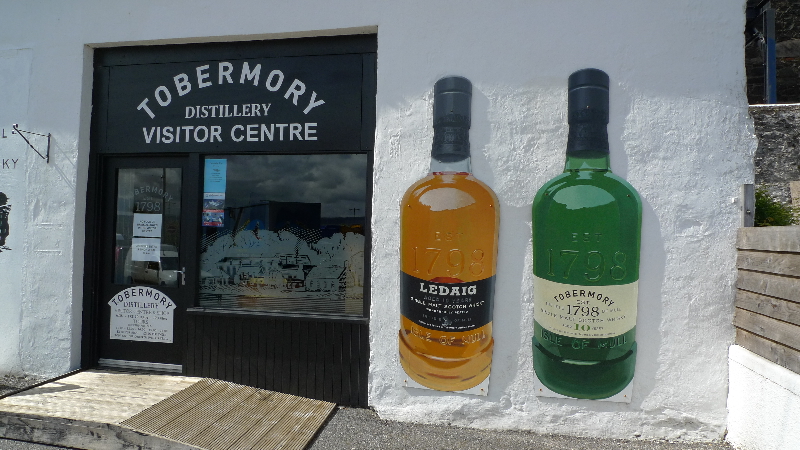
I only planned one full day and two overnights on Mull since it has but one distillery. Now that I’m here, I’ve fallen in love with the island and could easily spend a week here alone. After the traditional full Scottish breakfast, we made our way down to Tobermory distillery for an 11:00 tour. For a brief history of the distillery, see the third paragraph of my G&M Ledaig post.

Right in the heart of town, the distillery is a large triangle of connected buildings with a courtyard in the center. We started with a short video in the little tasting room which is connected to the distillery shop. The first question I asked was if the malt for the Tobermory single malt was slightly peated. The tour guide told me it is not, but the water they use does run through peat and picks up some of its flavor, giving the final product a subtle peat note. She said some can taste it, others don’t pick it up. Nice to know I was on point with the tasting notes I made last night.


As we moved into the distillery, we were again told no photography. Hopefully this trend doesn’t continue. The tours all follow the same basic pattern of grist mill – mash tun – wash backs (fermenters) – stills & spirit safe. But as you go along and ask a few politely prying questions, some interesting details usually emerge. The one that got my attention here was that they run a much longer fermentation for the peated Ledaig than the unpeated Tobermory. The former running close to four days, and the latter going about two days. We also learned that most of the aging is done in former bourbon barrels (I think exclusively for the Ledaig 10yr and the Tobermory 10yr), but the Tobermory 15yr spends 14 years in bourbon barrels, and is then transferred to sherry barrels for one year. (I’m not sure if I was misinformed by the tour guide or simply misunderstood her, but I have since learned that the 15 year is aged exclusively in Oloroso Sherry casks which spend 14 years on the mainland before coming back to Mull for a final year of maturation.)


Toward the end, we learned that in the late 1980’s, the distillery was close to going bankrupt after being mothballed since the mid 1970’s. When it was bought, the new owner had to raise capital to get it going again. They chose to sell of the warehouse building across the street to a real estate developer who turned it into apartments.


The whiskey is now aged in the warehouses of Bunnahabhain, on Islay, who are owned by the same parent company. They do still have a tiny warehouse space on site where we got to see something special. They have several barrels (sherry butts I believe) of Ledaig from 1972 that will be bottled later this year as a 40yr, probably selling for upwards of £1000 a bottle. A few years ago they did a similar release of a 32yr Tobermory, with just 902 bottles released, it sold for about £200 a bottle.

Finally back to the tasting room for a dram, we were given a choice of either 10yr. I went with the Ledaig, a well made heavy hitter of peaty island character. I picked up a miniature to take home, detailed tasting notes to follow.


We spent the afternoon on a long driving tour of the island – glorious tight twisting single track roads surrounded by stunning scenery. I could ride my bicycle here for days on end.


After dinner I opted for a 15yr Tobermory for dessert, and took notes. Rich candied fruit nose, same heavy body as the 10yr, but a little deeper, darker and more richness on the palate, with fruit and spice notes emerging later, and the spice notes eventually taking over on the finish. The finish is slightly delicate compared to the 10yr. It evolves well, showing nice complexity.

After dinner we popped into the Aros Lounge (the pub in a hotel on the waterfront with close to 100 single malts) for a few drinks. No tasting notes as we were enjoying a chat with a few of the locals, but I did try a Tomatin 12yr and an Old Pulteney 12yr.


I had noticed floor to ceiling windows facing the street in the still room during the tour, and was told that they ran a night shift at the distillery, so I went back after dark to get a picture of the stills when they could be seen from the outside. I’m persistent, what can I say?


Scotland, Day 2


After finally getting some of sleep, day two in Scotland seemed a bit more civilized. Following breakfast, we caught the 11:00 tour at the Oban distillery, just a short walk from the B&B we had stayed in. Sadly, they didn’t allow photography anywhere in the distillery, so I only have a picture of the outside of the building and a few inside their shop (which sells some hard to get, high end singles malts from their parent company Diageo).


The tour started off seeming sort of mundane, but as we asked questions along the way, we got some interesting details from the guide. One example is the fact that Oban lets the fermentation process go on for four days, where most other distillers stop it after 2 or three days. This produces a higher alcohol wash (the fermented liquid) of 9.5% abv, where most others are around 8% to 8.5%. They also claim that this longer fermentation time is responsible for the fruity-orange flavor that Oban is known for.


Oban only has two commonly available official bottlings, a 14yr which is aged exclusively in 2nd fill ex-bourbon barrels (meaning they originally held bourbon first, then they were re-used for single malt from another distillery, then they are re-used again for Oban. After that, Oban sells the barrels on to other distilleries to be used once more.) The other is the Distiller’s Edition, which is the 14yr that has been aged an additional 8 months in European oak Sherry casks. At the end of the tour we were taken into the cask filling room where we got a special treat – a sample of 12yr cask strength Oban drawn straight from the barrel. After that we moved on to the tasting room for a dram of the standard 14yr. We were then informed of a special bottling exclusive to the distillery. It was at cask strength with no age statement, but they claimed it was mostly 14yr with some older Oban mixed in, and possibly some variety of cask types. Being a lover of Oban single malt, my father decided to take one of those home, I’m looking forward to trying it.

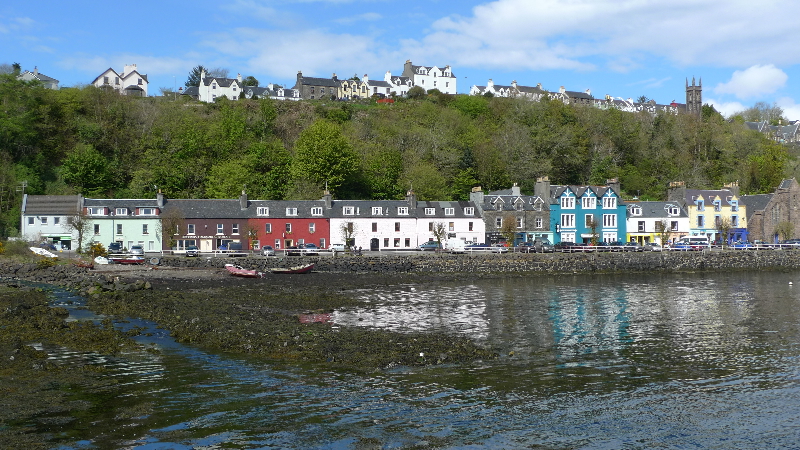
We got in some sightseeing and lunch, then took the Ferry over to the isle of Mull. It was a very scenic ride with nice views of Ben Nevis (the mountain, not the distillery), then we drove across the island to Tobermory (the town, we visit the distillery tomorrow). It’s a stunning drive along the inland coast of the island, in all its rural glory, with a two way single track road, slowly crossed by sheep while you wait.


A spot of dinner to sample to local seafood, then out to the pub for more scotch. I got caught up in conversation with a colorful local character, so not many details on what I drank at Macgochan’s, but I did sample the 15yr Tobermory, a Glen Grant that I never found out the age of, and Glencoe 8yr single malt at cask strength (58% abv). All quite enjoyable, but very different from each other in style.

The single malt collection at Macgonchan’s made the selection at Cuan Mor the night before look unimpressive by comparison. The later had about 34 bottles, with a few being Distiller’s Edition’s and a few others higher up the age scale, but most were the run of the mill flagship offerings from well known distilleries. Macgochan’s on the other hand had upwards of 60 bottles, with several from closed distilleries, many obscure brands, some uncommon variations of well known brands, and a couple of cask strength bottlings. I could drink in there every night for a week and find something I was excited to try every time.

Finally, back to the B&B, which has the wonderful feature of complimentary single malt Scotch, for one last drink before bed. Now I’m sipping on the 10yr Tobermory (un-chillfiltered at 46.3 abv). It’s a little malty (and maybe slightly herbal) on the nose and quite full bodied. It is mild up front, but picks up flavor intensity quickly from the mid palate through the finish. It has a nice mix of malty flavors, mixed with floral notes, but they seem to be on the spicy and of the floral range as opposed to the perfume like floral flavors that I have an aversion to. I get a little more flavor late in the finish, it could be subtle oak notes, or a very minimal peat influence, hard to tell.


Monday, April 23, 2012

Scotland, Day 1


I stretched myself a bit and really made the most of the first day in Scotland after a sleepless night of flying, the highlight of which was a free sample of Ardbeg in London Heathrow during my 3 hour layover. As I marched toward my connecting gate, I was drawn over to the table from 20 ft away by the smell alone, and much to my delight they had a choice of 10yr, Uigeadail or Corryvreckan. “Uigeadail? Yes please. Thank you. I’ll be at the distillery in a few days”.

If you can navigate the tangle of roads in Glasgow, Auchentoshan Distillery is only 15 minutes from the airport. It took me a bit longer, even with GPS. But I got there eventually. As luck would have it, it was open house weekend: free tours all around. I was a bit knackered from the travel, so I think some facts went in one ear and out the other, but it was an interesting and informative tour nonetheless.


The tour ended in a lovely tasting room, with two drams on offer. The first was their flagship Classic (I think the tour guide said the age range in the Classic was typically 7yr to 9yr and it was aged exclusively in bourbon barrels). Auchentoshan is one of only three remaining lowland distillers, and the only one to continue the lowland tradition of triple distillation, so this dram is rather light and easy drinking by nature. Next up was a bottling from their Travel Retail range. The web site descriptions gets right to the point of how these are made, but the airport store shelf talkers made the whole line sound like contrived marketing-speak. I’m glad to report the at least the “Heartwood” version was a worthwhile whisky, with a lot more weight and flavor development than the Classic.


From there we made a slight detour out to the Glengoyne distillery. It is just outside Glasgow, but technically it falls into the area designated as the Highlands. We loitered around the distillery shop trying to decide if we wanted to wait 30 minutes for the next tour. The wonderful women working there poured us a small sample of the flagship 10yr, and after chatting with us for a good bit offered a taste of a special bottling called the Teapot Dram. This special edition of 3105 bottles came from 5 first fill Sherry butts married together (3 9yr American oak, 1 13yr American oak, and 1 14 year European Oak), that was enough to convince me to take the tour – my father opted for a nap in the car this time around.


The tour started in the tasting room, with a proper pour of the 10yr and a short video, then, it proceeded through the distillery. More extensive tasting options were available, but I still had a few hours of driving to do, so I picked up a miniature of the 21yr instead. The 10yr is nice, but its very prominent fruit flavors dominate a little too much for my preference. I think with more age and heavier sherry influence, it becomes a much better balanced whisky. I’m basing this on past tastings of the 17yr, and the lovely Teapot Dram that was bottled at 58.8% abv. I’m kind of regretting not spending the £50 on a bottle. This was another informative tour, during which I learned that many steps are taken throughout production to maximize the spirit’s contact with copper, giving it the strong fruit flavors that are characteristic.


The best part of the day was seeing the still setups and comparing the different methods used by these two distilleries. Auchentoshan gets its light style through triple distillation, and looking at the three stills, the second is smaller than the first. This makes sense, there is less liquid as you move through the process and the alcohol becomes concentrated. It stood to reason that the third still would be smaller yet, but it wasn’t, it was sized between the first and second. I asked the tour guide about this and was told that the third still would be too small, and not as fuel efficient at that size. So they made it bigger and they run two batches through the first two stills and combine them in the upsized third still before it gets fired up.


At Glengoyne they have a very different philosophy. They double distill, but have three stills. All of the liquid runs through the first still, then, it is split into too even smaller batches which are run through two smaller but identical second stills. This is done do increase the ratio of copper surface area to liquid (and gaseous) spirit in the second distillation, adding more of the fruit flavors that they are after.


After a long drive to Oban, we took a nap, went out to dinner and ended with a nightcap at Cuan Mor, a local bar with a respectable single malt collection. The highlight there was the Cragganmore Distiller’s Edition. It started off with a dry malty nose, followed by malt, biscuit and cocoa (all in a dry way) on the palate, and wound up with a smooth, warming finish. None of the floral notes that turn me away from the 12yr bottling were evident.

Sunday, April 22, 2012

And so it begins


It all started simply enough about seven years ago, when I posed the basic question “what’s the difference between bourbon and scotch?” to a group of friends and family. The only attempt at an answer that I got was “bourbon is made by drunk hillbillies in Kentucky and scotch is made by drunk hillbillies in Scotland”, not exactly the level of detail I was looking for.

And that was the beginning. The beginning of my quest for information about, knowledge of, and experience with all things whisk(e)y. I strove to unlock the mysteries of this ubiquitous brown liquid and dissect its inner most secrets. It has been a mission of reading and research, tasting and comparing, conversing with those more knowledgeable than myself, and of outings in search of rare expressions.

But there came a time when even all of that was not enough, I needed more. I needed a sense of place and perspective. I needed to explore the origins, to peer into the inner sanctums of whisky production, and to experience the process first hand. That need has resulted in my quest manifesting itself into an epic journey. As I type this, I’m sitting on a 747, midway over the Atlantic, en-route to Scotland. Ahead of me lays a path of discovery and exploration, and a two week itinerary laden with a full spectrum of whisky related activities. My hope is to write daily, but I may do so less often if is too cumbersome. Join me.