A Sunday night flight out of Boston and a short layover in Reykjavik, Iceland had me land in Glasgow mid to late morning today (Monday). There were some variables in timing after my arrival that I could not control, so I had planned tours at two distilleries that I was curious about, but would be okay if I missed one of them. These were somewhat obscure distilleries that just happened to be on my path of travel.
My plan to reach the Orkney Islands by the weekend meant that I would meander north-ward by about two hours a day. That had me staying in Pitlochry on the day of my journey. This small, quaint village showcases many old, stone buildings which are tightly spaced on narrow roads cut across the hillside that rises up above the River Tummel. Further north lay the mountains of Cairngorm National Park.

If I slept on my flights over it was for less than five minutes, leaving me a little foggy headed for the afternoon. The line to get through customs at the airport was painfully long and slow, and I could feel it eating into my distillery tour time. Once that was through and my luggage had been retrieved, I was met by a kindly rental car agent who gave me a free upgrade after I regaled him with tales of my intended journey.
Left-handed driving requires a bit of an adjustment period and on the highways around the airport isn’t exactly the best place for that to happen. The roundabouts are particularly daunting. Needless to say, I didn’t make great time as I moved north toward my first destination; the Glenturret distillery. I pulled in just after 1:30, which had been my goal, with the assumption that they gave tours regularly on the half hour. I was correct, and they let me join on to a small group a few minutes after their tour began.
This southern Highland distillery is located in Crieff, a little more than half way from Glasgow to Pitlochry. The guide was quite informative and I learned a lot from her, but I’ll follow up with most of that when I taste the 10 year old miniature which I acquired at their shop. The distillery is owned by the Edrington Group, who also owns Highland Park, Glenrothes and Macallan.
Glenturret is company’s least known and least promoted distillery, but it’s the closest to the population centers of Glasgow and Edinburgh. For that reason, it’s not surprising that the company has made it the home of their Famous Grouse blend. While 90% of the distillery’s output goes into the Famous Grouse, the tiny facillity only makes 170,000 liters per year, so it still may not be the blend’s most prominent single malt. Sadly, a company-wide policy prohibits photography inside their distilleries, so images will be lacking here.

The other interesting fact I learned was that Glenturret uses unpeated barley malt for half of the year and moderately peated (9 to 10 ppm) for the rest of the year. Glenturret single malts are only sold at the distillery, online, and in a few specialty stores. We were treated to small samples of their peated bottling as well as their Triple Wood, which is aged in Bourbon barrels, American Oak Sherry casks and European Oak Sherry casks. Both were quite tasty.
By the time I purchased a few miniatures and took a few pictures around the grounds, it was after 3:00. I pushed the little Peugeot 208 pretty hard along the narrow winding road going north, even giving the passenger side tires a hard rub on the curb when some oncoming traffic got a little too close on a tight turn.
But I did get to Blair Athol just in time to catch the last tour of the day at 4:00. This distillery is on the southeast edge of Pitlochry. Owned by Diageo and an adherent to their strict anti-photography policy, images will again be lacking here (in spite of my attempts to make arrangements in advance). Like Glenturret, this is a beautifully picturesque old distillery with a complex of interconnected buildings.

In this case though, production is much higher, at 3 million liters per annum. Only 0.3% of that is bottling as single malt which equates to 10 to12 thousand bottles per year. Most of that is sold in the distillery shop as a 12 year old.. The whisky from Blair Athol is a major contributor to the Bell’s Blend, with 26% of production going to it (and the rest going into other blends). As such, the distillery is the home to the Bell’s brand, though it’s not promoted there to the same extent that Famous Grouse is at Glenturret.
We tasted the 12 year old distillery bottling at the end of the tour. It was quite nice, but I plan to follow up with another sample and more production details in the future.
Once I’d settled into my lodgings, it was time for a much needed meal. I went to The Old Mill Inn in the heart of Pitlochry, at the suggestion of the B&B owner where I was staying. Wanting to jump right into tradition, I went with the haggis stuffed chicken. A wee little pudding (I say that sarcastically) for dessert still left a little room for whisky. The bar had a well rounded selection of about 40 single malts. Most of them were the flagship offerings of the distilleries they represented, but there was a wide array from the nearby Edradour distillery. Close to a dozen of her specialty bottlings lined the shelf.

I started off with a bottling called The Fairy Flag, which was aged for 15 years and bottled at 46%. It was nutty, malty and sherry fruit driven, as you would expect from the house style. Compared to the Flagship 10 year old, which I reviewed here, it was more full and bold, and it was drier with more of a spice driven character. The spice was fairly dominant on the middle of the finish, but very late in the finish a nutty oaky character came to the fore.
I finished with a single cask, sherry butt matured 10 year old which was bottled at 60%. This one was a beast, with big, brash sherry fruit that came crashing down in waves. Somehow, thought, it kept an even keel. I can’t wait to tour the distillery in the morning.
Five years ago, almost to the day, I was mid-way through my inaugural visit to Scotland. On that Sunday I journeyed by car and ferry from Islay to Campbeltown, on the southern tip of the Kintyre peninsula. Now, on this Sunday, I fly from Boston to Glasgow for my long-overdue return to the heartland of Europe’s distilling industry.

Springbank’s Whisky School was the impetus for the original pilgrimage. With one week already occupied, I only had to plan out an itinerary for the other week that I added on to the trip. A stay on Islay was an obvious choice since I’d be driving right past the ferry terminal as I made my way south. Wanting to see something a little off the beaten path (in terms of whisky tourism at least), I soon decided to spend a few nights in Tobermory (with its namesake distillery), on the Isle of Mull. A few distillery tours and a night in Oban on the way there rounded out my plans and then I just had to make a schedule of tours for the days on Islay.
This time around it was a little different; I was starting with a blank slate. The only must-see distilleries for me were Edradour and Glenfarclas. With so many options available and a full two weeks to work with, I found myself in a terrible state of indecisiveness. I considered focusing almost exclusively on Speyside, but I soon realized that even though the area is dense with distilleries, many of them do not offer tours. Feeling the need for some structure to work around, I finally opted to include an island expedition. The general plan was to head north, so all the way to the Orkney Islands I would go.
After that it was just a matter of planning out a route north that would allow me to tour a few distilleries each day while not involving more than a few hours of driving between the overnight stays. Once I got back to the mainland I could camp out in Speyside for several days, then finally head south for one last night closer to the airport.
Countless hours were spent pouring over distillery web sites to find tour schedules, getting drive times from Google maps, reserving appropriate lodging, booking ferry travel and even researching some non-whisky related tourism. It got a bit overwhelming at points, but I think I’ve put together an itinerary that would make Alfred Barnard proud.
My intent is make daily posts on the blog, but not to spend too much time writing. I’m hoping to put up a brief recap of each day; where I went, what I saw and did, and most importantly what I drank, along with a few photos. In the ensuing months I’ll follow up with posts that go into much greater detail. I’ll be visiting distilleries that are very well-known as well as some that keep a much lower profile. I also have a few special tours lined up that I’m really excited about. I hope you’ll follow along.
On the last night I would be staying in Frankfort, Kentucky, I was at Capital Cellars a little beyond their official closing time of 9:00. By the time I made my way over to Serafini it was probably getting close to 9:30, but fortunately they serve food until 10:00. Once I had settled in with dinner and a beer, the server who had originally waited on me let me know that her shift was ending and that she would be passing my care off to the closing bartender.
At some point he struck up a conversation and enquired about where I was visiting from and the nature of my journey. When I mentioned that I was a whiskey tourist he excitedly told me that I should introduce myself to a gentleman who was part of a group of people sitting behind me; he was the second biggest whiskey collector in the county. I was intrigued, but I was also in the middle of making tasting notes for the Old Forester Birthday Bourbon I was sipping on. Not only that, but the group seemed rather large and boisterous and I was feeling semi-introverted, so I decided not to mind the barman’s suggestion.
As time passed, the group dwindled down to the gentleman in question and just a few others. The bartender seemed to know him well and was quite insistent that we meet, finally taking it upon himself to facilitate an introduction. I conceded and made my way over to the high top tables in the bar area. We found common ground with our shared interest in whiskey pretty quickly. The initial conversation was about our respective collections. My Scotch-heavy, 100-plus bottle quiver was admittedly humble compared to the nearly 1000 bottles of mostly American whiskey he had amassed. He was, however, impressed that I still had a mostly full bottle of E. H. Taylor, Warehouse C Tornado Surviving bourbon, and also seemed appreciative of the rare single malt holdings I mentioned; a 33 year Bruichladdich Legacy and an Ardbeg Airigh Nam Beist among them.
His collection had great depth and breadth, even though a very high percentage of it came from the Buffalo Trace distillery. The one that really caught my attention though was an A. H. Hirsch 16 year old (this is the famous bourbon that was distilled in 1974 at the Michter’s Distillery, near Schaefferstown, PA). The best I could do was mention the notable releases that had already come and gone from my collection; the 10, 12, 15 and 20 old Van Winkle bottlings, the Buffalo Trace Experimental Collection Rediscovered Barrels (17, 19 and 21 years old), and each of the Antique Collection expressions.
The conversation eventually meandered over to my home state. He was exited to learn that I was from Vermont, mentioning that he had visited Burlington over the summer as one of his children was looking at UVM as a prospective college. He had actually eaten dinner in the sister restaurant of the one that I work in and had stayed in the hotel it shares a building with. His trip also included a visit to a whiskey bar I’ve sat at more than once, where he and his wife polished off their bottle of Warehouse C Tornado Surviving bourbon.
It was getting late on a Thursday night, and new friend then asked what I was doing for the next couple of days, intimating that an invitation to examine his collection over the weekend was forthcoming. Sadly, I had to inform him that I was leaving for home in the morning. The clock was nearing midnight, but I needed to be patient to see where this might go. He needled me a little more about the possibility of sticking around a bit longer, but there was no way to extend my stay as I really had to show up for work on Saturday afternoon. I’m not one to try to invite myself over to someone’s house, especially someone I hardly know, but given the circumstances it didn’t seem inappropriate to suggest that I was willing to go see the collection that night, as long as that was amenable to him, and more importantly to his wife.
With spousal approval, my plans to get a good night’s sleep prior to the 15 hour drive home were blown apart. They explained that their house was quite a few miles outside of town, along some winding, narrow back roads. I agreed to follow them carefully after fetching my car from the other end of the block, and we were off. Much like Vermont’s capital city, Montpelier, you don’t have to drive very far out of Frankfort before finding yourself on a dirt road that feels like it’s in the middle of nowhere.
We eventually arrived at our destination and I was welcomed into their spacious, modern home. After a few brief pleasantries were exchanged, glassware was retrieved and a bottle of Thomas H. Handy Rye appeared seemingly from nowhere. The label showed it to be at 132.4 proof, indicating that it was from the 2012 release. We sipped on that beast of a whiskey as the conversation continued on.

At some point, the question was posed; “So, do you want to see the collection?” Of course I did! We made our way to the cellar where two tables (each roughly the size of a ping-pong table) were covered with boxes of whiskey bottles, and more were on the floor for a lack of a better place to put them. Some were packaged individually, others in cases of up to 12 bottles. There seemed to be an endless supply of Pappy Van Winkle 15 year and 20 year bottles. I believe every vintage of the Antique Collection was represented as well as every release from Buffalo Trace’s Experimental Collection and Single Oak Project; multiple bottles of many, if not all of them. Bottlings from the Frankfort-based distillery dominated the collection, but there were plenty of rare and special selections from other American distilleries too.
Then came the grand question; “So, what do you want to drink?” Two weeks earlier I had set off in search of whiskey adventure, but never could have imagined myself in this scenario. With so many splendid choices before me, that was no easy decision. It would have to be something I had never had before, and something I was unlikely to have the opportunity to taste again. I pondered briefly before coyly stating “A. H. Hirsch.” My new friend shook his head and said apologetically “I’m sorry, I can’t open that.” I smiled and told him that I had assumed that would be the answer, but I had to ask. “So, what else do you want to drink?” was the follow-up.
I started sliding bottles out of boxes to examine labels and soon gravitated to the short, 375 ml Experimental Collection bottles. I came across the Rediscovered Barrels bottlings, which I had purchased myself back in 2011. Then I pulled a few that had been made with oats and rice in their mash bills and remembered seeing some not-so-great reviews of them. Finally, something caught my eye; the 23 year old Giant French Oak Barrel bottling (at 135 gallons, this is about 2.5 times the size of a typical bourbon barrel). With my host’s approval, we went back up to the kitchen to crack it open.
We discussed how amazing it was that any American distiller was initiating such experiments back in 1989, and I noted that I had seen a recently filled (maybe 2012) barrel of the same size on the first floor of Warehouse C during my tour of Buffalo Trace earlier in the day. After sipping our way through a healthy pour of that whiskey, a mason jar of clear liquid mysteriously appeared on the kitchen counter. This was allegedly white dog from a distillery somewhere in Kentucky, and from a run that will be used for a special bottling at some point in the future. I have doubts as to the legality of such things, so I’ll only say that is was quite delicious (at least as far as un-aged spirit goes) and leave it at that.

The gentleman’s better half had retired to bed by this point, and our conversation drifted on to the Single Oak Project. He opened a cabinet that was filled with different bottlings of it, all arranged in a lattice style rack, and told me to pick one. Not knowing one of these from the next, I had no idea which one to pick. I was pretty sure the one bottle from this series I had at home carried a double digit number, so I picked #171 just to ensure I didn’t taste something I already had. Just for the record, barrel #171 is a wheat based bourbon which was entered into the barrel at 125 proof and aged in a warehouse with wooden floors. The barrel was charred to #4 and its staves were from the top of the tree, course grained and seasoned for 12 months.

Around 2:00 in the morning the cell phone call came from upstairs; it was time for my generous host to go to bed. All too aware that I may have overstayed my welcome, I apologized (the call had somehow gotten onto speaker-phone), thanked her for their kind hospitality and promised to be out the door in the few short minutes that it would take to finish the whiskey in my glass.
The ever-polite man of the house saw me out, and while we were on the front porch he presented the Experimental Collection bottle we had opened earlier, telling me to take the rest of it. Not wanting to take advantage of the kindness of someone who was at least moderately intoxicated, I politely refused. He insisted and I refused again. By the third offer he was pushing it into the open pocket of my jacket and I finally caved. He did have more than one bottle of almost everything in his collection, so at least knowing that made me feel a little better about accepting it. And, of course, I can now make proper tasting notes to go along with this post.
The nose has lots of shoe polish and saddle leather, subtle vanilla and a delicate hint of fragrant spice.
There’s a maple syrup like sweetness up front, which is soon joined by, and eventually surpassed by round, complex spice notes which are warming but not fiery. Teaberry, vanilla and a touch of nuttiness join the fray as well. The oak becomes more prominent late in the finish, but not to the point of being overwhelming.
The spice notes seem to be primarily from the French oak, but with a minor influence from rye grain as well. This is really good and interesting without getting too exotic.

Interestingly, this bottle is labeled as “whiskey” rather than bourbon, even though it is made with one of Buffalo Trace’s bourbon mash bills. The French oak does not disqualify it from that designation, but the barrel entry proof of 130 does.
Thank goodness for modern technology; I only had to touch the saved location of the hotel I was staying at in my GPS and the Garmin’s little purple line guided me safely out of the wilderness.
My departure the next morning was only slightly delayed, but I did have to take a brief detour through the Buffalo Trace Distillery Shop to pick up a bottle of Peychaud’s barrel-aged bitters for a friend. This was a distillery exclusive offering that had been aged in former Sazerac Rye barrels for 140 days and was selling for $17 for a 5 oz bottle.
There was a nice unintended consequence to that little task. If I had left for home from the hotel, the GPS would have put me on I-64 as the quickest route over to I-75. But since I was starting from the north side of town, I was instead led east on US-460, which goes right by the old National Distillers plant at the Forks of Elkhorn. The former home of Old Grand Dad, that facility is now the site of Jim Beam’s bottling operation and finished goods storage, as well as a small number of aging warehouses. It was great to get a little more historical perspective on the way out of town.
stats: Kentucky Straight Bourbon, 14 years old, 59.7%, $125
Yesterday was my birthday and I got into some good whiskey, as one would expect. While I still have one more post left to complete the tale of my adventures in Kentucky last year, I’m going to take a brief diversion and talk about what I drank last night. Rather than fretting over what to open from my collection I decided to step out to the local pub, where I knew there was something special on the shelf. This way I wouldn’t have to cook dinner either.
That something special was a bottle of Four Roses 2016 Limited Edition Single Barrel, also known as Elliott’s Select. In a previous post I detailed information about the Four Roses Limited Edition bottlings (both Single Barrel and Small Batch) from their inception through the 2013 vintage. Initially these were releases of about 2000 bottles. They grew as the years rolled on, with the LE Small Batch getting up over 12,000 bottles in 2013 and the LE Single Barrel reaching 4000 bottles that year, before creeping up to 5000 bottles in 2014.
Then came the news that no one wanted to hear in 2015; the annual Limited Edition Single Barrel releases were being suspended. Four Roses had grown in popularity to the point that there just wasn’t enough extra aged stock on hand to support the Limited Edition bottlings in the volume that had become necessary. The company decided to sacrifice the LE Single Barrel offering to ensure the future of the of the LE Small Batch releases. They did, however, announce that going forward there was the possibility of the Limited Edition Single Barrel product occasionally returning for special commemorative bottlings.
And that was exactly what happened in 2016. After Jim Rutledge retired from his position as the Four Roses Master Distiller (which he had held for more than 20 years) in 2015, he was succeeded by the distillery’s Operations Director, Brent Elliot. The company wanted to introduce their new Master Distiller with a special bottling, and chose to revive the Limited Edition Single Barrel for 2016 in his honor.
Many consumers mistakenly assumed that the LE Single Barrel was back for annual releases after a one year hiatus, but Elliot has reaffirmed that it will not be offered every year going forward. There definitely won’t be a 2017 LE Single Barrel; if there was we certainly would have heard about it by now. Also, the duty of commemorative bottling will fall to the LE Small Batch this year; it will honor Al Young’s 50th anniversary with the company. He has served in many roles during his career at Four Roses, but has been the Brand Ambassador for the last 10 years.

The inaugural Limited Edition Single Barrel was actually introduced in 2007 as a tribute to Jim Rutledge, having reached 40 years of service in the Bourbon industry. That release was of just 1442 bottles, while the 2016 version dedicated to Brent Elliot consisted of 10,224 bottles. Coming from roughly 51 individual barrels, it’s no surprise that the proof ranged from about 100 to 120. All of the bottles carry a 14 year age statement and come from the OESK recipe, which uses the 20% rye mashbill and the spicy yeast. This yeast produces a whiskey which is full bodied, slow aging and with a particular spicy quality distinct from that of rye grain. The particular bottle that I’m sampling is on the high end of the proof range, at 119.4 (59.7%).

The nose is full of dense aromas, but without being sharp or volatile. Notes of vanilla, leather, old books and subtle berry fruit are all layered beautifully together.
On the palate there’s a fruitiness up front that’s quickly overshadowed by a wave of complex spice notes. Traditional rye-based spice character combines with spice that is more floral and minty in nature, while balancing oak notes linger in the background.
The spice notes evolve to become more warming and fiery on the lengthy finish.
It’s big and bold, but surprisingly well-composed and approachable for the given proof.
After a day spent touring Four Roses and Buffalo Trace, as well as visiting the former Old Crow and Old Taylor distillery sites, I was ready for an evening out in Frankfort on the last full day of my vacation. Faced with a 15 hour drive home the next day, the plan was to take it easy and get to bed early that night; just a drink or two at Capital Cellars (where I’d had lunch that afternoon) and some dinner and another whiskey or two at Serafini.
The sun had already set by the time I got back to the hotel from the day’s adventures, and then I went for a swim and spent a bit of time organizing my belongings to facilitate a quick escape in the morning. Needless to say, I got kind of a late start heading out on the town. As I mentioned in my previous post, Capital Cellars has a very laid-back, café-like atmosphere. It’s a nice, quiet place to have a drink, but you don’t really feel like you’re at a bar there, at least not in the traditional sense.
After asking about a few whiskeys that were listed on the menu but not visible on the shelf (they were sold out; I seem to have a knack for picking unavailable items on whiskey lists), I inquired about the Van Winkle Family Reserve 13 year old Rye. It was on the shelf but not the list, so I was curious about the price. My interest was lost at $40 though. Don’t get me wrong, if a bar is going to keep Van Winkle whiskeys around for any length of time, they have to price them steeply. That particular whiskey just wasn’t appealing to me at that price.
I decided to go out on a limb and asked the bartender for a suggestion in the $25 to $30 range from their collection of about 70 bottles. He reached for the 17 year old Wild Turkey Master’s Keep, but was interrupted by the second bartender who felt that there where better whiskies in the same price range. She suggested a Limited Edition Yellowstone bottling, and he deferred. It was a bourbon that was definitely to my liking, but proper tasting notes were never taken as I had become engrossed in conversation with the staff. I’ll take a moment to detail the history of the brand though.

Yellowstone bourbon is named for the national park, and the brand was established shortly after the park was established in 1872. It was originally a product of Taylor & Williams, a wholesale whiskey firm based in Louisville, KY. The whiskey used for Yellowstone was first sourced from several distilleries but the brand grew in popularity and at some point in the 1880’s its production and bottling was contracted out to the Cold Springs distillery in Gethsemane, KY. In 1903 Taylor & Williams merged with the owner of the Cold Springs distillery, J. B. Dant.
The distillery was renamed after its Yellowstone brand and 1910 the company absorbed an adjacent distillery owned by Minor Case Beam. The combined sites continued to operate under the Yellowstone name and members of the Beam and Dant families were involved in its operation until Prohibition.
The brand was re-established by members of the Dant family after Prohibition when they built a new Yellowstone distillery outside of Shively, KY. In 1944 that distillery and the Yellowstone brand were purchased by Glenmore Distillers. By the 1960’s Yellowstone had grown to be the best selling bourbon in Kentucky. Finally, in 1991, Glenmore was purchased by Guinness and the Shively plant was closed. In 1993 the Yellowstone brand was sold to Heaven Hill and the closed distillery was sold to Florida Citrus Distillers, who started using it to produce wine and vinegar. Heaven Hill quickly sold the Yellowstone brand to the David Sherman Corporation.
David Sherman established his company in 1958 but in 2006 it was renamed to Luxco, reflecting a shift in ownership among its founding families. Until recently the company operated exclusively as a non-distiller producer. Their products (both whiskey and other spirits categories) tend to occupy the bottom shelf. Even Ezra Brooks and Rebel Yell, which are their more well-known brands, can barely aspire to the middle shelf. When the company purchased the Yellowstone brand in 1993 they contracted its production out to Heaven Hill, but I have read that whiskies from other sources may be in the mix as well.
Then, at the end of 2014, Luxco announced that they had acquired a 50% stake in the Limestone Branch distillery. The focus of that partnership is to reinvigorate the Yellowstone brand. Brothers Paul and Steve Beam established their Limestone Branch distillery in 2011, in Lebanon, KY. They started with a focus on “moonshine” style products, with a vision to expand and add properly aged whiskeys in the future.
The Beam brothers are descendents of Minor Case Beam on their father’s side and the Dant family on their mother’s side. One of their uncles actually had a copy of the original Yellowstone bourbon recipe. Teaming up with Luxco allowed them to quickly expand their operation and since 2015 they have been distilling whiskey for the Yellowstone brand using its original recipe.
It’s likely that the low-quality incarnation of Yellowstone that has long been sold by Luxco will be eliminated when the new version comes of age. In the meantime some transitional bottlings of Yellowstone have come out using better quality sourced whiskey selected by the Beam brothers. What I tasted at Capital Cellars was the first of those; the 2015 Limited Edition bottling. It’s a 105 proof bourbon, priced at $105 a bottle, which commemorates the 105th anniversary of Minor Case Beam selling his distillery to J. B. Dant. 6000 bottles were produced and the end result is a marriage of 12 year old rye-based bourbon, 7 year old rye-based bourbon and 7 year old wheat-based bourbon.
Later in 2015 they introduced Yellowstone Select; a bourbon priced at $50 a bottle, which is a marriage of barrels aged for 4 years and 7 years. Luxco is also currently constructing a $35 million distillery in Bardstown, which should go into production late in 2017 and will be the new home of their Rebel Yell and Ezra Brooks brands, among others.
Feeling pangs of hunger before I was ready to depart from Capital Cellars, I asked about ordering an appetizer. It was a good bit after the 8:00 cutoff for ordering food, but the staff was kind enough to put together a Smoked Salmon Carpaccio plate for me. After my snack I was ready to wander down to the other end of the block for the main course.
Serafini is an upscale establishment with an Italian influenced menu. White table linens in the dining room bring an air of fine dining, but the bar area has a more casual feel. The bar itself is small, with only four or five stools, but it’s backed up by several high-top tables. The back-bar is densely packed with bottles, featuring upwards of 150 selections of American whiskey.
I’m not usually one for pairing whiskey and food, so I had a local beer with the baked salmon, which was quite good. After studying the list and inquiring about a few unavailable whiskeys (again) I finally settled on a glass of 2015 Old Forester Birthday Bourbon, which was a 12 year old bottled at 100 proof. I wrote pretty extensively about the background of the Birthday Bourbon series in this post, if you’re curious.

The 2015 vintage has big aromas, featuring ample leather and oak. The nose is sort of hot, in a volatile sense. It punches above its weight, bringing plenty of flavor and heat for its given proof. Dark and brooding on the palate, it’s quite dry with lots of fiery spice notes and struggles to stay in balance. Further contemplation reveals more complexity with hints of mint, charred oak, cinnamon, teaberry and subtle dry, dark berry fruit all emerging before it gets through the long, warming finish.
Now, one would think that would have been the end of my little whiskey adventure; but the real adventure was only about to begin…………
As noted in my previous post, dinner on the first night my stay Frankfort, KY left a little to be desired. When I got back to the hotel room I went online and started researching to see if I could find a better option for lunch the next day, and maybe even an impressive dinner for the last night of my two week vacation.
The search quickly led me to the straightbourbon.com discussion forum. I soon learned that Lexington, which is only 25 miles from Frankfort and has a much bigger population, tends to suck all of the oxygen out of the state’s capital city, at least in terms of nightlife and restaurant choices. One commenter mentioned that Frankfort has lots of dining options, all of which are chain restaurants; not really my cup of tea. Two names did come to my attention though, Capital Cellars and Serafini. It appeared that they were both well regarded for their food as well as their whiskey collections.
As I checked into the details of each establishment, I realized that Capital Cellars also offers retail liquor sales, which are focused primarily on American whiskey. Due to the time constraints of my visit to Kentucky, I had only planned on buying bottles from distillery shops rather than putting in the extra effort of hunting down stores where I could potentially find something special. A lunch spot that included a whiskey bar and retail sales was the perfect time saver.
My revised game plan for the day was to check out Capital Cellars between the morning tour at Four Roses and the afternoon tour at Buffalo Trace. Serafini would be my dinner destination, but if I liked what I saw behind the bar while having lunch, I could revisit Capital Cellars for a drink before dinner. The two businesses are a short walk from each other, located at opposite ends of the same block on West Broadway St. in Frankfort’s historic downtown.
After spending a good bit of time outside on a relatively cold winter morning during the Four Roses tour, I was ready to warm up with lunch. I sat at the bar at Capital Cellars and started to order tea when I realized that I was in the south and would need to specify that I wanted my tea to be hot and not sweet.
The space has a café-like feel. It’s quite casual, with a friendly staff and a menu that is simple but appealing. The whiskey collection lines the back bar and the bottles for retail sale against the same wall but to the left of the bar. Tables for dining are in an adjacent room with windows facing the street and another room behind that one houses a respectable selection of craft beer and wine.

I passed on having a bourbon with lunch since I was tasting samples on the tours, but the Virginia Baked Ham sandwich was just what I needed. As I ate, I saw enough interesting bottles behind the bar that I decided I would come back for a beverage in the evening. Once I was done eating, I wandered around the store for a bit, checking everything out before I honed in on the retail whiskey section.
One of the great misconceptions of many whiskey tourists visiting Kentucky for the first time is that they will find an abundance of limited, special release bottlings on local store shelves. Hard to find items like Old Forester Birthday Bourbon, anything Van Winkle, the Buffalo Trace Antique Collection and Four Roses Limited Edition (Small Batch and Single Barrel) are on allocation in Kentucky just like they are in every other state. If anything, those bottlings are even harder to get in their home state because a higher percentage of the population is aware of them and on the hunt.
So, what should one be on the lookout for when passing through the Bluegrass State? Worthwhile targets are solid performing, mid-shelf bottlings that offer strong value and aren’t widely distributed outside of Kentucky. Unfortunately, a few prime examples of this category were discontinued long enough before my visit that they had completely disappeared. Ancient Ancient Age 10 Year (not to be confused with AAA 10 Star) from Buffalo Trace went out of production toward the end of 2013 and Heaven Hill’s Very Special Old Fitzgerald was eliminated about a year later.
While I did see a few interesting looking labels at Capital Cellars, they were bottlings I wasn’t familiar with and high enough up the price scale that I wasn’t going to pull the trigger on any of them without having done some research. But I did find two bottles that fit my above noted criteria; Heaven Hill White Label, a bottled-in-bond, 6 year old bourbon, and Very Old Barton bottled-in-bond bourbon from Sazerac’s Barton 1792 distillery.
The VOB once carried a 6 year age statement, but that was dropped a few years ago. Unfortunately the “6” was left on the neck label while the words “aged” and “years” disappeared, which is quite disingenuous. Anyway, let’s see how they taste.
Very Old Barton, bottled in bond, non-age stated, 100 proof, $14:
The aromas a densely packed and well integrated. I’m getting lots of clay and saddle leather, with a hint of caramel balanced by dry, earthy notes. Some pretty assertive spice character jump right out on the palate entry. Everything stays pretty dry throughout, with pencil shavings and nuttiness playing off of a complex range of spice notes. It does go a little out of balance as it moves into the finish, with an odd bit of minerality coming to the fore (this seemed more offensive on the first sip, but was less obvious as I proceeded).

Heaven Hill, White Label, bottled in bond, 6 years old, 100 proof, $12:
The nose is more subdued than that of the Barton, but it shares a relatively dry profile. A little more oak comes through on the aromatics, and there’s a subtle mineral character which is similar to George Dickel #12. The flavor profile is definitely less spice-driven up front. Leathery oak notes are interlaced with subtle hints of pine and tobacco.
It does turn a little astringent on the mid-palate, but redemption comes when warming spice notes emerge to keep it lively on the finish.
Are there better whiskeys out there? Absolutely; but these are both interesting and perform respectably for their given price range.
When I planned out my travel itinerary through Tennessee and Kentucky last year, I was mostly focused on coordinating the available distillery tours that I wanted to take and calculating drive times so everything would proceed smoothly. The only meal I had considered in advance was lunch on the Thursday I would spend in and around Frankfort. I’m not much of a breakfast person, and with limited window of time between the 10:00 tour at Four Roses and the 1:30 tour at Buffalo Trace I wanted to make sure I knew where that meal was coming from. I could figure out where to have dinner on Wednesday night and Thursday night at my leisure.
A very cursory online search turned up a place called Bourbon on Main which sounded promising and was penciled in to my schedule for that day. The day before, I started with the first tour of the morning at George Dickel. Despite their website listing it with a 9:00 start time, the tour didn’t get underway until 9:30. By the time I finished the post-tour tasting it was 11:00 and I was losing an hour to a time zone change on the ensuing drive to Kentucky, effectively making it noon.
Google maps put the drive to Maker’s Mark at a little over three and a half hours, but the run from Interstate 24 to Interstate 65 goes right through the heart of Nashville, so I was concerned about the potential for traffic. With the last tour at Maker’s starting at 3:30, I was going to have to skip lunch if I would have any chance of getting there on time (I ended up making it with about 20 minutes to spare).
Needless to say, by the time I had checked into my hotel after finishing the tour in Loretto and making the hour-plus drive to Frankfort, I was starving. No time for research; I was off to Bourbon on Main for dinner.
Frankfort can feel like a bit of a ghost town if you’re driving through on a weeknight in February, so I was a little surprised to see a lively atmosphere when I walked into the two story brick building housing Bourbon on Main. I later learned that BOM had only been open for about six months, having taken over the space previously occupied by a different restaurant. The room on the second floor can be used for private events or additional seating on busier nights. There was actually a Four Roses bourbon dinner, hosted by the master distiller, happening upstairs that night. The event was already underway and sold out when I arrived, but that’s the sort of thing I would check for in advance if I was going to be back in the area.
The building sits on the bank of the Kentucky River, which bisects Frankfort. The back deck seems to be one of the prominent features of this business; it overlooks the river and has views of the state Capitol building, which is less than a mile away. This was obviously not in use in the middle of winter though. The bar is on the smaller side, with five or six stools, but a few of them were free when I walked in, giving me my preference of seating.
I was quite happy to get a burger in my belly, but the food left a little to be desired. I wouldn’t say it was bad by any means, just uninspiring. I also got the impression that the kitchen was undersized relative to the rest of the space and it was hard for them to get food out in a timely fashion if the upstairs was full of diners or the back deck was in season on a busy night.
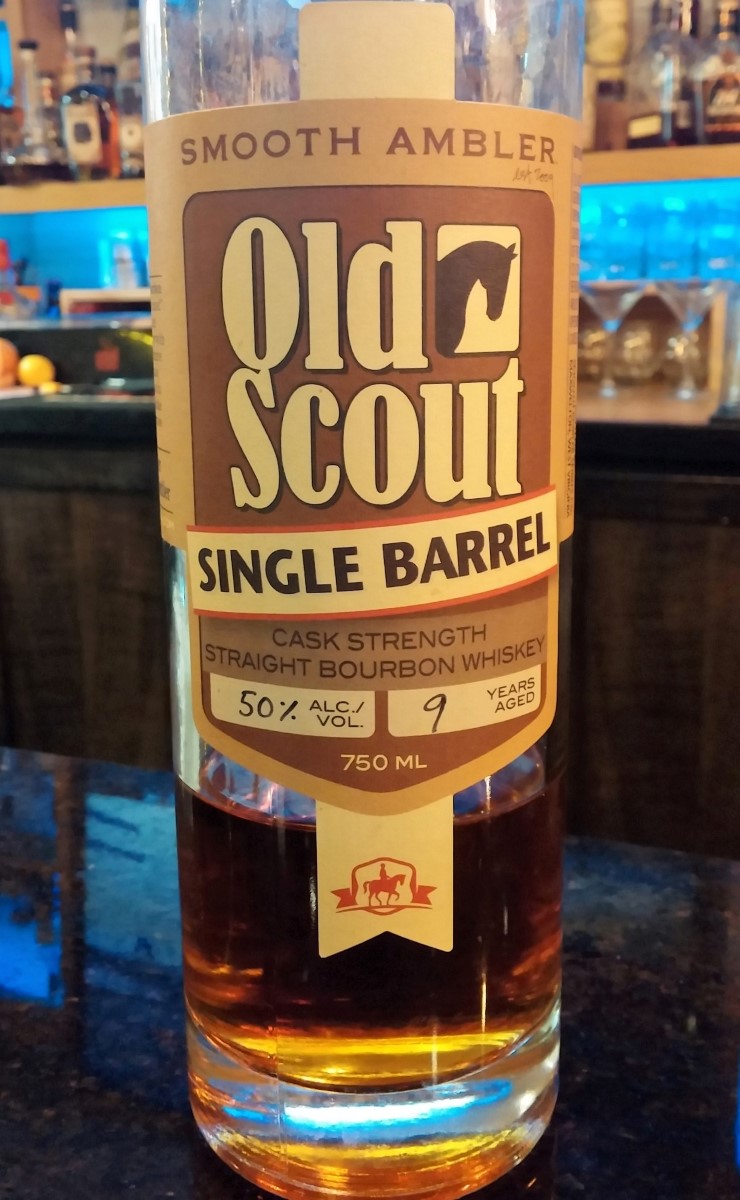
I sampled a few local beers before and during dinner, and then moved on to the whiskey in lieu of dessert. The list of American whiskeys on their website currently shows slightly more than 100 selections. I feel like that has probably grown since my visit last year, when I’m guessing they had closer to 70 offerings. I decided to try out the Old Scout Single Barrel, Cask Strength Bourbon.

This is from Smooth Ambler, which is a craft distillery located in West Virginia that was established in 2009. In addition to what they distill themselves, Smooth Ambler also bottles sourced whiskeys. But they are very transparent about what they do and keep all of the whiskey they don’t distill themselves under the Old Scout label. Most, if not all of these come from the MGPI distillery in Indiana. The Single Barrel, Cask Strength bottling is an older and stronger version of their standard Old Scout Straight Bourbon, which is aged a minimum of 7 years and bottled at 99 proof. Both are non-chill filtered and come from a mashbill of 60% corn, 36% rye and 4% malted barley.

This particular Single Barrel, Cask Strength bottling was aged 9 years and came in at 100 proof. It was big and full flavored (but not too hot or punchy), with a rich and dark character showcasing saddle leather and abundant spice notes. The long, spice-driven finish carried balancing oak notes and a subtle, dark baked fruit character. A solid performer.
With last winter’s road trip, which included a few days of whiskey tourism in Tennessee and Kentucky, having transpired more than a year ago, I think it’s high time that I write the last few posts necessary to tie up all of the loose ends associated with that little adventure. Then I can move on to more pressing business.
As I mentioned toward the end of my post covering the visit to Buffalo Trace, my tour guide, Shelly, informed me that I would see very little on the Trace Tour that I hadn’t already seen on the Hard Hat Tour (she had extended our tour a good bit since it wasn’t a busy day, covering most of what would normally be seen on both tours). Rather than hanging around for the 4:00 Trace Tour, she suggested that I take a little drive and visit the sites of the former Old Taylor and Old Crow distilleries, which are essentially right next to each other. She also let me know that given my interest in the history of the industry, I’d probably get a lot out of the Buffalo Trace National Historic Landmark Tour, which is offered Monday through Friday at 11:30, should I come back to visit in the future.
Shelly gave me easy-to-follow directions to get to the defunct distilleries from the hotel I was staying at, which was much better than taking the slightly more direct but much more confusing route there from Buffalo Trace. With just two days set aside for touring distilleries on my two week road trip, I hadn’t even considered trying to visit any historic former distilling sites, assuming that it would just be too tough to fit that into my itinerary. I had no idea some of the prime examples were less than four miles from the hotel I’d picked for my two nights in Frankfort.
When I reached the T-intersection where I would turn right and drive just a little further to reach my destination, there were signs pointing to the Woodford Reserve distillery if I turned left instead. It was less than three miles down the road.
The three distilleries all lie in Woodford County on Glenns Creek, a tributary of the Kentucky River. Their histories are interrelated, so I’ll go over all three here. A key figure in this story is Colonel Edmund Haynes Taylor Jr.
E. H. Taylor started in banking in the early 1850’s, establishing his career in the business of his adoptive uncle. He got into the whiskey industry about a decade later, but from the position of a financier and business manager, rather than that of a practical distiller. He soon transitioned out of banking and eventually went into local politics during the 1870’s, but continued on with his whiskey industry interests. Taylor was involved in at least seven different distilleries during his lifetime.
Where Woodford Reserve stands today was once the site of the Old Oscar Pepper distillery. I covered the history of distilling there in my Woodford Reserve, Distiller’s Select post, but I’ve since discovered some new historical sources, so I’ll go over everything again with the updated information. On some points there are still conflicting sources, so what I’ve cobbled together here is the most likely course of events (in my opinion) based on all of the information I’ve found.
Whiskey was first distilled there by Elijah Pepper in 1812 when he established his farm-distillery on the 350 acre property. Pepper’s first foray into distilling was in 1780, when he was living in Virginia. He migrated to Kentucky in 1797 and operated a farm-distillery in Versailles with his brother-in-law for several years. That was about five miles away from the site he established as his own on the Grassy Springs Branch of Glenns Creek in 1812.
Elijah Pepper passed away in 1831 and his son, Oscar Pepper, took over the operation. The distillery was expanded in 1838 with the addition of a new stone still house, among other improvements. This was likely the year in which it took on the Old Oscar Pepper Distillery name. When he passed away in 1865, Oscar Pepper left no will. This is where the history gets a little convoluted. Many accounts assume a five year hiatus in production after Oscar Pepper’s death. But I’ve come across some pretty convincing evidence that Pepper’s oldest son, James Edwards Pepper, assumed control of the distillery in 1865 and continued to oversee the operation through 1866. He had only turned 15 about a month before his father’s passing, but was already well versed in his knowledge of the distilling business.
Colonel E. H. Taylor had been appointed as James Pepper’s legal guardian after Pepper lost his father while still a minor. I suspect that Taylor immediately had some influence at the distillery. In 1867 the Old Oscar Pepper Distillery was leased to Gaines, Berry & Co. This group, which invested in various distilling projects, was organized by Taylor in 1862. Gaines. Berry & Co. was reorganized into W. A. Gaines & Co. in 1868 when several new investors were brought into the group.
The courts finally settled the estate of Oscar Pepper in 1869. The property was divided equally among his seven children, but the portion with the distillery and all of the other business assets was left to the youngest son, Presley O’Bannon Pepper, who was only seven years old. This effectively left Oscar Pepper’s widow in charge of everything. She signed an agreement to lease the distillery out to W. A. Gaines & Co. for another two years on January 1st of 1870. Later in that year Colonel Taylor withdrew from W. A. Gaines & Co. In the 1870 census James Pepper was still listed as the distillery manager, so he was likely involved in its operation all along.
Toward the end of 1872 James Pepper won a lawsuit against his mother and regained full control of the distillery. In 1874 he entered into an agreement with Taylor, where Taylor invested capital for major improvements at the distillery. When Pepper declared bankruptcy in 1877 he lost the distillery property to Taylor. Shortly thereafter Taylor experienced his own bankruptcy, leaving the distillery in the hands of George T. Stagg, who had paid off Taylor’s creditors for pennies on the dollar. By the end of 1878 Stagg had sold the distillery on to James Graham, who then partnered with Leopold Labrot. They changed the name slightly to Labrot & Graham’s Old Oscar Pepper Distillery, but eventually (likely when emerging from Prohibition) it was shortened to the Labrot & Graham Distillery.
Finally, in 1940 the distillery was sold to Brown-Forman who used it to produce bourbon for their Early Times brand. They closed the distillery in 1957 and sold off the property in 1973. Brown-Forman re-purchased the site in 1994 and using the original 1838 still house as well as a pair of stone warehouses that date to the 1890’s, they built the distillery that is now known as Woodford Reserve.
Following McCracken Pike, the road which runs alongside Glenns Creek, to the north for 3.3 miles from Woodford Reserve will bring you to the former Old Taylor distillery. The site was originally home to the Johnson farm and distillery; it was also referred to as the Old Anderson Johnson distillery and later the James C. Johnson distillery (I’m assuming that James was Anderson’s son). Its date of establishment is unknown, but it was definitely in operation by the 1830’s and may have started as early as 1816.
The distillery was purchased by Jacob Swigert Taylor in 1879 and its name was changed to the J. Swigert Taylor distillery. E. H. Taylor bought the distillery from his oldest son in 1882, but Jacob continued to run the operation and its name remained the same.
After E. H. Taylor’s 1877 bankruptcy he had stayed involved in the O.F.C. distillery (which he had previously owned, and is now Buffalo Trace) in Frankfort, in partnership with George T. Stagg. But Taylor eventually had a falling out with Stagg and they parted ways at the start of 1887. Colonel Taylor formed a new partnership with two of his sons (Jacob Swigert and Kenner; his youngest son, Edmund Watson joined them at a later date) and they renamed their distillery Old Taylor.
Many accounts of the history of this site assume that a new distillery was built there in 1879 and again in 1887. None of the buildings that exist today were built before 1887 and any details of the evolution of the site prior to that year are speculative. More recent research has shown that the distillery was rebuilt and expanded over a period of many years after 1887, but primarily between 1900 and 1912. This was E. H. Taylor’s last distillery project; what he built there was to serve as an impressive tourist attraction as well as being a tribute to his namesake brand of whiskey.

The still house is the most iconic building on the property. Taking the form of a medieval castle, its limestone construction features corner turrets and crenellated battlements. This building’s construction lasted from 1901 to 1907. A small octagonal spring house and the larger, peristyle spring house are both architecturally significant. Just north of the castle is the Sunken Garden, which is one of the site’s most spectacular features. Warehouse B, which dates to 1912, is at the far north end of the property. At 68 feet by 530 feet, it is supposedly the longest brick masonry warehouse constructed in the world during that era.


The distillery operated up until Prohibition, and then it was acquired by American Medicinal Spirits in 1927 and used as a concentration warehouse. AMS was taken over by National Distillers in 1935, just after the end of Prohibition. Old Taylor quickly came back online and went through a period of expansion and modernization with several new buildings being added between 1935 and 1940. The largest of these is Warehouse E, which sits between the creek and the Sunken Garden.


Once production ceased in 1972 as the industry entered a major downturn, the property was neglected and gradually fell into a state of disrepair. National Distillers was acquired by Jim Beam in 1987, but they bough National primarily for the brands it owned and nothing was done with the Old Taylor property. Beam sold off the site in 1994 and the next owners wanted to bring distilling back there, but lacked the financial resources to do so. The site sold again after 10 years and unfortunately Warehouse C and Warehouse D were torn down in 2005 so the brick and wood could be sold off. Their outlines can clearly be seen in overhead views, lying across the street from the Sunken Garden and the Historic Bottling House. Also visible are the ruins of Warehouse A, which was next to Warehouse B and dated to 1910.

Finally, in 2014, the distillery was sold to someone who was interested in its preservation and in resuming distilling at the site. The Sunken Garden was brought back to life and restoration work on some of the buildings had begun at the time of my visit. No one was there while I was poking around, so all of the pictures I took were from the road. It is currently running as the Castle and Key distillery, but I’ve read that they are negotiating with Buffalo Trace for the rights to the Old Taylor name.

Before I cover the third distillery on Glenns Creek, let’s take a look at the man that connects them all. Dr. James Crow was born in Scotland in 1789. He trained as a physician and chemist in Edinburgh, graduating in 1822 and immigrating to the United States in 1823. Initially settling in Philadelphia, he followed the westward migration to Kentucky in 1825.
Crow was hired to run the farm distillery of Willis Field in 1826. This was on Griers Creek, about three miles west of Versailles. James Crow revolutionized distilling by applying scientific methods to whiskey making. He is often credited with inventing the sour mash method, but it is more likely that he was able to fully understand how it worked and improved the process by using litmus paper to measure the acidity of the mash. He was also one of the first distillers to use the thermometer, hydrometer and saccharometer. He would only make a certain amount of spirit from a bushel of grain, indicating a narrow cut of the spirit run, and he insisted on barrel aging for all of his whiskey at a time when that was not always done. Perhaps influenced by his medical background, he also took great care to ensure the hygiene of his distilling equipment.
Crow made a superior product very consistently and his reputation quickly spread. In 1833 he was hired as Oscar Pepper’s distillery master, moving five miles north of his previous employer. He worked there until 1855, with the exception of 1837 and 1838. That hiatus was likely due to the rebuilding and expansion of Oscar Pepper’s distillery which happened during that time. Crow found work at the nearby distillery of Newton Henry to fill that gap. Finally, Dr. Crow went to work at the Johnson distillery, located a few miles further north on Glenns Creek, in 1956. He died while on the job at that distillery later the same year. As detailed above, that site eventually became the home of the Old Taylor distillery.
We don’t know exactly when whiskey began to be sold under the Old Crow brand. But we do know that when James Crow worked for Oscar Pepper, his compensation was 1/8 of the whiskey produced (in 1855 this was 10 barrels of the 80 barrel total). It’s likely that Dr. Crow sold this whiskey as his own and associated it with his name from an early date. His reputation was such that it wouldn’t surprise me if Oscar Pepper also sold some of the whiskey produced at his distillery under the Old Crow brand in addition to using his own Old Oscar Pepper label.
We also know that in 1849 Robert Letcher, a former Kentucky Governor, wrote a letter to a friend where he praised the qualities of Old Crow whiskey, so it was certainly well-known as a brand by that point.
When James Crow died in 1856, his long-time assistant, William Mitchell, was still working at the Old Oscar Pepper distillery. Mitchell was quite familiar with Crow’s recipe and methods for making whiskey. Since Pepper still had aging stocks produced by Crow and the ability to make more whiskey to the same standards, it made sense for him to continue using the Old Crow brand name. This was one of the earliest instances of brand name marketing in the U.S., a practice that was mostly pioneered by the soap industry.
When the Old Oscar Pepper distillery was leased out in 1867 to Gaines, Berry & Co. (which became W. A. Gaines & Co. in 1868), Mitchell was retained as the distiller and the company continued to use the Old Crow brand. When James Pepper regained control of the family distillery in 1872, W. A. Gaines & Co. took the Old Crow brand as their own. I’m not sure if they paid the Pepper family for the rights to the name or if they simply assumed its ownership after using it for the five years during which they leased the Pepper distillery.
The distillery owned by W. A. Gaines and located on Glenns Creek, just north of Old Taylor then became the home of Old Crow. This is where the history gets really confusing. Depending on where you look, dates for the establishment of that distillery are listed as 1872, 1878 and 1882. After way too much research, I think I’ve figured out the most likely scenario.

The above mentioned distillery was probably built in 1868 by Gaines, Berry & Co. as the Hermitage distillery (this was their other major brand). William Mitchell is reported to have left W. A. Gaines & Co. in 1872. I believe he stayed loyal to the Pepper family and continuing to work for James when he regained control of the Pepper distillery. At the same time, Van Johnson, Mitchell’s assistant of several years, was hired by Gaines to take over as their head distiller. With his knowledge of Dr. Crow’s techniques and recipe, it was possible to shift production of Old Crow whiskey to the Hermitage distillery in 1872 (hence the first mistaken date of that distillery’s establishment).

It seems that at some point Gaines, Berry & Co. bought another distillery, one which had existed since at least 1871 (it can be seen on maps from that year), and moved the Hermitage name there. That distillery was located on the Kentucky River in the southern part Frankfort. It was turned into a chair factory during Prohibition before being torn down in 1945. Any modern traces of it have been lost to urban sprawl. At the same time the original Hermitage distillery would have been renamed as the Old Crow distillery. I’m guessing that this happened in 1878, as it would explain the second mistaken date of the establishment of the distillery on Glenns Creek.
In1882 Gaines, Berry & Co. registered trademark for “Old Crow Distillery, Woodford County, Kentucky. Copper Distilled Whiskey. W. A. Gaines, Distiller” (Congress had just passed a new trademark act in 1881). This is likely the origin of the third incorrect date of establishment of the Old Crow distillery. In 1887 W. A. Gaines & Co incorporated under the same name (having been a co-partnership previously). This can also add to the confusion of the company timeline.
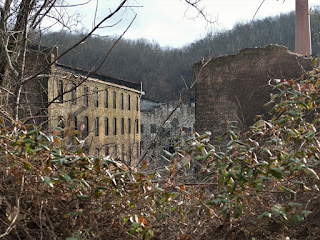

During Prohibition Old Crow, like Old Taylor, was absorbed by the American Medicinal Spirits Company, which then became part of National Distillers. National reopened the Old Crow distillery shortly after the end of Prohibition and even refurbished and expanded it in the 1960’s. Unfortunately they screwed up the recipe, getting the backset ratio wrong when they modernized the distillery. The whiskey didn’t taste right and the brand lost much of its following. The problem was finally corrected in the 1980’s but just a few years later, in 1987, National was bought by Jim Beam and they immediately closed the plant. The Old Crow brand lives on but in the form of low-quality, minimally aged Beam distillate.

Beam continues to use seven of the warehouses for barrel aging; they are the more modern ones on the south end of the site. A few of them were even refurbished a few years ago. The rest of the distillery site was left to deteriorate through the years. Finally, at the end of 2013, Beam sold off the portion of the property that they weren’t using for warehousing. The new owners have set up a small scale distillery in the former bottling hall and are operating as Glenns Creek Distilling. They are making attempts to preserve and restore the remaining buildings as time and finances allow.


At the time of my visit there was some activity on the site, but it didn’t really look like it was open to the public, so again, all of my photos were taken from the road. As the daylight began to fade I drove down to Woodford Reserve. It was after 5:00 so the gate was closed and you can’t see too much from the road. I’m looking forward to returning to the area so I can tour all three distilleries now that I understand their interrelated histories.