1792 Ridgemont Reserve, Kentucky Straight Bourbon, 46.85%, $30
The nose shows fruit and grain with soft spice notes. It’s more robust on the palate than I remember (I originally tasted this bourbon about eight years ago, but this is the first time I’ve revisited it recently). There’s some sweetness on the palate mingled with rye spice. It comes across relatively bold, but remains well integrated.
It’s no secret that 1792 Ridgemont Reserve is a Sazerac product. The Sazerac Company owns the Buffalo Trace distillery and bottles the whiskey made there under so many different brands that many people forget (or just don’t realize) that they actually own a couple of other distilleries as well. One of them is A. Smith Bowman, a micro-distillery located in Virginia, and the other is the Barton 1792 Distillery, of Bardstown, Kentucky. The later produces Ridgemont Reserve bourbon.
The distillery dates back to before Prohibition and sits on the grounds of several historic distilleries. Like many of the early American whiskey distilleries / brands, it has a long and convoluted history. All of the details are too complex to go into here, but it was known as the Tom Moore distillery up until a change of ownership in 1944, when the name was changed to Barton. The company that owned the distillery eventually became known as Barton Brands (as the company grew, it acquired several other whiskey brands along the way, as well as changing owners several times), and in 2008 they changed the name of the distillery back to Tom Moore in a historical tip of the hat. A year later, Barton Brands, along with their distillery, was purchased by Sazerac (owners of the Buffalo Trace distillery since 1992). Sazerac promptly changed the name of the distillery back to Barton, although I’m not sure when the 1792 was added into the distillery name.
The likely reason for the distillery not being too well known is because for most of its history it only produced smaller, regionally distributed bourbon and rye brands; not to mention the confusing series of ownership and name changes that the distillery went through. One of the distillery’s better known brands, Very Old Barton, was only distributed in Kentucky for many years. Sazerac has increased distribution of VOB, but it’s still only available regionally.
In 2002, Barton Brands introduced Ridgemont Reserve bourbon nationally as a premium brand, selling at a higher price point than any of the distillery’s other offerings. But it started off with a different name; Ridgewood Reserve 1792. Brown-Forman sued Barton, claiming that the name was too close to that of their Woodford Reserve bourbon. Brown-Forman won, and the name of the new bourbon was soon changed to 1792 Ridgemont Reserve. The name contains 1792 as a reference to the year in which Kentucky gained statehood.
Ridgemont Reserve bottles carried an 8 year age statement up until December of 2013. The Sazerac website and the Ridgemont Reserve website both still claim that the bourbon is aged at least 8 years, but that doesn’t really mean anything; it only has to be at least that old if it says so on the bottle. The Ridgemont website states that all of the barrels for this bourbon are housed in Warehouse Z, one of many spread across the distillery’s sprawling property. It sits on a bluff, receiving full sun all summer and is said to have optimal aging conditions.
The other feature of this bourbon is its mash bill, which is somewhat of a mystery. Their website claims that it has a higher percentage of rye than most, but the company won’t reveal the proportions. The Very Old Barton mash bill is known to be 15% rye (75% corn, 10% malted barley). That’s pretty middle-of-the-road for rye content in a bourbon. Most of the known mash bills have a rye percentage in the 11% to 18 % range. The two mash bills used by Four Roses have 20% rye and 35% rye. I’m guessing that two different bourbon mash bills are produced at Barton, the known one for VOB and a higher rye recipe for Ridgemont.
Recalling my impression of this bourbon eight years ago and comparing that to how it tastes now, I can only wonder if it started off being made from the VOB mash bill and was gradually transitioned over to a higher rye mash bill. Such a change would taken time; vatting the two together in varying percentages across several years.
Templeton Rye, Straight Rye, 40%, $37
The nose has slightly sweet fruit aromas and gentle, flowery rye spice notes. On the palate the warm, lingering rye spiciness carries through to the finish with just a hint of sweetness. I found this whiskey to be soft in all aspects except the rye spice. And that spice character is more pervasive than aggressive, resulting in a whiskey that is approachable, albeit with a bit of an edge.
When it comes to catching heat for trying to make someone else’s whiskey look like one’s own, Templeton Rye is probably one of the most well known examples. They’ve been very successful at marketing their product, first in Iowa and shortly thereafter in Chicago; the first major market they entered. That caught the attention, and ire of Chicago based whiskey writer Chuck Cowdery.
First, the story on which Templeton Rye’s successful marking strategy is predicated. The small Iowa town of the same name had a reputation for producing illicit rye whiskey of a very high caliber during Prohibition. The whiskey was eventually nicknamed “the good stuff” and supposedly brought to bigger markets by Al Capone. They even say it was his personal favorite and he had some smuggled into Alcatraz. The tradition of bootleg whiskey continued on in Templeton after Prohibition, and some say it still goes on today.
Scott Bush started Templeton Rye in 2005 to produce a legal version of Templeton’s historic whiskey, which his great grandfather had supposedly once distilled. Bush brought on Keith Kerkhoff as a partner in the business to gain access to his family’s whisky recipe, which had been passed down from Kerkhoff’s grandfather, a prolific Prohibition era distiller.
When they first started selling Templeton Rye, every bit of their marketing material made it sound as if they were producing all of the whiskey themselves, in their tiny Iowa distillery. But red flags quickly began popping up: well-aged whiskey available shortly after the company started, pictures of barrels marked with the company logo and “barrel entry” dates going back years longer than they had been in business, etc.
Before I analyze the truthfulness of Templeton’s current marketing, let’s take a look at where their whiskey actually comes from. There’s a very large distillery in Lawrenceburg, Indiana that dates to 1847. It became part of Seagram’s in 1933, and then Pernod Ricard acquired it in 2000 when Seagram’s collapsed. Next it was sold on to CL Financial in 2007 and renamed LDI (Lawrenceburg Distillers Indiana). CL fell victim to the financial crisis of 2009 and in 2011 sold the distillery to MGPI, a Kansas based food and alcohol producer.
The distillery had made straight whiskeys for many years, but few people knew that since the whiskeys weren’t sold as such, but rather used as flavoring components in blends like Seagram’s 7. In April of 2006, Pernod Ricard announced that it would close the distillery. Not long after that, they made their existing stocks of straight whiskey available on the open market. Templeton was their first customer, followed very shortly by High West. Instead of being closed, the distillery was sold to CL Financial. That deal was completed in July of 2007. CL had plans to develop their own brands before they folded, but MGPI has chosen to stick with producing and leave brand development to their customers. Brands buying from them now include High West, Redemption, Dickel Rye and Buillet Rye, just to name a few.
I’ve gone back and read quite a few blog posts about Templeton Rye that span the last six years. The owners of Templeton even respond to the criticisms in a few of them and it paints an interesting picture. The rye whiskey made by LDI/MGPI is unique in that it is made up of 95% rye, a much higher proportion than any of the other mass produced American ryes. When Templeton started they were very secretive about who made their whiskey (and no one who was speculating thought of LDI as it wasn’t one of the “usual suspects” at that point). Templeton also went to great lengths to give the impression that all of the whiskey they sold was made in-house, at least to the less informed observer.
Under heavy criticism, Templeton had to admit pretty early on that they were working with another distillery, and by 2010 they had finally revealed that LDI was the source of their whiskey.
Looking over Templeton’s website today, it doesn’t take long to see that they are still playing fast and loose with the truth though. They do mention their distilling partner in Indiana on one page of the web site, but everywhere else, especially on the fact sheet describing the production process, they still put forth a strong effort to make it sound like the whole process is done in-house.
They claim that their “master distillers utilize the original Kerkhoff family recipe” and that it is “unique for the remarkably high rye content”. These statements are pretty ridiculous. This is the same recipe of rye whiskey (95% rye, 5% malted barley) that many other NDP’s buy from MGPI. Chuck Cowdery has researched the history of that recipe; it was developed by Seagram’s (therefore pre 2000, before Templeton even claims to have started). Creating custom whiskey recipes is part of what MGPI offers today, but that is a fairly recent development. It was certainly not a service offered when the distillery was owned by Pernod Ricard or CL Fiancial. Templeton states (on their website and on the bottle labels) that their recipe is “more than 90% rye”; that’s a great way to introduce plausible deniability, letting the less skeptical believe they may be using a unique recipe. But the real kicker comes from a 2010 Chicago Tribune article about Templeton. In it, Keith Kerkhoff is quoted as saying "The Tax and Trade Bureau requires us to make it at least 51 percent rye. Prohibition whiskey was probably less than that". That’s a pretty big contradiction to the company line.
Templeton is a Straight Rye without an age statement. That means it is at least four years old. For their story of an original recipe coming from LDI/MGPI to be possible, their relationship would have to have been established at least four years before they started selling whiskey. And that is what they claim on their website; that the building blocks of the company were put in place in 2001. They even go so far as to claim that the first batch of 68 barrels was aged entirely in Iowa. This is clearly revisionist history put in place to lend credence to their marketing claims. There is no evidence of Templeton Rye existing as a company before 2005. They didn’t even file to register a trademark on the name until April of 2007. And finally, Chuck Cowdery states that they received their alcoholic beverage producers license in 2005; they could not have taken possession of a single barrel of whiskey without that (I’m doubtful they could have even purchased the whiskey and left it in LDI’s hands without the license).
The interesting thing is that they have been distilling at Templeton since pretty early on (probably starting some time in 2006). But it has always been in miniscule amounts relative to what they sell. The whiskey they make themselves is sold in very limited local releases and is not the same as the mass produced whiskey that is their main product. Actually, they can’t even legally call the limited releases whiskey because even though there’s some rye in the mix, the main ingredient is sugar. That moonshine style recipe is likely a lot closer to the Prohibition era family secret than what they are sourcing from MGPI.
Templeton Rye is a good whiskey. Whether or not it’s worth the price they sell it for is a debatable point. But clearly, everything the company puts out there to promote the product is nothing more than smoke and mirrors.
Breckenridge, Bourbon, 43%, $40
This bourbon has a pleasantly grainy nose which is full and a little sweet. It’s easy drinking with good flavor development and notable rye spiciness that nicely rounds out the finish. I found it surprisingly well composed for its young age (stated as “a minimum of two years” on the bottle, and two to three years on their info sheets / web site).
I was very impressed upon tasting such a seemingly well made young whiskey. I should have been suspicious instead. Before I get into the details of what I’ve found, I’ll take a quick look at the background of the operation. Breckenridge distillery, located in the ski town of Breckenridge Colorado, was founded in 2008 by Bryan Nolt, a physician turned distiller. He brought on Jordan Via, who was the American Distilling Institute’s Master Distiller, first as a consultant and later as Breckenridge’s Master Distiller.
The bourbon is their flagship product, but they have a full portfolio of distilled goods: vodka, rum, brandy, bitters, several liqueurs, and a malt whiskey that is in the works but needs further aging before it’s released. I’m not sure when they started distilling in earnest, but they opened to the public for tastings and tours in October of 2010, and began distributing their bourbon and their vodka in July of 2011.
When I research an American whiskey that I’m not familiar with there are a few places that I look first. I check a couple of trusted blogs and also search through some whiskey discussion forums (straightbourbon.com in particular). In the case of Breckenridge, what I came up with was troubling because the information was so conflictory. Some said it was sourced whiskey, others said it used to be sourced but no longer was, and there were reports of it being a mix of sourced whiskey and whiskey distilled in-house. Worst of all, most of these statements could be traced back directly to the distillery.
From what I’ve pieced together, it looks like the folks at Breckenridge started off being fairly up front about the bourbon being sourced, but then things changed in 2012. They had embarked on a big marketing push and were trying to increase their distribution dramatically. Their “small distillery” story was a key selling point, and sourced whiskey certainly wouldn’t fit that narrative.
I found references from 2011 stating that they were pretty open on their website about the bourbon being sourced whiskey. By 2012 the web page with that information was still up, but there was no link to it from the rest of their site. Now that page is gone.
What I consider to be the most accurate information comes from someone who posts on straightbourbon.com and visits the distillery about twice a year. The latest information he posted was from April of 2013. At that time he was told (at the distillery) that the bourbon was originally 100% sourced, and then they switched over to blending the sourced whiskey with their own distillate, but they wouldn’t reveal the proportions of the two components. When that switchover happened, they changed the label a little; it went from saying “bourbon” to saying “bourbon whiskey”. He was also told that the bourbon would “eventually” be 100% their own and that another label change would happen to differentiate those bottles.
Interestingly, in June of 2013 one of the bloggers I have a lot of respect for was told by the distillery that their bourbon was still 100% sourced, and that eventually they would blend with their own distillate before transitioning to 100% made in-house bourbon.
Unfortunately, for the last couple of years they’ve also been telling a lot of people that the bourbon they are selling is all made at their Colorado distillery, and most of those statements originate with the company’s owner. One example was a restaurant manager from Atlanta who was fed this story directly by Bryan Nolt in February of 2012. I also found a blog post that called out Breckenridge for sourcing their bourbon. Someone commented with a quote from the distillery owner (it was a recent comment, but I think the quote dated back about a year) where he essentially stated that that they had sourced whiskey in the past, but were no longer doing that. But he also said they occasionally used whiskey distilled elsewhere that was made for them, with their recipe, yeast strain, etc. And finally I came across one more blog post where Bryan Nolt told the writer that most bottles are 100% their own whiskey, but occasionally a batch would require some older, sourced stock. That was in February of 2013.
Adding to the confusion, the bottle carries and age statement of two years, their marketing material says two to three years, and just about a year ago they told a prominent blogger that the age range was two to six years. When the same blogger questioned them about their use of unmalted barley, they told him that statement was a mistake and that they use malted barley. A year later that same information about unmalted barley is still on their website.
Their marketing is based on a few key points (followed by my rebuttals):
They claim to be the highest distillery in the world at 9600 ft.
While distilling at higher elevations has some advantages, it doesn’t guarantee that you’ll make good whiskey. And just 40 miles away, in Leadville, Colorado, is the Two Guns Distillery, at more than 10,200 ft.
Their water is supposed to come from snow-melt.
Apparently the distillery does have very high quality water. The water also comes off the tap at 38 degrees, and that does make their condenser very efficient. The water may originate from snow-melt, but I came across a newspaper article from 2011 where the distiller stated that it is municipal water and has to be filtered to strip out additives like chlorine and bromide.
They have a unique mash bill (56% corn, 38% rye, 6% unmalted barley).
First there’s the discrepancy that I mentioned above about the unmalted barley. In addition to that, I’ve seen references to the stated mashbill dating back as far as March of 2012, but I also found a youtube interview with their Master Distiller from May of 2012 where he stated the mashbill as being 56% corn, 34% rye and 10% malted barley.
They won an award in 2011 where they scored better than Pappy 23 year.
There are so many spirits awards out there that it is almost comical; most of them are judged by people whose opinions I don’t have much faith in. Much like modern-day school kids, almost everyone in these competitions gets an award and no one has to have their feeling hurt.
They have a custom copper Vendome combination still; the owner says that “Every shape, every bend affects the flavors”.
Reports from last year state that their plans for expansion include the installation of a column still to increase capacity. Not to mention that if they are sourcing as much whiskey as I suspect, then a significant proportion of the whiskey they have been selling would have come from a column still.
Clearly there are some honesty issues with this distillery. I decided to look for some numbers to see if I could draw any conclusions about the percentage of sourced whiskey that is in the bottle. After spending a considerable amount of time Googling, I did come up with some insightful information.
One article said they were one of the first craft distillers to sell more than 12,000 cases in their first year of distribution. I think that was for all of their products, but the bourbon is their focus and I’m sure it accounts for the vast majority of their sales. So let’s say 10,000 cases of bourbon in their first year. At the time, they were distributed in about 18 states. That was before their big marketing push in 2012. Looking at the product locator on their website, they are now in at least 29 states. But more importantly, they are in a massive number of locations in each state. Breckenridge bourbon is a regularly stocked item in 17 different stores in the Binny’s chain alone. And they are in all of the major markets: New York City, Chicago, San Francisco, Texas, Florida……
I think it’s safe to say that they’ve easily quadrupled their sales since their first year, so I’m going to estimate at least 40,000 cases last year. Just as a frame of reference, Maker’s Mark was selling 175,000 cases per year in 1994, and 14 years later they had increased sales almost ten-fold.
So, can Breckenridge make that much whiskey? There are two bottlenecks – distilling capacity and warehouse capacity. They were working on expanding both in the spring of 2013 and everything was supposed to be up and running by the fall of 2013. The old warehouse could hold up to 320 barrels and the new one was going to have a capacity of 3700 barrels. Assuming that they’re aging the bourbon for three years on average, the benefits of that expansion are still a few years away. For three years of aging that would give them 100 barrels per year. There are a few variables, but a barrel will typically yield 250 bottles. That would work out to about 2100 cases per year (12 bottle cases). The distillery does have a second warehouse in Denver (that info dates to late 2011), but I could find no information about its size so that is somewhat of a wildcard. To support 40,000 cases per year, the Denver warehouse would have to hold 5800 barrels, which is much bigger than the new warehouse at the distillery and I’d be very surprised if they had something that big.
The twice-a-year visitor to the distillery I mentioned earlier stated that he was told they were going to add a column still to increase capacity. In talking about that expansion, the owner of the distillery said production capacity would go from two barrels per day to 16 barrels per day. Again, with the aging time, that expansion is still a few years away from taking affect. Two barrels per day is about 700 per year. That works out to 44,000 cases per year. Breckenridge does make a lot of other products besides their bourbon, but it’s hard to say how much of the distilling capacity is taken up by those products.
I was really hoping I could come up with a good ballpark estimate of the ratio of sourced whiskey to house-made whiskey in Breckenridge’s bourbon, but without knowing the size of their Denver warehouse there are just too many variables. Their current sales could be a lot higher than my estimate too. Based on what I tasted, it’s my belief that it is a blend of the two, that the two to three years age statement refers to the whiskey they made themselves, and that there is a significant amount of sourced whiskey in the mix that’s in the four to six year age range.
The big story here is that once a distillery goes down the road of telling blatant lies and ends up with a bunch of conflicting information floating around on the web, it becomes hard for the informed consumer to trust anything they say, even if they do eventually start telling the truth.

My first full day in Florida was all about catching up on sleep, then hunkering down and polishing the details of that evening’s presentation. My only obligations on the second day were a late afternoon staff training session and dinner with my host. The food & beverage management at Frenchman’s Creek were kind enough to arrange for one of the local liquor distributors to put on an American whiskey tasting at the club on the last night I would be there.

Having spent ample time on the beach without sun-block on day two, I had brought myself right to the verge of a substantial burn. My mission on day three was to avoid the ultraviolet rays; and besides, I still needed to make proper tasting notes of the single malts from the dinner I had hosted. So I cranked up the air conditioning and hid out in my room for much of the afternoon with four sample bottles, slowly sipping, analyzing and taking notes.
And how does one transition from an afternoon of Scotch induced contemplation to an even tasting of American Whiskeys? Well, if you’re in Florida, you have a glass of whiskey during “happy hour”. The lobby bar at my accommodations had a few bottles that piqued my interest; it was only logical to sample one when everything was half price, from 4:00 to 6:00. From this lengthy day of tasting, followed by one more whiskey for the road before checking out the next morning, a theme would eventually emerge……
Ten years ago virtually all of the whiskey produced in the U.S. came out of a mere 14 distilleries. Of course, the number of brands was much higher than the number of distilleries. There were some independent bottlers; companies who bought bulk aged whiskey on the open market and bottled it for retail sale. These companies could focus on their marketing and image building activities while letting someone else deal with the nuts and bolts of whiskey making. Many of the brands, however, were owned by the big distilleries. This business model gave them the flexibility to shift their product across the brands they owned as the popularity of those brands waxed and waned.
The landscape of American whiskey has changed tremendously over the last decade, and the explosive rise of whiskey’s popularity has set the stage for this change. The lion’s share of American whiskey is still produced by a small number of macro-distillers, but there are now well over 300 small distilleries also producing whiskey in the U.S. The number of non-distiller producers (ndp’s, just another name for independent bottlers) has risen dramatically, to well over 100, not to mention several brands recently created or resurrected by the big distillers.
While it may seem like the American whiskey industry is moving into uncharted territory, in many ways it is becoming more reminiscent of how things looked in the decades leading up to prohibition. In the early 1800’s, much of the whiskey made in the U.S. was produced on small farm distilleries, and some of those lingered on into the early 20th century. After the Civil War (1861-1865) the new railroads allowed much greater distribution than was possible when whiskey was transported primarily by river, ushering in the era of big, commercial distilleries. Large, nationally known whiskey brands first started to appear in the mid 1800’s, with Old Crow and Old Oscar Pepper being some of the earliest examples.
Through the latter half of the 19th century, most of the whiskey coming from the big distillers was sold in bulk to wholesale merchants. The wholesalers employed travelling salesmen who would entice customers with product samples. Those customers were usually the owners of bars or general stores, who would buy the whiskey by the barrel and sell it at the retail level. Most of the brands back then were created by the wholesale companies, who often mixed whiskey from different distilleries to create a variety of offerings. This is a big part of why there were so many small, regional brands back then.
Unfortunately the industry had very little regulation prior to 1900 and trademark protections were also weak at the time. At best, unscrupulous wholesalers would use bait and switch tactics, with their sales samples being of far greater quality than the whiskey that was eventually delivered in barrels. At worst, they would water down the whiskey, then put in additives, which ranged from harmless to toxic, in order to mask the deception. Deceit happened on the retail level as well, and knock-off brand names were all too common.
While the whiskey trade has come a long way since the days of the Wild West and consumers enjoy a lot of protections in the modern era, deceptive practices are still seen today. Some of the terminology used on whiskey labels is undefined (at least officially) and unregulated, leaving how those terms are used to the discretion of the producer. One example is “barrel proof”; this should be the proof of the whiskey as it exits the barrel, but if a producer wants to add a little water to each batch so they have a consistent proof number and don’t have to change the label, there is no rule against that.
But most of the current deception in the industry relates to the source of the whiskey, with many ndp’s buying bulk whiskey from the big distillers and trying to give the impression that they distilled it themselves. There are also issues with the history and provenance of many of the brands and producers (there seem to be a lot of tall tales of “old family recipes” going around these days). I’m going to run through the nine offerings that I tasted as my trip wound down since they represent an interesting cross section of American whiskey, and along with my opinion of each, I’ll look at their stories and try to separate the fact from the fiction.
Angel’s Envy, Kentucky Straight Bourbon finished in Port wine barrels, no age statement, 43.3%, $45
The nose is fairly sweet and soft, but still very bourbon-like. I find it reminiscent of Maker’s Mark. On the palate it is full flavored, but soft and approachable. Corn, dark berry fruit and sweetness is the main theme here, with a minimal oak and spice influence. As with the palate, the flavors through the finish are robust, yet soft, round and approachable. I suspect that this is a wheat based bourbon. While I think it is well made, liking it will come down to personal preference; it is at the opposite end of the spectrum compared to an aggressive, spice driven, high-rye bourbon. I think it would do well in a cocktail with a strong bitter component, like an Amaro.

Lincoln Henderson, a former Brown Forman distiller, founded Angel’s Envy. It was first released in the spring of 2011, and from the start the company has talked about their plans to open a micro-distillery in Louisville, KY. Such projects take time, and they finally announced the ground breaking for the distillery in July of 2013. They’ve made no secret of that fact that they are working with sourced whiskey, and that will continue until the whiskey they’ll eventually distill themselves comes of age.
Unfortunately, Lincoln Henderson passed away in September of 2013, but the company grew considerably and attracted significant investment in its first few years. Angel’s Envy will continue on, even without its founder.
Which distillery a whiskey is sourced from is often kept confidential, whether it is at the behest of the producer or the purchaser. In many cases the information is leaked from someone with inside knowledge, but the folks at Angel’s Envy have managed to remain tight lipped regarding the origins of their whisky. While doing some research, I did come across information that the source for the bourbon they are using may have changed at some point in the first year of production. Early on the age was claimed to be in the 5 to 7 year range, more recent statements put it in the 4 to 6 year range. The finishing time in French oak Port casks is said to be 3 to 6 months.
Even though they don’t disclose the source of their whiskey, the folks at Angel’s Envy are pretty upfront about the fact that they are using sourced whiskey. The copy on their website does raise my suspicions though. They talk about being involved in every step of the production of their whiskey, from the distillation through the aging process. It may be bottled in small batches, but this is bulk whisky produced by one of the big distilleries. I find it very hard to believe that Angel’s Envy, as one of their customers, is actually involved in the earliest stages of production. In the grand scheme of things though, this is actually a fairly minor embellishment.
Breaking & Entering, Bourbon, 43%, $39
The nose is soft and sweet, but still somewhat potent. It seems to have a wheat-like aroma characteristic. On the palate it has good complexity, with an interesting marriage of sweetness, wheat-like softness and rye spiciness. The finish is a little mild, aside from some lingering rye spice. I find it kind of gentle, but pretty good overall with nice complexity.

Breaking & Entering is the product of St. George Spirits in Alameda, California. This is one of the earliest craft distillers in the U.S., having started with eu de vie (clear fruit brandy) in 1982. They began producing and aging malt whiskey in 1997 and released the first lot in 2000. Other notable achievements for the company include the creation of Hanger One vodka and the distillation of the first legal American absinthe since it was banned in 1912.
But Breaking & Entering is not distilled by St. George Spirits. They sourced the bourbon from distilleries in Kentucky and are proud of it. The name is even a play on words to intimate that they stole someone else’s whiskey. Viewing this project as a foray into the art of blending, they assume (and rightly so) that there is nothing wrong with sourcing whiskey, even for an established craft distiller, if you are honest about it.
The bottle has no age statement, but the website claims that all of the whiskey is in the 5 to 8 year range. The online product description mentions that they selected nearly 400 barrels from various Kentucky rickhouses. But looking at the historical timeline on their site, it states that 320 barrels were brought back from Kentucky in 2011, when Breaking & Entering was first made. This leads me to believe that B&E is an ongoing project and the folks at St. George have gone on at least a couple of barrel sourcing missions. I’m not sure if it was done on purpose or not, but the product description kind of makes it sound like the project was a one time deal.
I did see a few older reviews that mention this whiskey being made up of 80 barrels. I’m guessing that when 300 to 400 barrels are brought back from Kentucky, they are blending the whiskey together in 80 barrel batches. The bottles do have batch numbers on them, but I’ve never seen any references to variations among the different batches.
Dancing Pines, Bourbon, 44%, $50
The nose is slightly restrained, showing notes of clay and soft rye spice. I find some resemblance to Old Grand Dad. One the palate, the flavors are in line with the aromas but they are overpowered by a high level of heat. The flavor that’s there seems nice, there’s just not enough of it. The whiskey doesn’t evolve too much; the flavors and heat recede at an equal pace through the reasonably long finish. Adding a bit of water opens the nose just a little and helps to bring out the flavors right up front, but the heat still rises up and takes over pretty quickly. I see some potential here, but it just comes across as being too immature. I’d love to try it at twice the age.

Dancing Pines is a craft distillery located in Loveland Colorado. It was started late in 2009 by a former homebrewer and hobby distiller, along with his wife and a little help from his father. Rum production is their main focus, but they also make a variety of flavored liqueurs, brandy, gin and the above tasted bourbon. The bourbon is double distilled in a small copper pot still, and, as with their other products, it is all made in house.
In my tasting notes I mentioned that I’d love to try it at twice the age, which begs the question; what is the age? Looking over the bottle as I was tasting, I noticed the “aged less than 4 years” statement, which raised a red flag. That is not a true age statement and is essentially meaningless. A whiskey could be aged for two days and it would qualify as being aged less than four years. A true age statement should be in the format of “3 years old” or “aged 3 years”, or it could say “aged 3 years or more”.

I did a little research and came across a video interview where the owner of Dancing Pines mentions that his bourbon is matured in a combination of 15, 30 and 50 gallon barrels, with aging times ranging from nine months to two years. Keep in mind though, that this whiskey is labeled as bourbon, not straight bourbon. There are certain requirements for a whiskey to qualify as bourbon, a few more are added on to qualify for the straight designation and a few more requirements on top of that if it is going to carry the bonded label. All bourbon must be aged in new charred oak containers, but there is no minimum aging requirement, and having an age statement on the label is completely optional. Straight bourbon, on the other hand, has a minimum aging requirement of two years and an age statement is required if it is less than four years old. The age statement is optional for straight bourbons older than four years. Along with a few other requirements, bonded bourbons must be aged at least four years.
A whiskey label’s age statement must show the age of the youngest whiskey in the bottle. So if Dancing Pines had a true age statement on the label it would have to be “9 months old”. I’m not sure if what Dancing Pines has on their label breaks the rules for age statements, or if it doesn’t matter because they aren’t required to have one, but either way it is a bit disingenuous. I think it’s great that they’re making all of their own whiskey even though they haven’t been around very long, and the product shows a lot of potential. The age statement thing is really the only nitpick I have here.
This is the second part of a two part post. If you haven’t read the beginning, please start here.
When it comes to traditional whisky making techniques, the methods utilized by Springbank are about as comprehensive as it gets. While a few bits of modernity can be seen around the distillery, it is in many ways a working museum.
They utilize a wide range of cask types at Springbank, but most of the less traditional ones are reserved for limited edition bottlings. Bourbon barrels and Sherry casks are exclusive to their standard lineup, but the proportions vary from one expression to the next. In the case of the 12 year Cask Strength, it is 60% fresh Sherry hogsheads and 40% refill Sherry butts (just for reference, the 10 year bottling is from 60% Bourbon barrels and 40% Sherry casks).
As I mentioned above, Springbank does employ the direct firing method. But that is only on their wash still, and that still also uses an internal steam coil. Their other two stills are heated indirectly with internal steam coils.

I also made note of Springbank’s condensers above. The wash still and the #2 low wines still have the modern shell and tube arrangements, while the #1 low wines still uses the traditional worm tub.
Like Glengoyne, Springbank distills at a very slow speed. The photo below shows their three receiver tanks. You can see the dipsticks going into the tanks (all three are visible, but the one on the right is the easiest to see). During distillation, the liquid level in the tank should rise 7 cm every thirty minutes. This is checked and recorded in a log book. If it is rising too fast the steam valve is closed a little to slow down the distillation, and if it is rising too slowly the steam valve is opened a little to speed things up.

Where Springbank really stands apart from other Scotch producers is the parts of the process that lead up to distillation. First, they only use barley that was grown in Scotland, where many others source barley from England or even continental Europe. When I first heard this I thought it was just a matter of national pride. But I later learned that Scotland’s far northern location (which gives it a long summer with many hours of daylight) and its position right in the path of the Gulf Stream (which gives it a cool damp maritime climate) provide a long, slow growing season which results in barley that is low in nitrogen and has a high starch content, and that is ideal for making whisky.
The barley itself has evolved over time, especially since the 1960’s. New varieties are constantly being introduced in the hunt for better disease resistance and higher yields (both in terms for the tons grown per acre, and the amount of sugar available per ton). Golden Promise was the industry’s variety of choice from the mid 1960’s through the mid 1980’s. The succession then went: Triumph, Chariot, Optic; all of which had overlapping runs of about 15 years. Newer varieties come and go more rapidly, but Optic, whose prime years were 1995 to 2010, is still around. In fact, Optic is still the barley of choice at Springbank, at least as of mid 2012.
The next step is malting the barley. In Barnard’s time almost all of the distilleries did this in-house, on traditional floor maltings. That rapidly changed in 1960’s when most of the distillers embraced mass production in an effort to meet the demands of the post World War II whisky boom. Large malting companies had mechanized and automated the process, making it far less labor intensive and in turn less costly. I mentioned above that many single malt producers reduced their peat levels in the 1960’s to meet the requirements of the blenders who bought most of their whisky. Purchasing malted barley made this a little easier as they could just specify the peat level (in parts per million phenols) of the malt they were buying, rather than making and fine tuning adjustments to a process they were doing themselves.

There are currently only eight distilleries in Scotland that maintain traditional floor maltings. Most of them only malt 20% to 30% of what they use and purchase the rest malted to order. Springbank is typically touted as the only distillery to malt 100% of their own barley. In actuality, their sister distillery, Glengyle (which produces Kilkerran single malt) does as well. Glengyle currently only produces whisky one month a year, when Springbank is closed for maintenance. So Springbank’s malting floors are available for and able to cover the malting needs of both distilleries. The old malting floors at Glengyle are still intact, so when they eventually expand production, a little restoration work could easily have them back in action.


Many whisky writers say that traditional floor maltings are now used for no reason other than as a tourist attraction. I spent a long time trying to figure out if this was true. It seems logical that automating the malting process, a lot of which is temperature and moisture content sensitive, would make for much more consistent results. I couldn’t think of any quality advantage to be gained by the traditional method. Then it struck me; it’s the ability to maintain the flavor of the local peat. As you move around Scotland, the organic matter that makes up the peat varies from place to place. Highland Park buys unpeated malt and heavily peats the 20% that they malt in house. The two are mixed together to achieve a moderate peat level that showcases the floral, Heather driven smoke flavors of Oarkney’s peat. The staff at Laphroaig hand cut peat from their own beds. It is composed of an unusually high amount of lichens and mosses. Even malting just 30% of the barley they use is enough to let the pungent iodine-medicinal flavors of their local peat come through. I’m not sure what the peat local to Campbeltown is composed of, but it comes through as a soft, dry, earthy smokiness. And that characteristic is even more evident in Springbank’s heavily peated Longrow single malt.


After malting and milling, it’s time for mashing. This is where hot water is mixed with the barley so it can steep at specific temperatures which will activate enzymes, causing starches to convert into sugars. This happens in a vessel which has changed over the years. The older style, called a mush tun, is made of cast iron with an open top and slotted brass floor plates that separate the liquid from the grain. The newer version, called a lauter tun, is made entirely of stainless steel with a closed top (if the top is copper, that material was chosen for cosmetic reasons). The mash tun is generally deeper and has what is called a stirring gear, which rotates as it circles the vessel, keeping everything well mixed. Water, which is added through one large pipe, is drained off then refilled successively three or four times. The lauter tun is a shallower vessel so the water travels through less grain. A sparging arm rotates around in the tun, slowly sprinkling hot water down onto the grain. Mixing blades attached to the arm mix the grain and water. This arrangement allows a continuous flow of liquid through the lauter tun.


A lauter tun will do the job faster, and it will produce a wort (sugar laden water) with a higher original gravity (higher sugar content). At Springbank, they use a traditional mash tun, but they also run significantly more water through it than they really have to. This probably helps to pull every bit of sugar out of the grain, but the real reason they do it is to dilute the wort and send it off to ferment with a very low original gravity. The original gravity of the wort has a definite effect on the flavors produced during fermentation. By starting with such a low original gravity, Springbank is, to a certain extent, emulating the results that would have been achieved by the low yielding barley strains that were common prior to the mid 1960’s. This also means that they end up with a wash that is between 4% and 5% abv, where they typical modern distiller will be in the 9% to 11% range. I assume this means the stills have to do more work to get that liquid up to the target of 72% abv.
Speaking of fermentation, there are a few more factors at play here. Tradition washbacks (the fermentation tanks) are made of wood. Larch and Oregon Pine (the Scottish name for Douglas Fir) are commonly used. Many distillers have switched over to stainless steel washbacks, which last longer and are easier to maintain. Distillers with wooden washbacks say there are micro-organisms in the wood that have a distinct effect on the flavor of the whisky. At every distillery I visited that had stainless washbacks, I was told that they had no effect on the flavor. I guess that point is up for debate. But the length of fermentation is certainly not debatable. Prior to the 1970’s, fermentations lasting up to a week were the norm. Most of the alcohol is produced in the first two days of fermentation, but a lot of flavor development happens in the ensuing days. As production levels needed to rise in the 60’s and 70’s, fermentations times were cut back. Combined with faster distillation cycles, this resulted in many single malts losing their distinctive fruity character (typically citrus, tropical, stone and/or pome fruit flavors). Most distillers ferment for two to three days now, but Springbank holds on to the long fermentations of yesteryear, with five to six days being typical.

Although they have no impact on the taste of the whisky, a few other sights around Springbank are worth noting. The riveted seams on their wash still hearken back to the days before welding copper became commonplace, and they are a thing of beauty.
Modern distilleries have electric motors placed anywhere that mechanical motion is required. In Barnard’s time, a steam engine or a water wheel would run a series of belts, pulleys and shafts; transferring that energy to various locations around the distillery. Many of these ancient drivelines have been kept in tact at Springbank, and the old steam engine replaced by one big electric motor. The system provides a wonderful insight into how things would have looked in the 19th century.


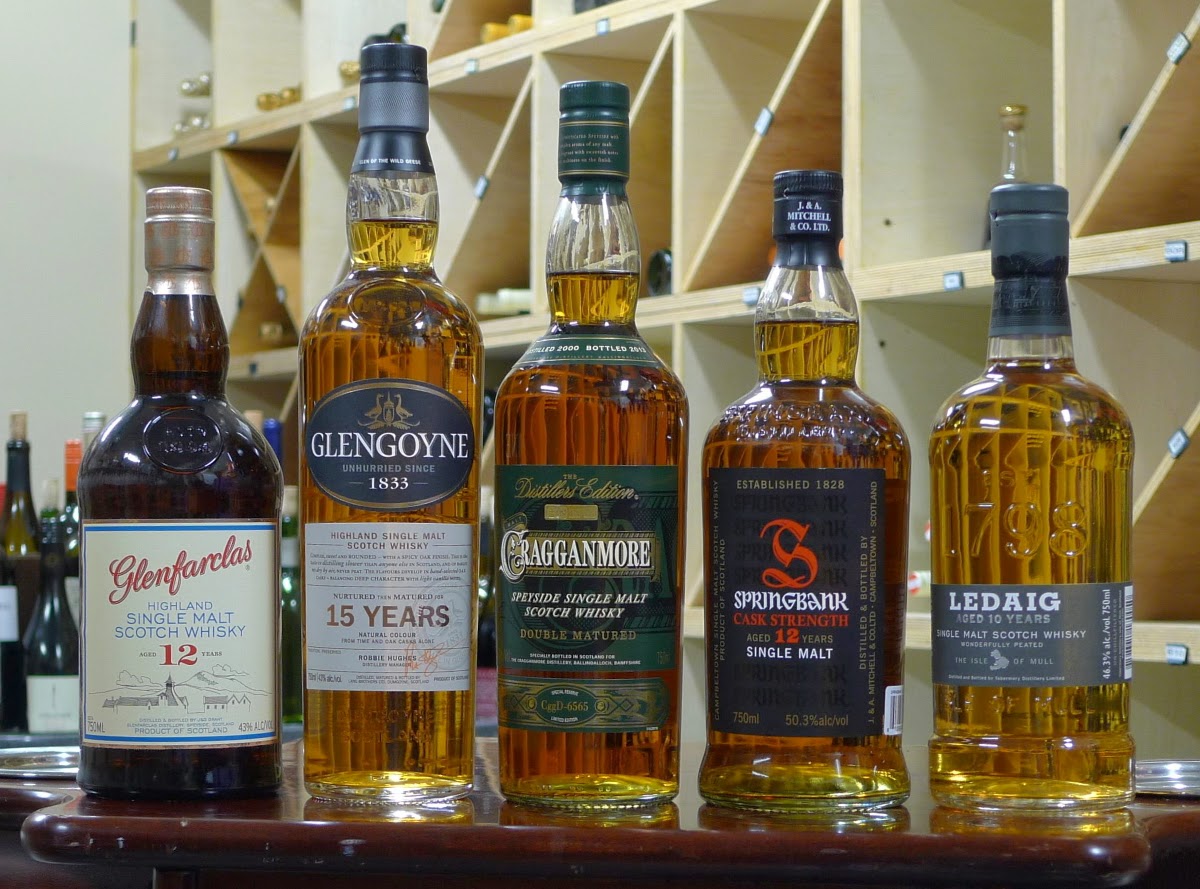
Springbank 12 year Cask Strength, 50.3%
nose: Big and sharp. Malt, fruit and moderate peat smoke followed by a distinct oxidative quality.
palate: Robust, full bodied. Bold fruit up front (apple, orange, baked berry fruit). Springbank’s signature soft, dry, earthy peat character follows shortly thereafter, but is less intense than I expected. A hint of brine comes through as well.
finish: Long with warming spiciness (dare I say, even a little hot?), a bit of fruit and peat smoke linger on as the spice notes slowly recede.
overall: Unbridled, a bit of a wild ride. Adding a healthy splash of water tones down the aromas but seems to accentuate the peat notes. I’d still call it full flavored with water added, but that seems to have tamed the beast. Everything is still there, but now it seems more refined and well-integrated. It’s rare that I add water to a whisky, even those at cask strength, but I think it makes a nice improvement in this case.
The last single malt of the evening would be accompanied by a round of hand rolled cigars, so something heavily peated was in order. I chose 10 year Ledaig because I’m quite fond of it, I like introducing people to relatively unknown scotches, and it related nicely to the last few points that I wanted to discuss.
Ledaig is the heavily peated offering from Tobermory. It’s the only distillery on the isle of Mull and has had checkered history since it was established in 1798. The last 21 years however, has been a period of relative stability under the ownership of Burn Stewart.
The company has owned the Deanston distillery since 1991 and Bunnahabhain since 2003. In 2010 they made the decision to eliminate the chill filtering process for all of the single malts from their three distilleries. Chilling the whisky before filtering it causes fatty acids, esters and proteins to come out of solution so they can be removed. This procedure will keep the whisky from going hazy at low temperatures and is done purely for aesthetic reasons. But many believe it has the ugly side effect of stripping flavor out of the whisky too.
Chill filtering has been around since the 1920’s, but it didn’t become common practice in the Scotch industry until the 1960’s. While still prevalent, many single malt Scotch producers have started to move away from the practice. Since the compounds that would be filtered out are more soluble in alcohol than water, the non-chill filtered whiskies are normally bottled at a higher alcohol level; otherwise they could go hazy even at lower room temperatures. 46% abv is usually the minimum level, but some lighter style whiskies that have fewer of those compounds to start with may be bottled at a lower abv. Burn Stewart raised the alcohol level of all of their single malts to 46.3% when they did away with chill filtration.
The addition of caramel coloring is allowed by the Scotch industry. This is a practice that sort of goes hand in hand with chill filtering. Producers who do it claim they add a minimal amount to ensure consistent color from batch to batch. Many critics feel that the artificial coloring is often added in a heavy handed manner to make the whisky more visually appealing, to the point that is has a negative impact on the flavor. Like most Scotch producers who eliminate chill filtering, Burn Stewart swore off caramel coloring at the same time.
The last topic that relates to Ledaig is the location of the aging warehouses. Much like the use of local peat that I mentioned above, aging the whisky in warehouses located close to the distillery can impart a local flavor. As far as I know, this phenomenon only manifests itself in coastal locations, where the sea air can infiltrate the warehouse. Slowly over time, that air will impregnate the casks as whisky evaporates out of them, imparting distinctive brine-like notes. If there are other local climate factors that can affect the flavor of the whisky as it ages, I am unaware of them.
In the age of mass production, large companies that own several distilleries are often involved in blending too, and will have a centralized location for their bottling and distribution operations. In this case it makes sense (from a business perspective) to have most of their warehouses consolidated at the same location. But this has resulted in the whiskies of some coastal distilleries losing the maritime character that they once had.
In the case of Ledaig, the Tobermory distillery sold off its only warehouse to a real estate developer in order to raise capital in 1979. Once Burn Stewart took over, they started aging all of the Tobermory and Ledaig casks in the Deanston warehouses, located outside of Sterling; about as far as one can get from the ocean on the Scottish mainland.


Then, in 2003, the acquisition of Bunnahabhain and its surplus warehouse space gave them an opportunity to age these island malts on the edge of the sea again. Ledaig and Tobermory may not be aged on the same island where they are distilled, but at least they are once again resting quietly with throwing distance of the ocean.

Ledaig 10 year, 46.3%
What I’m tasting today comports with the notes I made back in December, so I’m copying them here for the most part.
nose: Fresh, hearty peat smoke mixed with fields of hay and a gentle floral aspect.
palate: The mouthfeel is oily, and it attacks with bold peat up front. An intense campfire comes to life on the mid-palate and then it slowly backs down allowing other flavors emerge. Grassy, floral, nutty and vanilla notes come together providing good complexity.
finish: Most of the flavors from the mid palate continue on and fade gracefully though the finish.
overall: It’s well composed throughout and has just the right combination of youthful exuberance and aged refinement
Just a few brief footnotes before I wrap up. The folks at Springbank are quite proud of the fact that their whisky has never been chill filtered or had artificial color added. I would have preferred to use the non-chill filtered versions of Glenfarclas and Glengoyne, both of which are bottled at cask strength. Glenfarclas 105 was out of stock and probably would have put me way over budget, but I do have a bottle of it at home in the queue for blogging. Glengoyne used to have a cask strength 12 year old. They recently changed to a 43% abv 12 year old and a “no age statement” cask strength bottling. Unfortunately, that cask strength Glengoyne is the only member of their standard lineup that isn’t imported to the U.S. All of the official bottlings from Cragganmore are chill filtered. I have read that much of the weightiness that is gained by their use of worm tubs is lost in the process. As I said in my tasting notes, it seems to be holding something back; I suspect chill filtering is to blame. I’m definitely on the lookout for a non-chill filtered independent bottling of Cragganmore.

After a long day of final preparations and making my presentation, a little fishing was in order the next morning. The keen observer will note that I’m wearing the exact same outfit that I had on while fishing in the same spot last year. What can I say? I live in the mountains; my wardrobe is sparse when it comes to beach attire.
I suddenly find myself in sunny Florida, a bit like a fish out of water. Surrounded by warmth, wealth and development; this is not my natural environment. But where whisk(e)y opportunities abound, I shall go; and I’ve been invited back for an encore performance of the single malt scotch dinner that I hosted last year.
When it comes to whisky, I do what I do with enough confidence to make it look easy, but believe me, putting together such an event is no simple task. Coming up with an engaging theme and picking whiskies that will fit said theme is one thing. But when you factor in a budget that puts a lot of interesting whiskies out of reach and the fact that it’s not uncommon for many bottings to temporarily go out of stock these days, the challenges involved can mount quickly.
Also, a great deal of time and effort must be put into figuring out how long to talk and what exactly to say. Researching little facts to make sure I have them right as well as scouring my archive of images from Scotland to provide a little visual stimulation all adds to the undertaking. I’m sure the expectations of the dinner’s attendees are only exceeded by the expectations I place upon myself.
All of that being said, I was quite pleased with the single malts I was able to procure (not to mention that I was within 60 cents of my target budget), and the presentation as a whole. So, here’s a (not so) little overview of the 2014 Frenchman’s Creek single malt Scotch dinner that I had the honor of hosting.
As for the theme, I started off tossing around ideas for a few topics I wanted to explore, but soon realized that sourcing whiskies for them was going to be prohibitively difficult. With the event rapidly drawing near, I needed to come up with a subject that would lend itself to more readily available whiskies.
Within the last six months I’ve been tasked with making single malt selections for the restaurant where I work as well its newly christened sister outlet. The restaurants’ wine lists focus on natural wines; those made with minimal technological intervention and often produced by traditional methods. I carried that idea through to the single malts I picked, choosing selections from producers that in one way or another have shunned the wave of distillery modernization that swept through Scotland in the 1960’s and 70’s. With that topic fresh in my mind, it made a logical choice for the tasting I’d be presiding over.
I started off with an opening talk where I mentioned that even though the Scotch Whisky industry is steeped in tradition, the methods of production have gradually evolved over time. After going into a little background on Alfred Barnard and his book, Whisky Distilleries of the United Kingdom, I explained that the book gives us great insight into how a distillery would have functioned 130 years ago, as well as reading a quote from the book’s preface to set the mood.
That opening provided the perfect segue to the topic of steam heated stills, some of the earliest examples of which are mentioned by Barnard. Most distilleries in Scotland held on to the traditional method of heating their stills with a coal fire until the 1960’s. At that time, most of them switched to internal steam coils, a method referred to as indirect firing. At the same time, the direct fired holdouts were switching to natural gas or fuel oil. The last coal fired stills in Scotland were extinguished in 2005 when the Glendronach distillery converted to stills with internal steam coils.
Today, just four Scottish distilleries have direct fired pot stills: Springbank, Glenfiddich, Macallan and Glenfaclas. It is said that the direct firing method promotes caramelization of solids (mostly small bits of grain and yeast) in the liquid being distilled, having a significant effect on the flavor of the final product. Glenfarclas tested internal steam heating in one of their six stills in 1980. That test lasted just a week or so before the still was changed back when the owners decided that the whisky produced in it wasn’t the same; “it had no guts”. That is why I chose Glenfarclas 12 year to open the evening.
Glenfarclas 12 year, 43%
nose: Rich and malty with a biscuit like quality, some brown sugar-like sweetness, a hint of spice and just a whiff of peat smoke.
palate: Rich and complex. Malty sweetness balanced by dry spice notes, along with a variety of baked goods. Dark, sherried fruit notes are there but stay more in the background.
finish: Long and warming with spice and just a hint of peat hanging on.
overall: Very well made and immensely enjoyable.
I also took a moment to describe the rummager that must be used inside a direct fired still. A rotating vertical shaft drags a series of copper chains across the bottom of the still to keep everything inside moving around. This prevents overcooking and ensures that no burnt flavors come through in the final product. Pictures of the rummager in Springbank’s wash still were shown as an example, as well as the pictures of the bell on its external drive shaft that the distiller must listen for to be sure that everything is working properly.


From here, we moved on the Glengoyne 15 year. Glengoyne has been completely unpeated for quite some time, at least since the 1960’s. I made the point here that many single malts became less peaty, some to a greater extent than others, in the 1960’s and 70’s. This change didn’t happen because of modernization so much as it did at the behest of changing consumer tastes, and consequently changing demand from the blenders who were purchasing most of the malt whisky produced at the time.
I showed an image of the malt kiln pagoda at Glengoyne as evidence of its presumed peaty past. In retrospect, that was a misstatement on my part. Distilleries malting their own barley in the traditional method would have their kiln topped with the iconic pagoda regardless of whether peat or another fuel was being used to dry the malt. A quick look in Barnard’s book revealed what I was looking for. He clearly states that the kiln at Glengoyne was fueled by both peat and coke (a refined form of coal that produces little to no smoke).

For quite some time Glengoyne went a little too far in emphasizing the fact that it is made with unpeated malt. Some of their statements made it sound as if they were the only malt distillery in Scotland producing completely unpeated whisky (which they certainly are not), and they also phrased things in a way that made it sound as if the inclusion of peat smoke was detrimental to malt whisky. After coming under increasing criticism, they’ve fortunately changed course in the past few years and put most of their marketing emphasis on the slow speed of their distillation.
That slow distillation is the reason I chose Glengoyne for the second whisky of the night. Modernizing the distilleries was all about cutting costs and increasing production. A lot of the processes were sped up to make the most efficient use of the equipment at hand. But distilling slowly increases the amount of time that the spirit is in contact with copper, and the copper acts as a catalyst, causing chemical reactions. This removes sulphur compounds that can cause bitterness and encourages the formation of esters which produce many of the lighter fruit flavors.
When single malt producers started running their stills hot and fast 40 to 50 years ago, a lot of whiskies lost the fruity character that made them so special. Glengoyne claims to have the slowest distillations in Scotland. Running at five liters per minute, they say that is 1/3 of the speed typically used today. Another unique feature at Glengoyne is that they double distill with three stills. Each batch coming off the wash still is split in half and entered into their two spirit stills. This setup further increases the surface area of the copper that is available for the spirit to interact with. I actually find the 10 year expression of Glengoyne to be too fruity, but as you move up the range (increasing both age and the amount of Sherry cask influence), it really comes into its own.

Glengoyne 15 year, 43%
nose: Wonderfully fruity aromas. Full but not overpowering. The fruit notes are bright overall, but it has a nice balance of tree fruit and darker Sherry fruit notes spread across the canvass of a malty background
palate: Good balance of flavor intensity and heat. Apple and pear show just briefly right up front before giving way to a malt driven core accented by stewed berry fruit notes.
finish: The fruit and malt continue to evolve while they fade, and the warming spice notes pick up intensity as it moves on. Once the spice notes trail off, just a hint of a floral / fruity element remains at the very end.
overall: Maybe not quite as much depth as the retired 17 year or as refined as the 21 year (it’s been some time since I’ve tasted them), but still quite a good whisky in its own right It’s somewhat masculine (at least for a completely unpeated single malt), but without any rough edges.
Next we moved on the Cragganmore Distiller’s Edition. This starts as the standard 12 year old before it is finished for one additional year in Port casks, adding another layer of complexity to a single malt that is already noted for being quite complex.
This gave me an opportunity to talk about how the role of the cask has changed in the Scotch industry over the years. Back in the 1960’s Scotland had an abundant supply of high quality Sherry casks. Sherry was much more popular back then and it was often shipped in cask to the UK, where it was bottled. This gave distillers the ability to fill those casks with whisky very quickly after they had been emptied.
Today, Sherry is much less popular and it is all bottled in Spain. Meanwhile, Bourbon sales have taken off, especially over the last 20 years, and that product must be aged in new barrels, adding to the supply side of the equation. Many Scotch producers have shifted their aging regimes, either partially or completely from Sherry casks to Bourbon barrels for both cost and quality reasons. This has happened over the last 50 years, but the phenomenon has accelerated during the last two decades.
The most recent trend has been the focus on finishing Scotches in casks that previously held other spirits (usually rum or brandy), fortified wine (port, Madeira, even specific types of Sherry) or any variety of table wine. This is usually done after the initial aging period in Bourbon barrels. The practice can add variety to a product range, and it can help breath new life into mediocre whisky that started off in tired old casks.
Some distillers are more transparent than others about their shifting cask regimes. In the case of Cragganmore there is at least anecdotal evidence that they have slowly, quietly been shifting from primarily Sherry cask maturation to mainly Bourbon barrel maturation. Add in the Port cask finishing of the Distiller’s Edition and we have a single malt that neatly exemplifies the current trends in Scotch aging.

Conversely, Cragganmore does embrace an old school distilling technique that isn’t seen too often these days. It was once the norm for Scotch producers to condense their spirit in a worm tub. Today, all but 13 of them have switched over to the modern shell and tube condenser.
The worm tub is just and extension of what the original farm distillers would have done. A large, open-topped vessel (the tub) usually made of wood, sits in close proximity to the still. Inside it is a big coil of copper tubing (the worm) that winds around, gradually decreasing in diameter as in goes down. The top end of the worm is connected to the lyne arm (the pipe that comes off the neck of the still). The tub is filled with cold water, and during distillation it is receives a constant supply of fresh cold water flowing in from the top. The vapors coming off of the still condense as they move through the worm, finally emerging as liquid at the lower end (where the worm exits through the side of the tub at its base) and flowing into a receiving tank.
The worm tub is not a particularly efficient device, both in terms of how much space it takes up and how much cold water it must use. The modern improvement is called a shell and tube condenser. And enclosed cylinder, usually made of stainless steel, is packed with a series of small copper tubes that run down its length. The tubes are all connected together at both ends. Vapors coming off the still enter these tubes at the top and are condensed into liquid on their way to the bottom. Cold water enters the outer shell at its base and heats as it moves upward before exiting at the top. Because of its counter-flow nature and increased surface area (the result of many small diameter tubes), the shell and tube condenser is much more efficient, taking up less space and using less cold water to do the same job. I suspect it can also be run faster more easily by increasing the flow of cold water, if one were inclined to speed up their stills. I illustrated these devices with a picture from Springbank, since they use one worm tub and two shell and tube condensers.

Again, we have a modernization that affects the flavor of the whisky. The reactions prompted by contact with copper that serve to purify the spirit continue during condensation. But the increased surface area of cooper in a shell and tube condenser goes beyond the point of being beneficial, producing whisky that is notably lighter in style. Conversely, worm tub whiskies are weightier, with greater texture and character. Switching to shell and tube condensers isn’t necessarily bad for the whisky, but the move certainly alters its personality.
Cragganmore Distillers Edition (distilled 2000, bottled 2013), 40%
nose: There’s certainly a floral component there, but it’s rounded out by a complex mix of other aromas. Malt, grain, subtle fruit (primarily dark berry and baked fruit notes), a hint of peat smoke and perhaps a bit of minerality.
palate: The palate shows good complexity, with just about everything seen on the nose coming through, as well as some dry spice notes. Still, it gives the impression that it’s holding something back.
finish: Soft and gentle. Of moderate length, though it seems to go slightly out of balance at the very end.
overall: This is a very approachable single malt. It has some weight to it, but without too much intensity. I think I was initially attracted to this whisky when I first tasted it in Scotland two years ago because the additional time in Port casks has the effect of muting the strong floral notes that I feel are too dominant in the standard 12 year bottling (I last tasted 12 year Cragganmore about five months ago; it didn’t seem quite as floral as I remembered it being from many years ago. It’s hard to know if it is the whisky or my palate that has evolved).
I’ve gotten a little too wordy, so I’m going to split this post in two before I lose everyone’s attention. Part two will follow soon as it is already mostly written.

stats:
Talisker Distiller’s Edition: Single Malt Scotch, Islands, 45.8%, $85
Talisker 10 Year: Single Malt Scotch, Islands, 45.8%, $65
Failing to come across even a trace of Talisker Distiller’s Edition in Montreal meant that I was going to have to hunt down and buy a bottle for my review. It is not an item that I would find close to home though, as Vermont and New Hampshire are both liquor control states that do not stock it. This would take a bit more effort.
My next best option was to try to find one when I was in the Boston area during the holidays. A quick search online showed that it could be had at Gordon’s Fine Wines in Waltham. A respectable retailer with a single malt collection 300 bottles deep, I had visited the store at least twice in the past. But I was in the mood for exploration and decided to venture a little further from the city to Julio’s in Westborough. I’d heard great things about this store and had wanted to pay it a visit for some time. If I struck out on the Talisker DE there, I could always swing by Gordon’s on the way home.
Well, Julio’s certainly lived up to its reputation and I felt like a kid in a candy store. In addition to the usual single malt suspects and a solid array of limited edition bottlings, they also had a great variety of independent bottlings. The highly regarded Amrut whiskies of India were well represented and the store’s Japanese selection was outstanding, including most of the expressions that have only recently begun to appear in the U.S.
I even came across a non-chill filtered variant of Aberlour 12 year; something that I didn’t even know existed. But my whisk(e)y collection has grown to be unwieldy and I was only here for one bottle. As difficult as it was, I did manage to restrain myself and walk out of the store with nothing more than a bottle of Talisker Distiller’s Edition.
The Talisker DE, like the Oban DE that I wrote about in my last post, starts off as the distillery’s standard expression before it is transferred to fortified wine casks for a finishing period. In this case that would be 10 years in Bourbon barrels before it is transferred to Amoroso Sherry casks. It carries no age statement, but the label lists the year of distillation as 2002 and the year of bottling as 2013. That gives a margin of 12 months on each end, so the finishing time could be anywhere from a few months to a few years, but I suspect it is in the neighborhood of one year.
Of course my next logical step was to try and find out what Amoroso Sherry is, as I was unfamiliar with the term. Sherry classifications are a little confusing to begin with, and it turns out that some of the regulations have changed recently so it took me a while to get the information all sorted out.
I’ll try to keep the Sherry lesson concise as it seems to be a subject whose details can easily snowball. There are two main styles of Sherry; Fino and Oloroso. All Sherries are fully fermented in stainless steel tanks before they are transferred (along with the yeast) to oak casks for aging. The indigenous yeasts of Andalucía used to ferment Sherry go through a transformation after all of the sugar has been converted to ethanol. They then begin to convert acids into other compounds, and at the same time the cells attain a waxy coating causing them to float. They form into a protective coating called “flor” on top of the liquid, shielding it from oxygen. Sherry casks are only filled to 5/6 of their capacity, leaving plenty surface area for the flor to occupy.
Sherry is only fortified after it is placed in cask. Fino Sherries will be fortified to an alcohol level of 15% to encourage the growth of flor. Fino Sherries are pale in color and light in flavor. The flor protects them from oxygen and also contributes to their flavor. Oloroso Sherries will be fortified to an alcohol level of 17.5%, creating an environment in which the flor cannot survive. This allows the wine to oxidize as it ages, producing a wine which is dark in color and has a rich, nutty character.
Manzanilla is an especially light variant of Fino that comes from a small coastal village. Amontillado is a style that starts off like Fino, aging for several years under a layer of flor. Then it is further fortified, which eliminates the flor, and it continues to age oxidatively. This produces a hybrid style mid way between Fino and Oloroso. Palo Cortado is Sherry that was intended to be Oloroso, but did not develop its powerful bouquet. Palo Cortado has the nose of an Amontillado with the concentrated mouth feel of an Oloroso.
Pedro Ximenez and Moscatel are sweet styles for Sherry named for the grapes that they are made from. The grapes are laid out in the sun to dry, concentrating their sugars to the point that even after fully fermenting they still have residual sugars. They are then fortified to an alcohol level of 18-20%.
Sweetened versions of Oloroso Sherry are created by adding Pedro Ximenez or Moscotel to dry Oloroso. Names such as Rich Oloroso, Sweet Oloroso and Oloroso Dulce were used until new regulations went into effect in the spring of 2012. Those terms are now banned, and the word Oloroso can only appear on the label of its sweetened versions under certain conditions.
Categories for sweet Oloroso Sherry have been created and are defined by the amount of residual sugar (in grams per liter) in the wine. They are as follows:
Dry Sherry: 5 – 45
Pale Cream Sherry 45 – 115
Cream Sherry 115 – 140
Medium Sherry 5 – 115
This is fairly confusing as Dry Sherry isn’t “dry”, and the residual sugar range for Medium Sherry covers two of the other categories.
Now, back to where this all started; Amoroso. That is just an alternate term for Medium Sherry. So, the Talisker Distiller’s Edition has been finished in a cask that once held a sweetened version of Oloroso Sherry, one which covers a broad range of residual sugar levels (but not as sweet as Cream Sherry). I was unable to determine if the term Amoroso was banned with the new regulations that went into effect in 2012. But even if was, that wouldn’t really matter as the regulations apply to bottle labels for Sherry, not cask descriptions for Scotch.
I fortunately managed to line up my Talisker Distiller’s Edition next to a bottle of their flagship 10 year for a proper side by side tasting.

Talisker 10 year
nose: sea spray and peat (intense, but not overtly smoky).
palate: a quick hit of sweetness up front, followed by peat smoke which gradually intensifies as the characteristic black pepper spice starts to kick in.
finish: the smoke gives way as the black pepper element grows to dominate before slowly fading.
overall: the transitions aren’t harsh but it moves from one intense flavor to another, each being somewhat one dimensional.
Talisker DE
nose: more restrained overall. the salt and peat are still there but with the addition of some fruit (tree fruit and dark berry fruit), and perhaps a subtle floral note.
palate: the sweetness up front is more flavorful here, with fruit notes gracefully combining with butterscotch. the peat rises up on the mid palate as the early flavors carry through and are joined by brine and delicate floral notes.
finish: equally long but not as intense. the signature black pepper is still there, but toned down and joined by other flavors.
overall: more depth throughout and very well integrated. it makes the 10 seem quite monochromatic as the 10 moves through each of its three distinctive phases (sweet-smoke-pepper). The peat intensity is probably about the same for the two, but it stands out more with the DE because its peppery finish is much less dominant than that of the 10 year.
Talisker is unique not just for being the only single Malt from the Isle of Skye, but also for its distinctive black pepper finish. While I think the DE is the better of the two whiskies here with its far greater complexity, I can see some people being turned off by its diminished black pepper character and still having a preference for the raw power of the 10 year. I can also see myself occasionally being in the mood for the simpler yet more forceful style of the 10 year.


