Sunday, September 16, 2012

Whiskey bars of Washington DC, part 2


A short ride on the DC Metro from Union Station to Dupont Circle brought me within walking distance of the Adams Morgan neighborhood, home to the Jack Rose Dining Saloon and Bourbon. The two bars share a common ownership, and are on the same street, just about a block apart.

Jack Rose was just a fifteen minute walk from the closest Metro station. I arrived around 11:00, and looking in from the outside it seemed very crowded and very loud. The noise levels seemed to echo a common complaint of many online reviews. With a large, rectangular open floor plan, I think that problem is just the nature of the space. I decided to save the best for last, and hoofed it a little further up the street to Bourbon.

With a long, narrow layout, Bourbon has a more intimate feel than Jack Rose. It too was pretty packed with people when I got there, and I’m guessing this is typical of most bars in the area at 11:00 on a Friday night. I had checked out their website in advance, which shows a whiskey list 200 bottles deep, primarily American offerings as one would expect. The standard pour is 2 oz here, and ½ oz pours are available for most of the selections.

The list featured some limited releases, such as Van Winkle Family Reserve Rye 13yr, which I’ve been curious to try for many years, as well as Pappy Van Winkle Family Reserve 23yr Bourbon (at a very reasonable $8 for the ½ oz pour, considering the bottle’s $230 retail price tag). I was going in with a game plan.

Of course no seats were to be had at the bar, or near it for that matter. The bartenders were super busy, and it seemed that far more people were drinking cocktails than whiskey. I jockeyed my way forward and waited patiently for the attention of one of the two bartenders. It took a while, but when it was finally my turn, I went straight for the 23yr Pappy – only to be informed that they ran out of it a few weeks before. A short pause from me, and she was on to the next thirsty soul. I really can’t be too critical of this, I’ve spent plenty of time on the other side of the bar and when that many people want drinks at once, a good bartender will move on to someone who knows what they want after about 10 seconds of indecision.


Okay, on to plan b – pick something off the shelf. Fortunately, I’ve been at this long enough that I can figure out what many of the whiskey bottles behind a bar are, even if I’m not close enough to read the labels. My eyes honed in on a pair of matching ½ size bottles that could only be this year’s release of the Woodford Reserve Master’s Collection – a pair of 100% rye whiskeys, one aged in new oak casks, the other in used oak casks. It wasn’t too long before I was able to order a ½ oz of each, and a bar stool had actually become available in the mean time. I had narrowly passed up the opportunity to buy these bottles (at $100 for a pair of 375ml’s) three or four months prior, so I was really excited to have a chance to try them. Again, that tasting notes typed into my phone are essentially unedited.

Big color difference, medium amber vs. medium to pale straw. Light spice nose on aged cask version, fuller nose on new cask version, rounder too. New cask is a solid spice wave American rye, classic. Aged cask is nice, decent spice, but lacks the depth of the new cask version. Can almost liken them to a single malt vs. a blend.


Over the next hour the crowd thinned out a bit and the bartenders, who were both quite helpful, were able to spend some time guiding me through my selections. I later learned that the Van Winkle Rye had sold out too, but that was okay, there were plenty of interesting choices here.

While visually scanning through the bottles, I noticed one with a peculiar shape, short and squat with an extremely long slender neck. I thought it might be something I had hunted for in the past, so I asked one of the bartenders what it was. She brought the bottle over and it turned out to be the Willett Pot Still Reserve Bourbon (something totally new to me), a moderately priced 6yr old at 94 proof. The next thing I knew, she had poured me a (presumably) complimentary splash. The bottle was more impressive than its contents.

Deep Caramel and Vanilla nose. Fair to midland overall.

The next thing to catch my attention was a collection of bottlings from High West, another producer who had been on my radar for a bit, but remained untried. A micro-distiller based in Utah, they actually bottle a variety of whiskeys, younger ones that they have distilled themselves, and older ones that they have acquired from other sources. I decided to put my faith in the bartender, and asked him to pour me a glass of his favorite High West offering. I ended up sipping on the Double Rye, a marriage of 2 yr old (95% rye and 5% malted barley), and 16 yr old (53% rye, 37% corn and 10% malted barley).

Very mild nose. Palate is familiar, but can’t put my finger on it. Some sort of floral spice? Smooth finish. B+.


Next I noticed most of the Hudson Whiskey line from Tuthilltown Spirits. This is a fairly new distiller in upstate New York, known for aging their whiskey in small casks and using other techniques to increase the surface area of wood that the spirit is in contact with in order to mature their whiskeys more quickly. The lineup is well marketed, being presented in distinctive 375 ml bottles with eye catching labels, but they don’t come cheap, retailing around $50.

Once again, I decided to go with the bartender’s choice from the lineup. When I told him what I was after, he bluntly informed me that he didn’t really have a high opinion of any of them. I was then presented with another (presumably) complimentary splash. This time it was the Hudson Manhattan Rye Whiskey, I assumed it was the Hudson offering that the bartender found least offensive. My unbiased opinion definitely fell in line with his.

Hot, spice, lack of balance. Doesn’t suck, but meh.


The bar staff had steered me well thus far, and I felt safe putting the choice of my last drink here in their hands. I soon found myself sipping on a glass of Old Pogue Master’s Select Bourbon and it did not disappoint.

Subtle, smooth, sublime. It doesn’t do anything exceptionally, but it does everything extraordinarily well. A good, solid bourbon.

I like this bar, it has a comfortable feel, a helpful staff (who aren’t afraid to share their honest opinions), and a well rounded list of American whiskeys with plenty of obscurities and limited releases. For the true whiskey fanatics, I would suggest going at off-peak times to avoid the crowds.


I hate to stretch this out over 3 posts, but I’m going to for the sake of avoiding going far too long between posts.

Friday, August 31, 2012

Whiskey bars of Washington DC, part 1


While I prefer to spend most of my time near my secluded rural homestead, occasionally one must give in to the pressure of social obligations. I recently found myself in the position of being invited to a wedding and without a decent excuse not to attend (nothing against the couple getting married, I’m quite fond of them both, but I have a strong disdain for weddings in general). Having resigned myself to traveling to the Washington DC metro area for the weekend, I decided to try to make the best of my situation - if I’m stuck with lemons, I can at least make a whiskey sour.

Fortunately, I had recently read an article about a relatively new whisky bar in DC, a place with a collection of epic proportions, called the Jack Rose Dining Saloon. My obligatory trip was gaining a sense of purpose. A little online research turned up a few more prospects: a bar called Bourbon specializing in American whiskeys, and quirky sounding place named Little Miss Whiskey’s Golden Dollar. This was turning into a whiskey mission with a matrimonial side show.

I started at Little Miss Whiskey’s since it was furthest from where I was staying and located in a less-than-upscale neighborhood. Nothing too terrible, but it might be unwise to bumble around there drunk at 2:00 a.m. I wasn’t really sure what to expect here, their web site mentioned whiskey tastings but only had a beer list, and most of the online reviews focused on the music, the outdoor patio and a cocktail called Awesomeness that came out of a Slushie machine.


The sun was still above the horizon when I got there, and it was very dark inside, but my eyes eventually adjusted to the low light levels. The crowd was light for a Friday, but I was there pretty early in the evening. The music was eclectic (in a good way) and the décor had sort of a New Orleans / voodoo feel to it. The whiskey selection wasn’t as extensive as I had hoped, coming in between 40 and 50 bottles (about 15 single malt scotches, 15 American whiskeys, and maybe a dozen Irish bottles). Not a lot of depth, but at least they had a few variants of many of the brands they carried, rather than just the standard flagship offering from each distillery. Calling it a whiskey bar might be a bit of a stretch – it came across more as a cool, hip, upscale dive bar with a respectable whiskey selection.


They did have a printed whiskey list on the bar, but there were only a few offerings I was excited about. I started off with a 16yr Glen Grant – the only other Glen Grant I had sampled before this was a 38yr old from Gordon & MacPhail, so I was curious to try an official distillery bottling. The pours here are a solid 2 oz, and even thought it is not normally offered, the bartender was willing to do a half pour for me.

I have found that if I’m alone at a bar and start to write tasting notes on paper, it can draw unwanted attention. Not to mention that scraps of paper tend to disappear when I drink. I’ve switched to typing my notes into my phone using the notepad function. It looks like I’m texting so people usually leave me alone and I can concentrate on what I’m tasting without being distracted. My notes on the 16yr Glen Grant are as follows:

almost no nose. fairly big. mix of malt, fruit and spice. spice builds nicely as other flavors subside. dry finish. mostly just spice at the end of the long finish. I like.

I had also noticed a few offerings from Copper Fox on the list. This is a Virginia distillery started by Rick Wasmund. Some of his whiskies are branded Wasmund’s, while others are branded Copper Fox. Their barley is all malted in-house, and they are known for smoking it with American fruit woods, as well as adding charred wedges of fruitwood and oak to the whisky while it ages in former bourbon barrels. Production is limited, and this was the first time I’ve had a chance to try anything from this distillery in spite of being on the lookout for it for several years.

The menu listed a Copper Fox Rye and Single Malt. I later learned that the Single Malt is actually bottled under the Wasmund’s label, so there was a slight error on the list. I ordered the Single Malt first, and the second bartender, who had just come on duty, didn’t notice they were out of it and poured me the Rye by mistake. I didn’t realize this until I finished that drink and ordered the Rye (from the original bartender). I was almost certain he grabbed the same bottle, and it tasted just like my last drink:

very fruity nose, apple and cherry? interesting, unique palate. big fruit throughout, malt foundation up front gives way to moderate spice. lonely spice finish. good but slightly out of balance, fruit (cherry) is dominant.

I was a little unhappy about getting the same drink twice, especially on a night when I’d have so many things to taste and really didn’t want to be hungover the next day. But it was an honest mistake, and when I explained what had happened, the bartender only charged me for my first two drinks. He was a good man and was tipped accordingly.

While I didn’t love the Copper Fox whisky, I do love what this distillery is doing – pushing the envelope to create a new style of whisky that is uniquely American. I’m looking forward to trying more of their offerings in the future.

As for Little Miss Whiskey’s Golden Dollar, it’s a cool and unusual place. I wouldn’t go out of my way to make the journey there just for the whiskey, but if I was with friends who wanted to go to a fun, interesting bar and I still wanted to have some decent whiskey options, this would be the spot.

A thirty minute walk and a short train ride got me to the neighborhood with the next two whiskey bars, but I’ll to save the rest for my next post.

Thursday, August 16, 2012

Two from the Isle of Jura


stats:
Isle of Jura Superstition, single malt scotch, Islands, 90 proof, $48
Isle of Jura Origin 10yr, single malt scotch, Islands, 86 proof, $43

Looking at a basic map of Scotland several years ago, I made the assumption that one got to Islay by way of Jura, with a quick ferry ride at each end of the island. I later learned that this was not the case and that the only way to Jura (at least with a car) was via a short ferry ride from Islay, after having taken a much longer ferry ride from the mainland to Islay.

What I had once imagined would be an obligatory visit to the Isle of Jura distillery on the way to Islay, turned out to be an optional day trip that didn’t fit very well into the schedule of my trip around Scotland. Having tasted only one example of single malt from Jura, and not being all that impressed by it, the optional day trip was one that I never even seriously considered.

During my stay on Islay, I was treated to glorious views of the Paps of Jura (a small group of steep, rounded mountains that rise dramatically from the sea) from a multitude of locations. Since my return home, I have sampled an offering from the Isle of Jura distillery that I have a much more favorable opinion of.


Next time I am on Islay, the optional side trip will be seriously considered. For now, I can compare the two above mentioned single malts.


Superstition
A vatting of older Jura and younger, more heavily peated Jura. Medium golden-amber in color. The assertive, fragrant nose has a mix of peat smoke, malt, perfume and pine. It’s a little hot across the palate, with moderate peat smoke quickly followed by strong perfumed floral flavors. The two flavors seem to be at odds with each other, not in harmony. The finish has some length and warmth, with dry spice notes joining the fray at the end, but the flavors put forth still fail to impress overall.

Origin 10yr
Made from lightly peated malt. Almost identical in color to the Superstition, maybe just the slightest bit lighter. The nose is also similar to the Superstition, but with a lower proportion of peat smoke, and everything more subdued overall. It has mild peat on the palate, balanced by caramelized malt flavors. Gentle, not aggressive. Respectably long finish with subtle floral notes emerging, and then giving way to a dry spiced ending. While it’s not terribly complex at any given point, the flavors evolve nicely and are well integrated. Quite enjoyable.

The 10yr puts the Superstition in context. I can see where they were coming from and what they were trying to do. It wasn’t well executed, and doesn’t really work, but it makes more sense to me now.

Wednesday, August 8, 2012

Scotland follow-up, part 4


At last, I have reached the final Scotland follow-up post. This one will include an almost forgotten whisky review, but first a few thank-yous are in order.

We had the good fortune to stay at a series of top notch B&B’s, with wonderful proprietors who were instrumental in making our trip a truly special experience. Gary and Sue at the Heatherfield House in Oban, Jane and Adrian at the Strongarbh House in Tobermory on Mull, Andrea and Donna at the Cala Sith Guest House in Port Ellen on Islay, and Angela and Callum at the Feorlin Guest House in Campbeltown; they all could not be thanked enough in person. Their warm hospitality, local knowledge, and phenomenal home cooked meals made our trip the journey of a lifetime.

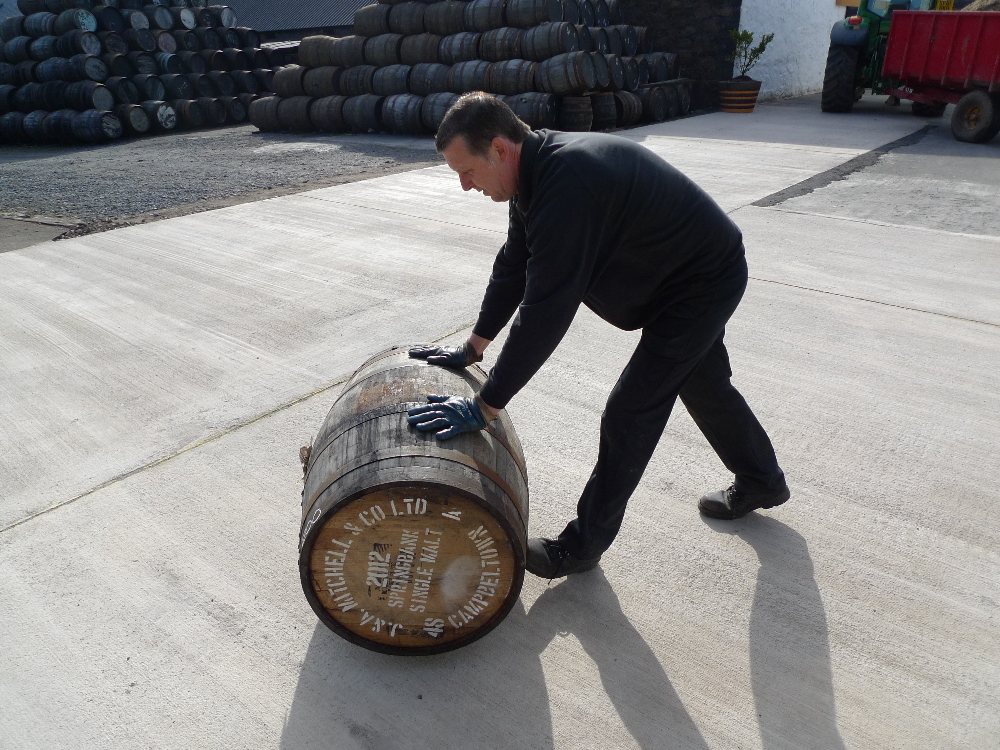
We also met a lot of great people along the way; tour guides, bartenders, distillery workers and whisky tourists from many other nations among them. But our Whiskey School mentors deserve special thanks. Pop, Norman, Kerry and Gordon at Springbank graciously allowed us to interrupt their normal work routines. Their generous information, patience and good nature were greatly appreciated.


As one drives south across Islay on the A846, the wide open agricultural landscape is suddenly interrupted by the massive, looming buildings of the Port Ellen Malting facility on the northern outskirts of the town of Port Ellen. Once the site of the distillery of the same name, many of the original warehouses and other distillery buildings lie just out of site behind the newer, dominant structures.

The distillery dates back to 1825, and even though no whisky was produced from 1929 until a 1967 rebuild, malting and warehousing operations continued throughout that time. The Port Ellen Maltings (where the process is an automated, mechanized alternative to traditional floor maltings) was constructed in 1974, alongside the distillery. Malted barley from this facility has been supplied to most of the distilleries on Islay since 1987, but originally its malt only went to Caol Ila, Lagavulin and Port Ellen. Those three distilleries were acquired by Distillers Company Limited (DCL) in the 1920’s. The 1980’s brought tough times to the scotch industry, and with three Islay distilleries in their portfolio, Port Ellen was deemed to be surplus and closed in 1983. Many single malt enthusiasts bemoan that fateful decision to this day. A series of mergers and acquisitions starting in 1986 eventually put the three brands, along with many others, in the hands of current owners, Diageo.


Not having produced any whisky for close to 30 years, Port Ellen single malt is becoming a rare commodity, and expensive. My last night on Islay seemed like an appropriate time to take the plunge. I made the short walk to the pub at the Ardview Inn, bearing the brunt of the Islay head wind, and ordered up a 27 year old Port Ellen (at 46% abv, distilled in the spring of 1983, from independent bottler Douglas McGibbon). I then sat quietly in the corner, tasting, contemplating, and typing notes into my phone.


My tasting notes, just about verbatim: Pale straw yellow. Good nose of sweet smooth smoke. Smooth moderate peat smoke on the palate, moves nicely through a range of flavors, from stone fruit to peaty smoke to a warming spicy finish, back into floral and fruit at the end.

So, did I like it? Was it worth it? While I certainly thought it was a well made, enjoyable single malt, I wasn’t blown away, and I definitely tasted more impressive offerings that week. But I think that may just come down to personal preference more than anything else. £25 is a steep price to pay for a single drink, at least in my world. While I found it to be an enjoyable dram, I wouldn’t pay that much for a second sampling. But to me it was worth the price just to satisfy my curiosity, and at the time I was able to justify the expense with an utterance of “hey, I’m on vacation after all”.

Tuesday, July 31, 2012

Scotland follow-up, part 3


On the evening of our first night on Islay, my father and I sat in the lounge of the Harbour Inn, enjoying a glass of wine and perusing the dinner menu. I couldn’t help but overhear the conversation between the two upper-crust English couples sitting nearby. When the topic turned to local distilleries, a rash of criticism was aimed at Bruichladdich. Most of their ire revolved around the dizzying array of special releases that had come out of the distillery in recent years (a debatable point, but beyond the scope of this post). Then one of them made a proclamation, something along the lines of “And what on earth are they doing now, mucking about with gin?” in reference to the Botanist Gin, which Bruichladdich started producing in 2010. With personas reminiscent of Thurston Howell III, I’m sure they had made their millions many times over, but they seemed to be oblivious to the economics of the whisky industry.


With lead times of 10 or more years between production and sales, and a product demand prone to unpredictable cycles of boom and bust, whisky is a tricky business to say the least. Gin, on the other hand, seems to have enjoyed a more stable pattern of consumption in recent history. And because it is not aged, increases or decreases in production can quickly affect inventory levels, so supply can be promptly adjusted to meet changes in demand. It doesn’t take much insight to see that gin is the perfect economic ballast for the treacherous seas that every whisky company must navigate. Of course, I refrained from informing my fellow diners of their ignorance.

A week later I was in Whisky School, where I learned much more about the inner workings of the whisky business. While the subject matter was primarily focused on production, I was still able to pick up some information along the way that helped me to infer a lot about the operational philosophy of Springbank’s parent company, J&A Mitchell & Co. By the end of the week, I had come to the conclusion that the history of Campbeltown’s whisky industry had been well studied, and that the lessons learned are currently being applied. The following is my analysis of what is being done to keep the mistakes of the past from being repeated.

In the first half of the 1800’s Campbeltown became Scotland’s most praised and respected whisky producing region, and was often referred to as the “whisky capitol of the world”. Just having the word Campbeltown on the bottle was enough to command consumer attention, and the town’s single malts were highly desired by blenders. Nearly two dozen distilleries were licensed here in the 1820’s and 1830’s, and the town was actually granted regional status, like the Highlands and the Lowlands. Unfortunately, that massive success partly led to the region’s downfall in the early 1900’s. Quality was compromised for quick profits, and with a tarnished reputation and plunging demand the vast majority of Campbeltown’s distilleries closed in the 1920’s. After a handful more closed in the 1930’s only two distilleries, Springbank and Glen Scotia, remained active for the rest of the 20th century. Not only had the town lost its prestige, it eventually lost its official status as a whisky producing region.

After my time there, it is my belief that returning some of the former glory to the area’s whisky industry is part of the master plan of the management of J&A Mitchell & Co. The resurrection of the Glengyle distillery in 2004, along with the introduction of Hazelburn single malt in 2005, has brought the town to a total of five unique single malts from three operating distilleries. The Scotch Whisky Association has recently reinstated the town’s official regional designation. The company has also started to integrate the phrase “Campbeltown Malts” into their marketing campaigns. Looking to the past, it seems obvious that they have seen the importance of not just promoting individual single malts, but also promoting the town as a region with a reputation for producing whisky of exceptional quality.


Campbeltown distillers enjoyed unrivaled prestige and a stronghold on the Glasgow market for much of the 19th century. But by the turn of the century, many distillers had tried to take advantage of the success of the region and maximize profits, even if it meant putting out an inferior product. I’m speculating here, but it is probable that lower quality, imported barley was used (demand likely having outpaced local production levels), short fermentation times employed, and stills would have been run hot and fast, with a wider cut taken. All of these steps would have sped up the process and increased output. The inferior spirit was then aged in substandard casks. I’m not sure if it was a rumor spread by competitors or just the running joke of the day, but at one point Campbeltown whiskies were said to be aged in old herring casks. The region’s reputation was ruined.

Springbank managed to maintain an image of quality throughout the tumultuous times. J&A Mitchell & Co seems to recognize very well the importance of continuing to produce first rate whiskies, and even though their two distilleries are set up very differently, they both achieve this in the end. Springbank is more of a working museum; the whisky is very much hand made, in an often labor intensive manner. It seems like the process is slow and inefficient here, sometimes just for the sake of maintaining tradition, but more often for the sake of maintaining quality. By contrast, Glengyle has a more streamlined layout, and a lot of modern equipment that minimizes the man power need to run it. But at the same time, as with Springbank, 100% of the barley used is floor malted and sourced only from Scotland, and long fermentation times in boat-skin Larch washbacks are followed by a slow distillation. The spirit is then aged in quality casks which have been carefully procured from reliable sources. Neither distillery has ever chill-filtered or added artificial coloring.


The death knell of the Campbeltown whisky industry was a combination of overproduction and a series of events that caused a dramatic decrease in demand. Times of high demand led to overconfidence, and many distillers increased their output to reckless levels. Much of this demand was driven by blenders and speculators who ended up sitting on stockpiles of overpriced whisky. When Pattison’s, Scotland’s largest blender at the time, collapsed in 1898 amid a fraud scandal, Campbeltown’s biggest whisky customer was gone over night. The construction of railroads in the late 1800’s into the Speyside region (which was rich with distilleries) provided easy access to Glasgow, breaking Campbeltown’s monopoly on that important market. WWI (1914-1919), Prohibition (1919-1933), and the Great Depression (1930-1940) all caused a strain on the whisky industry in general, and on Campbeltown in particular with its weakened reputation.

The powers that be at J&A Mitchell seem to be committed to not letting history repeat itself. Citing unstable commodity prices in 2008, Springbank stopped production for two years. Many in the industry thought this odd at the time, as whisky seemed to still be in a boom period that started earlier in the decade. But considering the current economic state of the world, especially the EU, it now looks to have been a very wise move. The Springbank distillery is currently operating at about half of its annual production capacity.

A lot of people are also very surprised to learn that the new Glengyle distillery is only operational for one month out of the year (it is run in November by the Springbank staff when that distillery is closed for maintenance). But until the flagship 12yr old becomes available in 2016 and actual demand levels can be established, it makes sense to minimize production. The alternative is to risk sitting on a huge stockpile of single malt that can’t be sold.

The company also keeps tight control over the whisky it produces these days. Very little Springbank makes it into blended whiskies and most of it that does ends up in their own Campbeltown Loch and Mitchell’s 12yr blends.

As a student of Whisky School, I learned that the parent company of Springbank has acquired most of the land between that distillery and Glengyle. The areas that they aren’t currently using are being leased out to other businesses, but are available to build future warehouses or even a second bottling hall. Although they are operating in a fairly conservative mode right now, they are smartly positioned for future growth, should market conditions warrant it.

And now my ramblings have come full circle, back to gin. In 1972, the independent bottler William Caddenhead added Old Raj Gin to its portfolio of products. Perhaps it is just coincidence, but that is the same year that Caddenhead’s was acquired by J&A Mitchell & Co. I’m not sure where the gin is distilled, but I did learn that the addition of Saffron (which makes Old Raj rather unique) happens in-house, and that the gin is bottled in the Springbank bottling hall. Maintaining a gin as part of their product line seems to be just one more step that the company has taken to ensure a long future.

Wednesday, July 11, 2012

Kilkerran, Work In Progress 2


stats: single malt scotch, Campbeltown, 92 proof, 6yr, $55

The history of the Glengyle distillery is intertwined with that of the Springbank distillery, so one must go back to their beginnings to see how things have some full circle.

In 1837 brothers, John and William Mitchell acquired the Springbank distillery which had been established in 1828 on the site of the malt barns and illicit distillery owned by their father, Archibald Mitchell II. At some point, William left Springbank after quarrelling with his brother over sheep. He joined his other two brothers at their distillery, Rieclachan, before eventually going out on his own, establishing the Glengyle distillery in 1872.

Glengyle was the 32nd of 34 distilleries to be licensed in Campbeltown in the 1800’s. Several of these operations closed in the 1850’s, but most went out of business after 1890. Glengyle held on until 1925, and with the 1934 closure of Rieclachan, Campbeltown was left with just Springbank and Glen Scotia as operating distilleries.

For a time after the closing, the Glengyle distillery buildings were used as an indoor shooting range by the Campbeltown Miniature Rifle Club. Attempts to bring the distillery back into operation were made in the 1940’s and again in the 1950’s, but neither was successful. By 1970 all of the equipment related to distilling was gone, and the buildings were being put to use by the Kintyre Farmers Cooperative.

Finally, in the fall of 2000, a new company was formed by J&A Mitchell & Co, with the intention of purchasing the former Glengyle site and returning it to its original purpose of whisky production. As the parent company of Springbank, J&A Mitchell & Co is currently led by Hedley Wright, who is a direct descendant of Archibald Mitchell II. Not only was the long deceased distillery being brought back to life, it was also being brought back into its founding family.

Assembling a distillery from scratch in abandoned buildings, whose restoration had to adhere to historical codes, was no easy task. It would be 3 ½ years before distillation took place. A used malt mill was acquired from the recently upgraded Craigellachie distillery, and the long dormant stills of Ben Wyvis were brought out of retirement for use at Glengyle (Ben Wyvis was a malt distillery which operated within the Invergordon grain distillery complex from 1965 to 1977). The rest of the equipment in the distillery would be new and purpose built.


Currently, all of the barley for Glengyle is malted (on traditional floor maltings) at Springbank. The former malting facilities at Glengyle are available (but in need of restoration) should future demand dictate that each distillery have the capacity to malt barley in-house. All of the Glengyle casks are currently being stored in the Springbank warehouses, but there is plenty of space available between the two distilleries for future warehouse expansion.


All things considered, it was logical to name the new distillery Glengyle. Unfortunately that name was already being used for a vatted malt from the Highlands, so an alternate name had to be chosen for the single malt produced at the Glengyle distillery. Kilkerran was selected as it is derived from the Gaelic name of the original settlement of Saint Kerran, in the current location of Campbeltown.

Ultimately, the standard Kilkerran bottling will be a 12yr, but that won’t be available until 2016, so some younger variants are being offered in the mean time. The first six casks (each of a different type) have been put up for sale as bottles which can be bought in advance for £175 a piece. These will be bottled as 10yr olds in 2014. Additionally, each year, from 2009 – 2013, a “Work In Progress” bottling of whisky distilled in 2004 will be released in limited quantity.

Tonight I am tasting Kilkerran Work In Progress 2, a 6yr old released in 2010.


It is pale golden in color, and the nose is full, with aromas ranging from floral to sweet/malty. Medium to full bodied, it’s primarily floral on the palate with a malty backbone, and turns warm/spicy on the finish. No flaws, but it comes across as being a bit immature. The finish isn’t big, but lingers on palate for some time, with just a hint of peat smoke emerging.

If this had been the only example of Kilkerran I had tasted, I likely would have relegated it to the category of “wait and see” (for the 12yr bottling). But as I mentioned in the “Scotland, Day 13” post, I had the opportunity to taste a sample of 8yr Kilkerran directly from a port cask (one of the original six casks filled in March 2004), and was stunned to say the least. I have seen the potential, and I’m looking forward to future Kilkerran bottlings with great anticipation.

Tuesday, July 3, 2012

Scotland follow-up, part 2


It seems like the more I learn about whisky, there more questions I have. There are some very informative books and magazines out there, and the internet is a great resource, but you can only get so far with Google. My distillery tour of Scotland was an opportunity to have many of those burning questions answered right at the source.

The typical distillery tour guide was usually well informed, but often lacked the depth of knowledge that comes with decades of employment in the industry. However, they were more likely to let out little bits of information that someone higher up the chain of command might keep tight-lipped about. For the tough questions, and especially when I wanted to know how things were done prior to the modern era, access to men like Iain McArthur at Lagavulin and Frank McHardy at Springbank was essential.

When I started asking questions about the Teapot Dram bottling that I tasted at Glengoyne on Day 1, the women in the shop were quick to produce a spec sheet for the whisky with all sorts of information about it and the 5 casks that were vatted together to create it. This is the kind of technical whisky detail I love to pore over.

It was interesting to hear which distilleries were running at what percentage of their maximum capacity – from Springbank and Bunnahabhain at 50% to Kilchoman and Caol Ila near 100% - as well as what percentage of a distillery’s production went to blenders, with Caol Ila at 95% and others claiming none at all (I believe Auchentoshan was amongst them).

One bit of information that I caught (and wonder if it wasn’t meant to be kept secret) was that the composition of Ardbeg Uigeadail has changed since it was originally released. Made up of younger bourbon cask whisky vatted with older sherry cask whisky, we were told that the sherried whisky stocks (of the particular age they had been using) were depleted and they had to decrease the age of the sherry component at some point. There is no way to tell by looking at the bottle, it has no age statement, and even if it did, the age would be of the youngest whisky in the bottle (the bourbon component in this case). I’m still a big fan of Uigeadail, but it has never seemed quite as magical as that first bottle I bought. Now I know why. This also explains the slight price drop of Uigeadail that I noticed after it had been out for a year or two.

For years I have heard about shortages of Lagavulin being caused by a big fire in the past at the distillery. I always had my doubts, and jumped at the chance to ask Ian MacArthur after the Warehouse Tour. He set the record straight: there was no fire at the distillery and they never closed. Along with the rest of the distilleries on Islay, they had a major slowdown in production in the 1980’s (actually, many of the others did close down for some time). This caused a serious shortage of their flagship 16yr single malt in the late 1990’s and early 2000’s.

Another myth that was dispelled on Islay had to do with the origins of Laphroaig’s distinctive medicinal / iodine flavor. I have always heard that this was caused by sea spray laden air permeating their casks. This never made much sense, as Lagavulin and Ardbeg are just a few miles away and also have warehouses right by the water on the same stretch of coast, but do not share this taste characteristic. While touring Laphroaig we were told that they hand cut all of their peat (for the 30% of their barley that they malt themselves), and the peat beds that they own contain an unusually high concentration of decomposed lichens and moss – heather, ferns, and grasses are more common. This unique peat is supposed to be the source of Laphroaig’s particular iodine pungency.


I had noticed the heavily tarnished stills at Bunnahabhain (and subsequently Glen Scotia) in stark contrast to the proudly shining pots at most of the other distilleries. Whenever I asked how that luster was maintained, I seemed to get a blank stare. Until I asked Frank McHardy, then it was a simple answer that they were washed with an acid solution and coated with a clear lacquer. This was done every five years or so. I was nice to have access to someone with close to five decades in the industry.


A few more interesting bits were gleaned at Springbank. We were told that the 8yr Hazelburn would be phased out in favor of the 12yr variant. We also learned that Hazelburn Rundlets and Kilderkins (aged in smaller casks, like the Springbank version that appeared recently) would come out in two years. Another interesting bottling that we learned about was the Longrow Red that will come out later this year. It is and 11yr old that spent 7 years in refill bourbon barrels and 4 years in casks that had previously held Long Row Cabernet Sauvignon from Australia. The official press release about this came out about five weeks after I learned about it at the distillery, and while there, we loaded new make Springbank into some of those recently emptied Cabernet casks.

Wednesday, June 20, 2012

Kilchoman, Spring 2011 Release


stats: single malt scotch, Islay, 92 proof, $60

My original intention was to post reviews of the Kilchoman Spring 2011 Release and an early Kilkerran release before I left for Scotland, as a prelude to the trip. Of course, planning and preparations for the trip took precedence, and those posts were put on the back burner. There are still a few Scotland follow-ups to come, but I’m going to intersperse them with these reviews to keep things fresh.

Kilchoman is one of a handful of new distilleries built in Scotland in the last ten years, and the first new one to open on Islay in 124 years. Opening a new distillery from scratch has got to be a daunting prospect. Land and buildings must be purchased or leased, milling, mashing, fermenting and distilling equipment must be acquired. Casks are another big expense. All of that and many years of production costs until you have properly aged whisky to sell. Unless you have incredibly deep pockets, something else must be done to generate revenue more quickly. Some new whisky companies will start off making vodka or gin for quick cash flow in the early years. Others will sell futures (pay now for the whisky that will be ready in 10 years).

Kilchoman has taken a dual approach to solving this problem. They actually started off as an independent bottler using the MacBeatha brand name. Not much info is available, but these all appear to be distilled at other Islay distilleries and bottled at Kilchoman. I did see one such bottle on display at Kilchoman during my recent visit, but didn’t think to ask about it at the time. The second method employed by Islay’s newest distiller has been to bottle and release some very young expressions. They started with 1 month, 1 year and 2 year old new spirit (Scottish law dictates that it must be aged at least 3 years to be called whisky), followed by several releases in the 3 – 5 year range. The current popularity of all things Islay combined with excitement over the first new distiller on the island in more than a century has fueled demand for these early releases. But this can be a risky strategy - if the young offerings don’t impress, the brand’s reputation can be damaged at an early stage.


The Spring 2011 Release is comprised of 4yr (30%) and 3yr (70%), all of which was aged in first fill bourbon barrels, with the 4yr being finished in oloroso sherry butts for 5 weeks.


The nose is dense and smoky in a youthful way without coming across as immature. Fairly heavy in body with aggressive smoke up front on the palate, countered by a balancing richness, which quickly gives way to smoldering peat flavors. Then it gradually progresses into the long, camp-fire finish which is laced with subtle fruit notes.

It is quite enjoyable regardless of age, and that much more impressive when its youth is taken into account. I’m guessing that by the time it reaches 10 years it will gain complexity and lose some of its intensity. Lovely now and showing great potential.

Friday, June 8, 2012

Scotland follow-up, part 1


My pilgrimage to Scotland was the trip of a lifetime. I wanted to make the most of my time there and I really tried to pack a lot into two weeks. Needless to say, plenty of advanced planning was essential. I spent countless hours online, reading reviews of B&B’s and restaurants, researching all the different distillery tours, mapping out my routes, estimating drive times and coordinating with ferry schedules. But once we were there, my efforts were well rewarded. I’m still amazed by how much we were able to see and do in 13 days. At the same time, I think I struck a good balance between always having something interesting to do, and never feeling overloaded with activities or rushed to stay on a schedule.

I was mostly able to stick to my goal of putting up daily blog posts, foregoing sleep for writing time. I think whisky adrenaline and copious amounts of black tea allowed me to get by on 5 hours of sleep a night for much of the vacation. Of course, I could only blog about so much each day, and I skipped over a lot that I would have loved to write about, so a few follow-up posts are in order.

I made the decision to immerse myself fully in the culture, and the culinary arena was a big part of that. I tried to experience as many savory items as I could, starting with local oysters on the ½ shell, on both Mull and Islay. Then it was on to porridge and black pudding with breakfast, and Cullen Skink for lunch (the name sounds more dreadful than it ought to, it’s just smoked haddock chowder). However, all of that is irrelevant if you can’t bring yourself to eat Haggis. Considered the national dish of Scotland, it consists of sheep heart, liver and lungs, minced with onion, oatmeal and suet. This was traditionally cooked in a sheep’s stomach, but most modern Haggis is prepared in a sausage casing. It took me a few days to work myself up to trying it, but when I finally did (stuffed into deep fried mushrooms) I was actually quite fond of it. I also had Haggis in a turnover with tatties and neeps (potato and turnip), but my favorite preparation was the Haggis panini with pickled cabbage served at the Ardbeg distillery’s Old Kiln Café.


Normally, I would consider it a great sacrilege to do anything with single malt Scotch other than put it in a glass and drink it. But, on my first night in Scotland, I was treated to an appetizer of salmon which had been cured in Oban single malt before being hot smoked.


Delicious. After that, I was happy to sample any whisky infused menu item that came my way. In fact, the next night I found myself having a chocolate pot for dessert which was laced with Tobermory single malt – quite delightful. At the Bunnahabhain distillery’s retail shop, I came across a box of Bunnahabhain fudge. The single malt was only 1% of the total ingredients, but it was just enough to add an enchanting dimension to the fudge. As soon as I tasted the first piece, I knew that the box wouldn’t last long enough for any of it to come back to the States. As good as this all was, the pinnacle of whisky foods was Laphroaig marmalade. The home-made specialty of the Cala Sith Guest House, it incorporates a healthy does of Laphroaig 10 yr single malt. Sticky sweet and wondrously smoky, you knew you could only be on Islay the moment you tasted it. I wouldn’t go so far as to say I was hungover on Day 6, but after the extended tasting tours at Lagavulin and Ardbeg the day before, I was definitely a little rough around the edges. Having Laphroaig marmalade on my toast first thing in the morning that day was certainly a shock to the system.